China Injects $54 Billion Into State Financial Firms
China's finance ministry is leading a 360 billion yuan ($53.6 billion) capital injection into three state-owned banks and five insurers.[2] Recipients include the Industrial and Commercial Bank of China, the Agricultural Bank of China and China Export & Credit Insurance Corporation.[2]
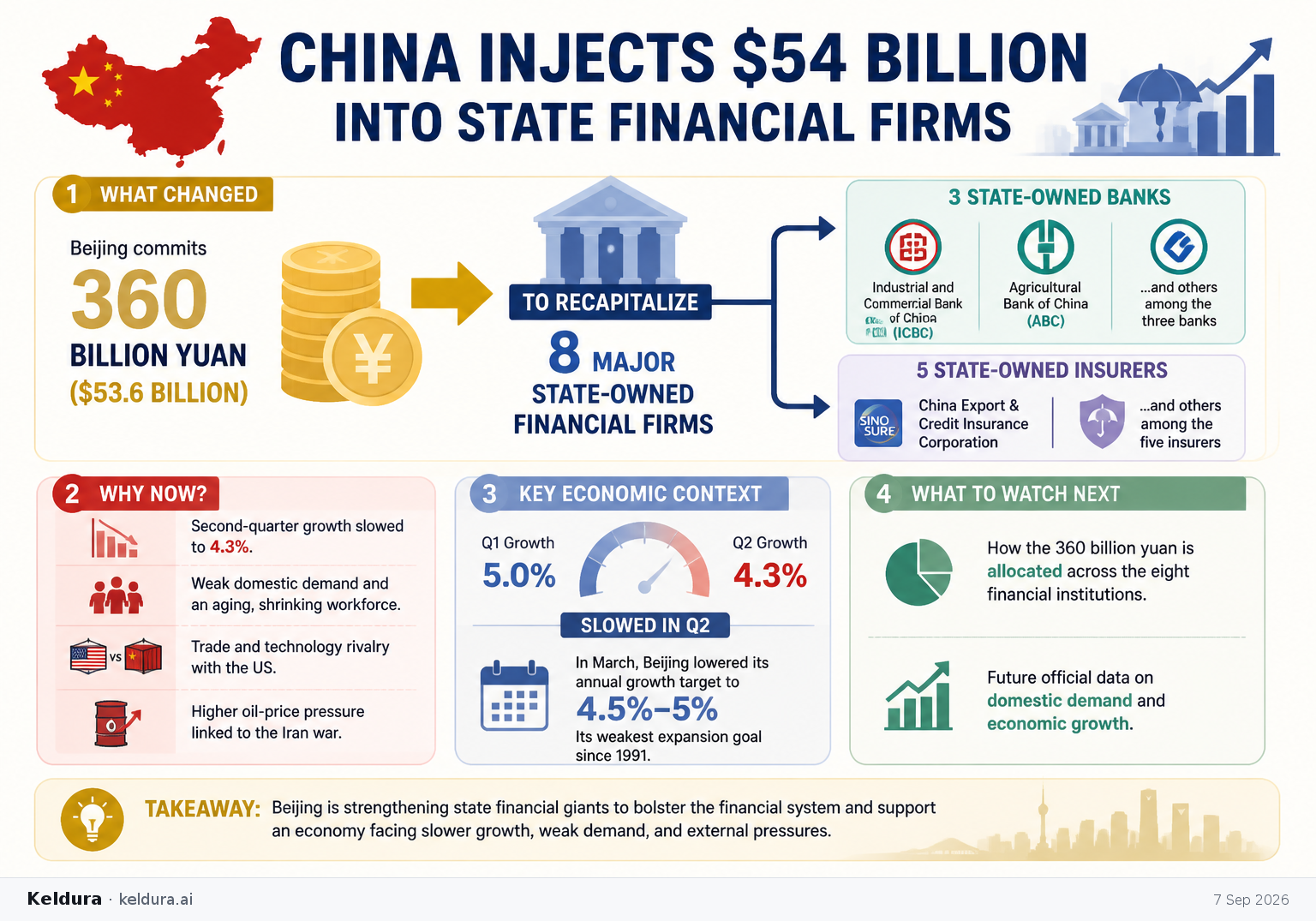
China's finance ministry is leading a 360 billion yuan ($53.6 billion) capital injection into three state-owned banks and five insurers.[2] Recipients include the Industrial and Commercial Bank of China, the Agricultural Bank of China and China Export & Credit Insurance Corporation.[2]
Why it matters: Beijing is trying to strengthen its financial system and support an economy facing weak domestic demand, an aging and shrinking workforce, trade and technology rivalry with the US, and higher oil-price pressure linked to the Iran war.[2]
Key insights: China's economy grew 4.3% in the second quarter, slowing from 5% in the first quarter and falling below Beijing's annual target range.[2] | In March, Beijing lowered its growth target to 4.5%-5%, its weakest expansion goal since 1991.[2] | Strong exports were not enough to prevent a sharp second-quarter slowdown as domestic demand weakened and oil-price pressures increased.[2]
Cheatsheet facts: What changed: Beijing committed 360 billion yuan to recapitalize eight major state-owned banks and insurers.[2] | Why now: Second-quarter growth slowed to 4.3% amid weak domestic demand and external economic pressures.[2] | Watch next: Watch the allocation of the capital across the eight institutions and subsequent official data on domestic demand and growth.[2]
China's finance ministry is leading a 360 billion yuan ($53.6 billion) capital injection into three state-owned banks and five insurers.[2] Recipients include the Industrial and Commercial Bank of China, the Agricultural Bank of China and China Export & Credit Insurance Corporation.[2]
Why it matters: Beijing is trying to strengthen its financial system and support an economy facing weak domestic demand, an aging and shrinking workforce, trade and technology rivalry with the US, and higher oil-price pressure linked to the Iran war.[2]
Key insights: China's economy grew 4.3% in the second quarter, slowing from 5% in the first quarter and falling below Beijing's annual target range.[2] | In March, Beijing lowered its growth target to 4.5%-5%, its weakest expansion goal since 1991.[2] | Strong exports were not enough to prevent a sharp second-quarter slowdown as domestic demand weakened and oil-price pressures increased.[2]
Cheatsheet facts: What changed: Beijing committed 360 billion yuan to recapitalize eight major state-owned banks and insurers.[2] | Why now: Second-quarter growth slowed to 4.3% amid weak domestic demand and external economic pressures.[2] | Watch next: Watch the allocation of the capital across the eight institutions and subsequent official data on domestic demand and growth.[2]