Democrats win Congress and gain leverage over Trump’s foreign policy
Democrats can challenge Trump’s war and tariff policies, but how much can Congress change before his term ends?
On November 3, Democrats won control of the US House and Senate, positioning them to challenge President Donald Trump’s Iran war and use of tariffs.
Democrats captured both chambers of Congress after two years of Republican control, creating a new institutional check on Trump’s foreign policy. [5][6][7][8] They are expected to challenge the Iran war and could limit his use of tariffs against China; Vice-President JD Vance publicly blamed the wa…
Open original (7 sources):
- [5] Explainer: Five ways US foreign policy may change with a Democratic Congress | Reuters — reuters.com
- [6] Newspaper headlines: 'Crushing midterm rebuke' and 'Trumped' — BBC World
- [7] World leaders express hope for a more stable US foreign policy after midterms | AP News — apnews.com
- [8] Globe at a Glance: From 'Bluenami' in midterms to stalemate in Israel — firstpost.com
- [1] What the US midterms mean for ties with China | AFP.com — afp.com
- [4] Vance walks Trump tightrope with scathing election critique blaming Iran war — BBC World
- [10] Middle East and far-right allies rattled by Trump's midterm defeat... Is Iran war set to resume? [U.S. Blue Tsunami] - The Asia Business Daily — asiae.co.kr
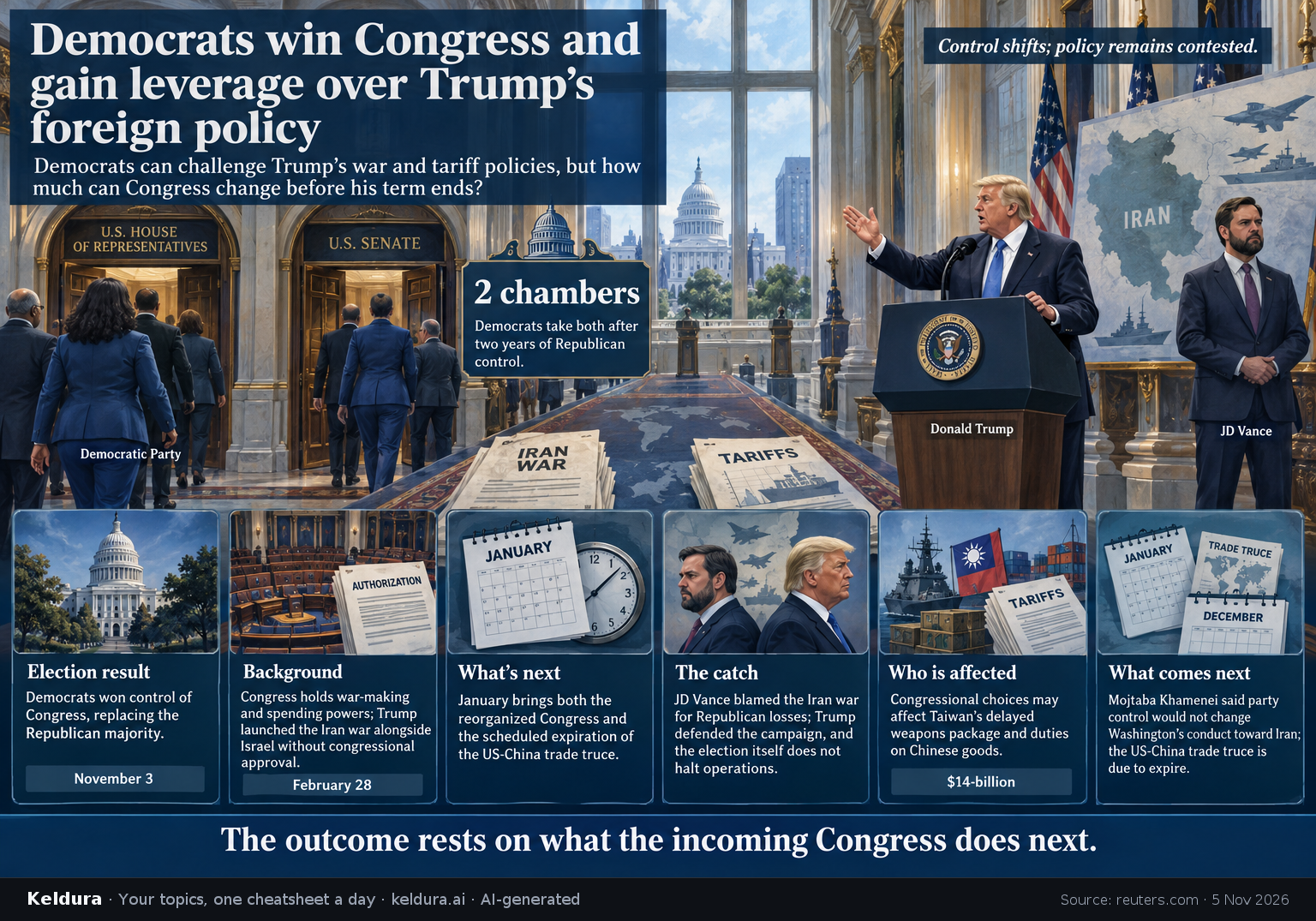
Democrats captured both chambers of Congress after two years of Republican control, creating a new institutional check on Trump’s foreign policy. [5][6][7][8] They are expected to challenge the Iran war and could limit his use of tariffs against China; Vice-President JD Vance publicly blamed the war for the Republican defeat. [1][4][5]
Why it matters: The consequences extend beyond Washington: congressional decisions could affect the continuation of the Iran war, duties on Chinese goods and Washington’s bargaining position before a US-China trade truce expires in January. Taiwan also faces uncertainty over a $14-billion weapons package that the administration has delayed for months. [1][5]
Key insights: Trump launched the Iran war alongside Israel on February 28 without congressional approval; Democrats have repeatedly voted to require authorization or end the fighting. [5] | Vance’s statement blamed the war for the election result, but Trump defended the campaign while acknowledging its electoral cost. [4] | Fudan University’s Wu Xinbo says congressional limits on tariffs would reduce Trump’s leverage in negotiations with China. [1] | Iranian leader Mojtaba Khamenei warned on November 4 that changes in US party control would not change Washington’s conduct toward Iran. [10]
Cheatsheet facts: What happened: Democrats won the House and Senate, ending two years of Republican control of both chambers. [5] | Why: Democrats campaigned against Congress surrendering its war-making and spending powers to Trump; Vance subsequently blamed the Iran war for Republican losses. [4][5] | The catch: The election is not an order ending the war: Trump defended the campaign, and the incoming Congress does not take shape until January. [4][10] | What's next: January brings both the reorganized Congress and the scheduled expiration of the US-China trade truce. [1][10]