Arctic sea-ice melt season is 7.5 days longer than in 1979
A University of Washington-led analysis found that the Arctic sea-ice melt season has lengthened by about 7.5 days since 1979, mainly because ice now forms later in autumn [2]. The study, published September 2 in Nature Reviews Earth & Environment, also examined changes in ice thickness, age, snow…
A University of Washington-led analysis found that the Arctic sea-ice melt season has lengthened by about 7.5 days since 1979, mainly because ice now forms later in autumn [2]. The study, published September 2 in Nature Reviews Earth & Environment, also examined changes in ice thickness, age, snow cover and perennial sea ice [2].
Why it matters: Longer periods of open water amplify warming because dark ocean reflects only about 7% of incoming sunlight, compared with roughly 60% to 90% for bright sea ice; the absorbed heat delays freezing and leaves subsequent ice thinner and more vulnerable [2].
Key insights: The Arctic is warming at roughly four times the global average [2]. | Snow cover on sea ice has become thinner and the ice smoother, potentially reducing the snowdrifts that polar bears and seals use for dens [2]. | Thinner snow and ice allow more light to reach algae at the base of the polar food chain, with potential consequences for fish and Arctic and sub-Arctic fisheries [2]. | Antarctica has experienced record sea-ice losses during the last four years, although researchers still face major questions about the causes [2].
Cheatsheet facts: What changed: The Arctic melt season is about 7.5 days longer than in 1979, primarily because autumn freeze-up occurs later [2]. | Why now: A new review covering roughly five decades of observations assessed not only sea-ice extent but also its thickness, age, structure and snow cover [2]. | Watch next: Track the timing of autumn ice formation alongside measurements of perennial-ice thickness and snow cover during forthcoming coordinated polar observations [2].
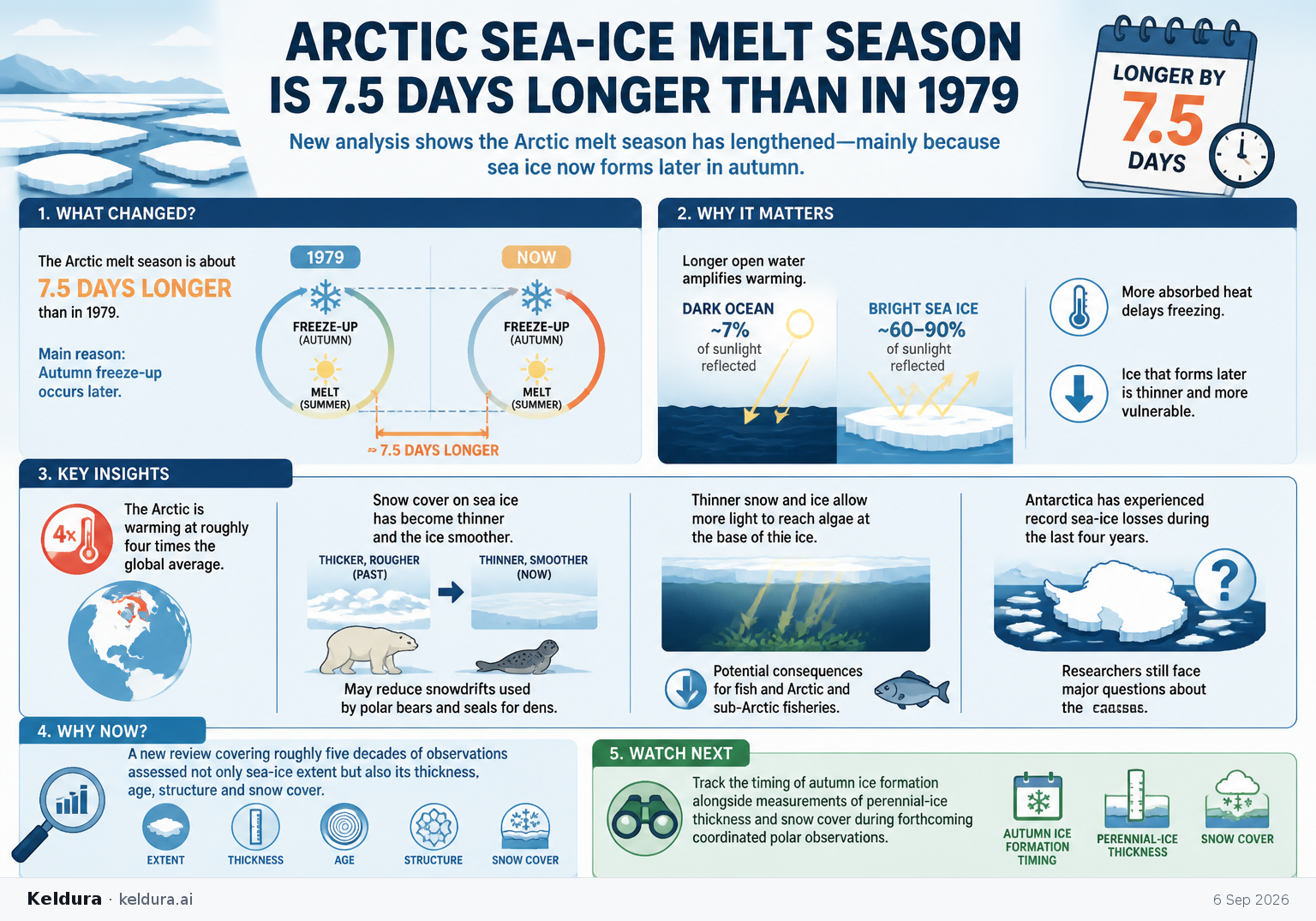
A University of Washington-led analysis found that the Arctic sea-ice melt season has lengthened by about 7.5 days since 1979, mainly because ice now forms later in autumn [2]. The study, published September 2 in Nature Reviews Earth & Environment, also examined changes in ice thickness, age, snow cover and perennial sea ice [2].
Why it matters: Longer periods of open water amplify warming because dark ocean reflects only about 7% of incoming sunlight, compared with roughly 60% to 90% for bright sea ice; the absorbed heat delays freezing and leaves subsequent ice thinner and more vulnerable [2].
Key insights: The Arctic is warming at roughly four times the global average [2]. | Snow cover on sea ice has become thinner and the ice smoother, potentially reducing the snowdrifts that polar bears and seals use for dens [2]. | Thinner snow and ice allow more light to reach algae at the base of the polar food chain, with potential consequences for fish and Arctic and sub-Arctic fisheries [2]. | Antarctica has experienced record sea-ice losses during the last four years, although researchers still face major questions about the causes [2].
Cheatsheet facts: What changed: The Arctic melt season is about 7.5 days longer than in 1979, primarily because autumn freeze-up occurs later [2]. | Why now: A new review covering roughly five decades of observations assessed not only sea-ice extent but also its thickness, age, structure and snow cover [2]. | Watch next: Track the timing of autumn ice formation alongside measurements of perennial-ice thickness and snow cover during forthcoming coordinated polar observations [2].