Climate pledges now imply 2.6°C warming as US emissions rise
Countries have promised emissions cuts, but what happens when those promises still leave warming above the agreed limit?
On October 21, 2026, the United Nations Environment Programme raised its projected warming under national climate pledges and identified US policy and emissions as contributors.
If countries fulfill their climate pledges, global temperatures are projected to reach 2.6°C above pre-industrial levels by 2100, 0.1°C higher than last year's estimate; current policies imply 2.8°C. The UN report attributes the worsened pledge-based outlook partly to US withdrawal from the Paris A…
Open original (2 sources):
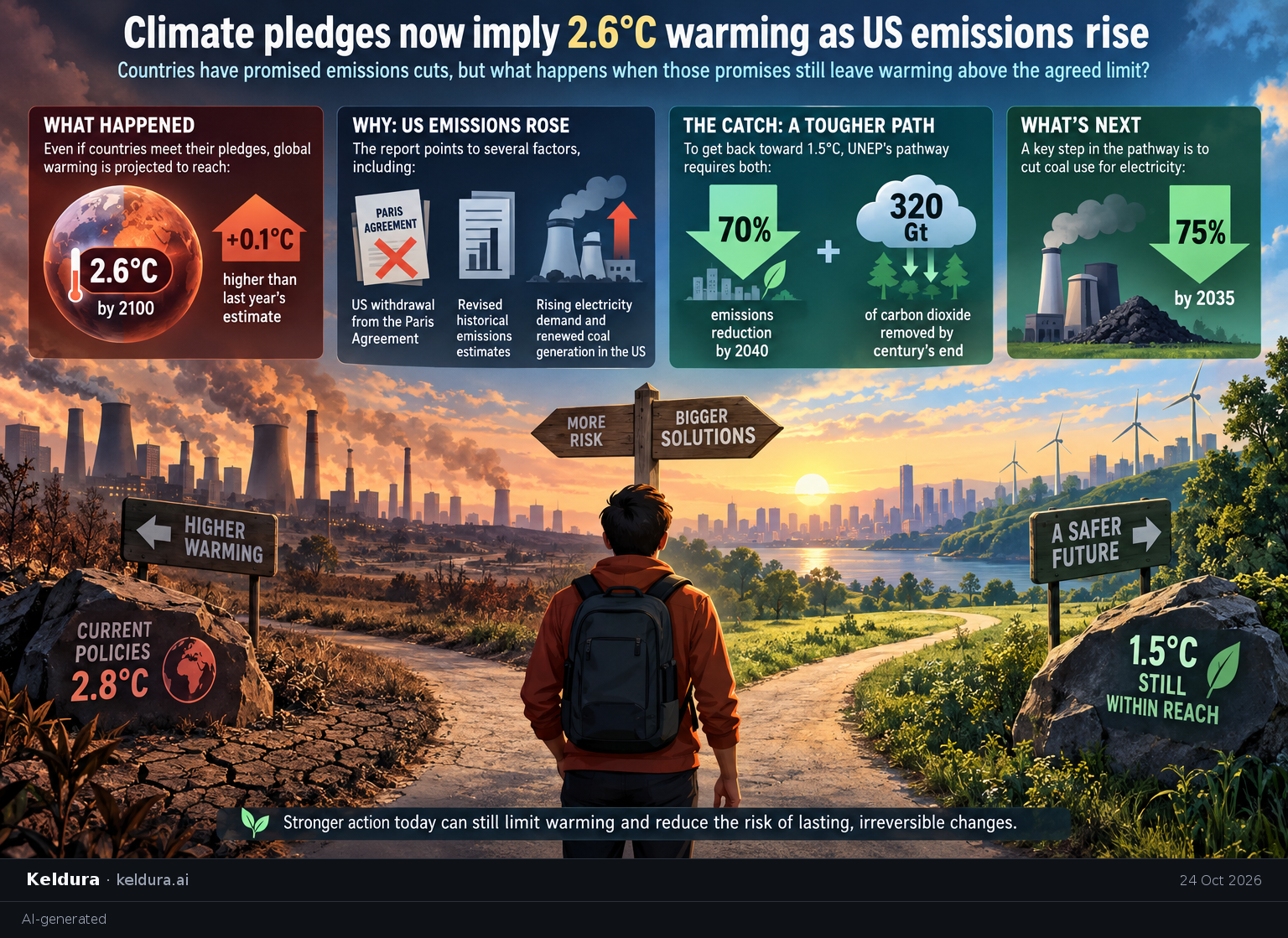
If countries fulfill their climate pledges, global temperatures are projected to reach 2.6°C above pre-industrial levels by 2100, 0.1°C higher than last year's estimate; current policies imply 2.8°C. The UN report attributes the worsened pledge-based outlook partly to US withdrawal from the Paris Agreement and revised historical emissions estimates. [6] UNEP also describes a pathway to limit the extent and duration of warming above 1.5°C, combining deep emissions cuts with large-scale carbon removal. [4]
Why it matters: The difference between promised action and a pathway back toward 1.5°C is substantial: UNEP's overshoot-limiting scenario requires greenhouse gas emissions to fall 70% by 2040 and 320 gigatonnes of carbon dioxide to be removed by century's end. The report says each additional fraction of a degree and year above 1.5°C increases the risk of irreversible changes. [4]
Key insights: The pledge-based projection worsened, but the current-policy projection remained at 2.8°C; those are different measures of the world's trajectory. [6] | The report attributes the US emissions increase to greater electricity demand and a rebound in coal generation, linking the global assessment to specific energy choices. [6] | UNEP's alternative is probabilistic, not a guaranteed recovery: its scenario gives a 66% chance of limiting peak warming to 1.8°C and even odds of returning below 1.5°C by century's end. [4] | Carbon removal does not replace emissions cuts in this scenario: coal-fired electricity use falls 75% by 2035 and is phased out by 2040. [4]
Cheatsheet facts: What happened: Full delivery of national pledges now implies 2.6°C warming by 2100, compared with a projection 0.1°C lower last year. [6] | Why: The report cites US withdrawal from the Paris Agreement and revised historical emissions; rising electricity demand and renewed coal generation also increased US emissions. [6] | The catch: The pathway back toward 1.5°C requires both a 70% emissions reduction by 2040 and removal of 320 gigatonnes of carbon dioxide by century's end. [4] | What's next: A measurable benchmark in UNEP's scenario is a 75% reduction in coal use for electricity generation by 2035. [4]
X copy pack
Edition complete
You've reached the end of this edition.