Latin America tries to turn mineral wealth into jobs and local industry
A World Bank-hosted regional dialogue in Santiago focused on how Latin America can convert copper and lithium wealth into jobs, innovation, infrastructure, and territorial development.[2] Speakers argued that the biggest gains from mining come not only from extraction, but from supplier industries,…
A World Bank-hosted regional dialogue in Santiago focused on how Latin America can convert copper and lithium wealth into jobs, innovation, infrastructure, and territorial development.[2] Speakers argued that the biggest gains from mining come not only from extraction, but from supplier industries, processing, logistics, workforce development, and stronger local supply chains.[2]
Why it matters: The discussion matters because it shifts the mineral conversation from output volumes to who captures the economic value, especially as global demand for critical minerals rises with the energy transition.[2] It also highlights a policy challenge many resource-rich economies face: turning commodity endowments into durable employment and broader development rather than isolated enclave growth.[2]
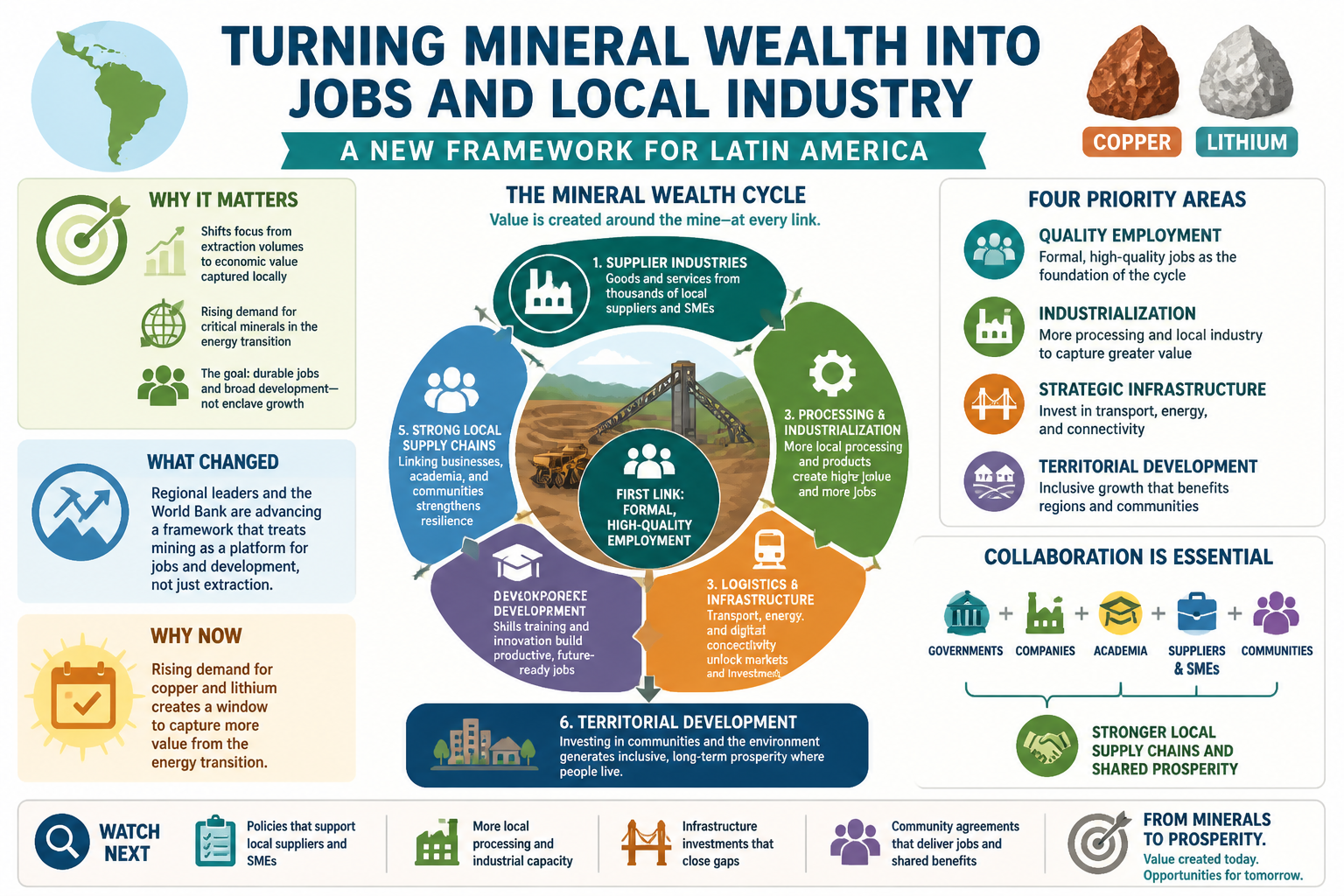
Key insights: Chile’s economy minister said the first link in the mineral wealth cycle is formal, high-quality employment, and noted the role of thousands of small and medium-sized firms around mining operations.[2] | World Bank officials said the greatest gains will come from what happens around the mine, including supplier industries, infrastructure, and workforce development.[2] | Participants identified four priority areas for capturing more value: quality employment, industrialization, strategic infrastructure, and territorial development.[2] | The event emphasized collaboration among governments, companies, academia, suppliers, and communities as essential to building stronger local supply chains.[2]
Cheatsheet facts: What changed: Regional leaders and the World Bank are advancing a framework that treats mining as a platform for jobs and development, not just extraction.[2] | Why now: Rising demand for copper and lithium is creating a window to capture more value from the energy transition.[2] | Watch next: Track whether countries adopt policies that strengthen local suppliers, processing, infrastructure, and community agreements around mining projects.[2]
A World Bank-hosted regional dialogue in Santiago focused on how Latin America can convert copper and lithium wealth into jobs, innovation, infrastructure, and territorial development.[2] Speakers argued that the biggest gains from mining come not only from extraction, but from supplier industries, processing, logistics, workforce development, and stronger local supply chains.[2]
Why it matters: The discussion matters because it shifts the mineral conversation from output volumes to who captures the economic value, especially as global demand for critical minerals rises with the energy transition.[2] It also highlights a policy challenge many resource-rich economies face: turning commodity endowments into durable employment and broader development rather than isolated enclave growth.[2]
Key insights: Chile’s economy minister said the first link in the mineral wealth cycle is formal, high-quality employment, and noted the role of thousands of small and medium-sized firms around mining operations.[2] | World Bank officials said the greatest gains will come from what happens around the mine, including supplier industries, infrastructure, and workforce development.[2] | Participants identified four priority areas for capturing more value: quality employment, industrialization, strategic infrastructure, and territorial development.[2] | The event emphasized collaboration among governments, companies, academia, suppliers, and communities as essential to building stronger local supply chains.[2]
Cheatsheet facts: What changed: Regional leaders and the World Bank are advancing a framework that treats mining as a platform for jobs and development, not just extraction.[2] | Why now: Rising demand for copper and lithium is creating a window to capture more value from the energy transition.[2] | Watch next: Track whether countries adopt policies that strengthen local suppliers, processing, infrastructure, and community agreements around mining projects.[2]
X copy pack
Edition complete
You've reached the end of this edition.