Morocco pairs a new ten-year partnership with local job creation in rural oases
The World Bank Group and the Government of Morocco announced a new Country Partnership Framework aimed at accelerating job creation and inclusive growth, with jobs for youth, women, and people in rural areas at the center of the plan.[4] In Morocco’s oasis regions, community-led initiatives are alr…
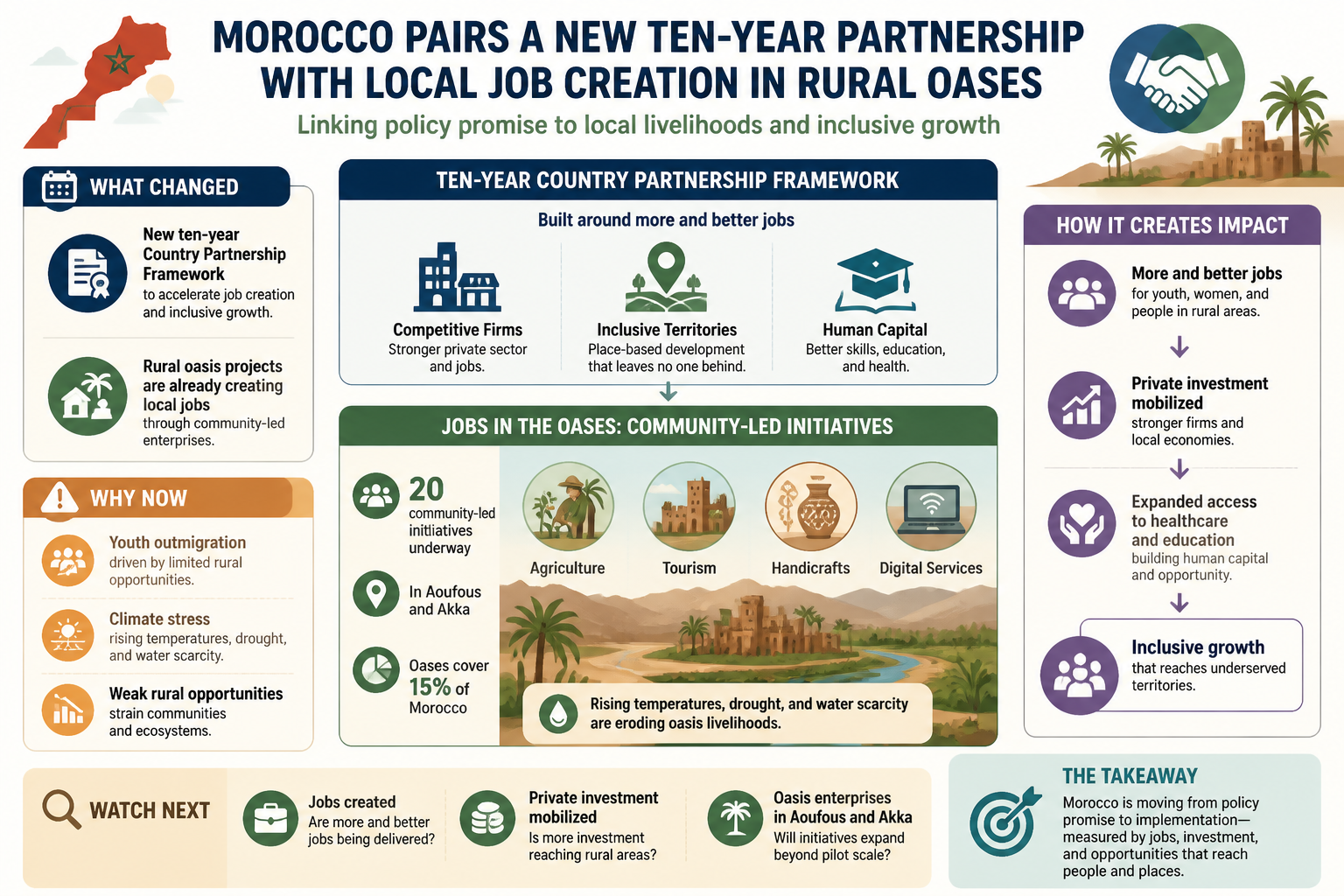
The World Bank Group and the Government of Morocco announced a new Country Partnership Framework aimed at accelerating job creation and inclusive growth, with jobs for youth, women, and people in rural areas at the center of the plan.[4] In Morocco’s oasis regions, community-led initiatives are already supporting women and young people through enterprises in agriculture, tourism, handicrafts, and digital services, showing how the broader strategy can translate into local livelihoods.[1]
Why it matters: Together, the two Morocco stories suggest the country is moving from a policy promise to an implementation model that links private-sector-led growth with place-based development and social inclusion.[4][1] That matters because both sources frame jobs as the main test of whether Morocco’s growth strategy can reach young people, women, and underserved territories.[4][1]
Key insights: The new Country Partnership Framework is explicitly built around more and better jobs, with emphasis on competitive firms, inclusive territories, and human capital.[4] | Morocco’s oasis regions cover 15 percent of the country and are economically important, but rising temperatures, drought, and water scarcity are eroding the livelihoods they support.[1] | The World Bank-backed oasis project says 20 community-led initiatives are underway in Aoufous and Akka, spanning agriculture, tourism, handicrafts, and digital services.[1] | The World Bank says progress in Morocco will be tracked through measurable indicators such as jobs created, private investment mobilized, and expanded access to healthcare and education.[4]
Cheatsheet facts: What changed: Morocco launched a new ten-year Country Partnership Framework, while rural oasis projects are already supporting local job creation.[4][1] | Why now: Job creation is being framed as urgent because youth outmigration, climate stress, and weak rural opportunities are straining communities and ecosystems.[1][4] | Watch next: Look for indicators on jobs created, private investment mobilized, and whether oasis enterprises in Aoufous and Akka expand beyond pilot-scale activity.[4][1]
The World Bank Group and the Government of Morocco announced a new Country Partnership Framework aimed at accelerating job creation and inclusive growth, with jobs for youth, women, and people in rural areas at the center of the plan.[4] In Morocco’s oasis regions, community-led initiatives are already supporting women and young people through enterprises in agriculture, tourism, handicrafts, and digital services, showing how the broader strategy can translate into local livelihoods.[1]
Why it matters: Together, the two Morocco stories suggest the country is moving from a policy promise to an implementation model that links private-sector-led growth with place-based development and social inclusion.[4][1] That matters because both sources frame jobs as the main test of whether Morocco’s growth strategy can reach young people, women, and underserved territories.[4][1]
Key insights: The new Country Partnership Framework is explicitly built around more and better jobs, with emphasis on competitive firms, inclusive territories, and human capital.[4] | Morocco’s oasis regions cover 15 percent of the country and are economically important, but rising temperatures, drought, and water scarcity are eroding the livelihoods they support.[1] | The World Bank-backed oasis project says 20 community-led initiatives are underway in Aoufous and Akka, spanning agriculture, tourism, handicrafts, and digital services.[1] | The World Bank says progress in Morocco will be tracked through measurable indicators such as jobs created, private investment mobilized, and expanded access to healthcare and education.[4]
Cheatsheet facts: What changed: Morocco launched a new ten-year Country Partnership Framework, while rural oasis projects are already supporting local job creation.[4][1] | Why now: Job creation is being framed as urgent because youth outmigration, climate stress, and weak rural opportunities are straining communities and ecosystems.[1][4] | Watch next: Look for indicators on jobs created, private investment mobilized, and whether oasis enterprises in Aoufous and Akka expand beyond pilot-scale activity.[4][1]