Africa’s health security improves overall, but biosafety, biosecurity, and surge deployment still lag
The 2026 Africa Health Security Index reports broad improvement across the continent: 52 of 54 countries improved by at least one point, and the continental average rose from 32.4 to 41.5 out of 100 [5]. But the assessment also finds serious weaknesses in biosafety, biosecurity, dual-use oversight,…
The 2026 Africa Health Security Index reports broad improvement across the continent: 52 of 54 countries improved by at least one point, and the continental average rose from 32.4 to 41.5 out of 100 [5]. But the assessment also finds serious weaknesses in biosafety, biosecurity, dual-use oversight, and rapid deployment of medical countermeasures, even as laboratories, surveillance, and sequencing capacity expand [5].
Why it matters: This matters because the region’s preparedness gains now appear to be shifting from building capacity to safely governing it and getting it into use during emergencies [5]. The evidence suggests that stronger institutions, logistics, and coordination may matter as much as new infrastructure.
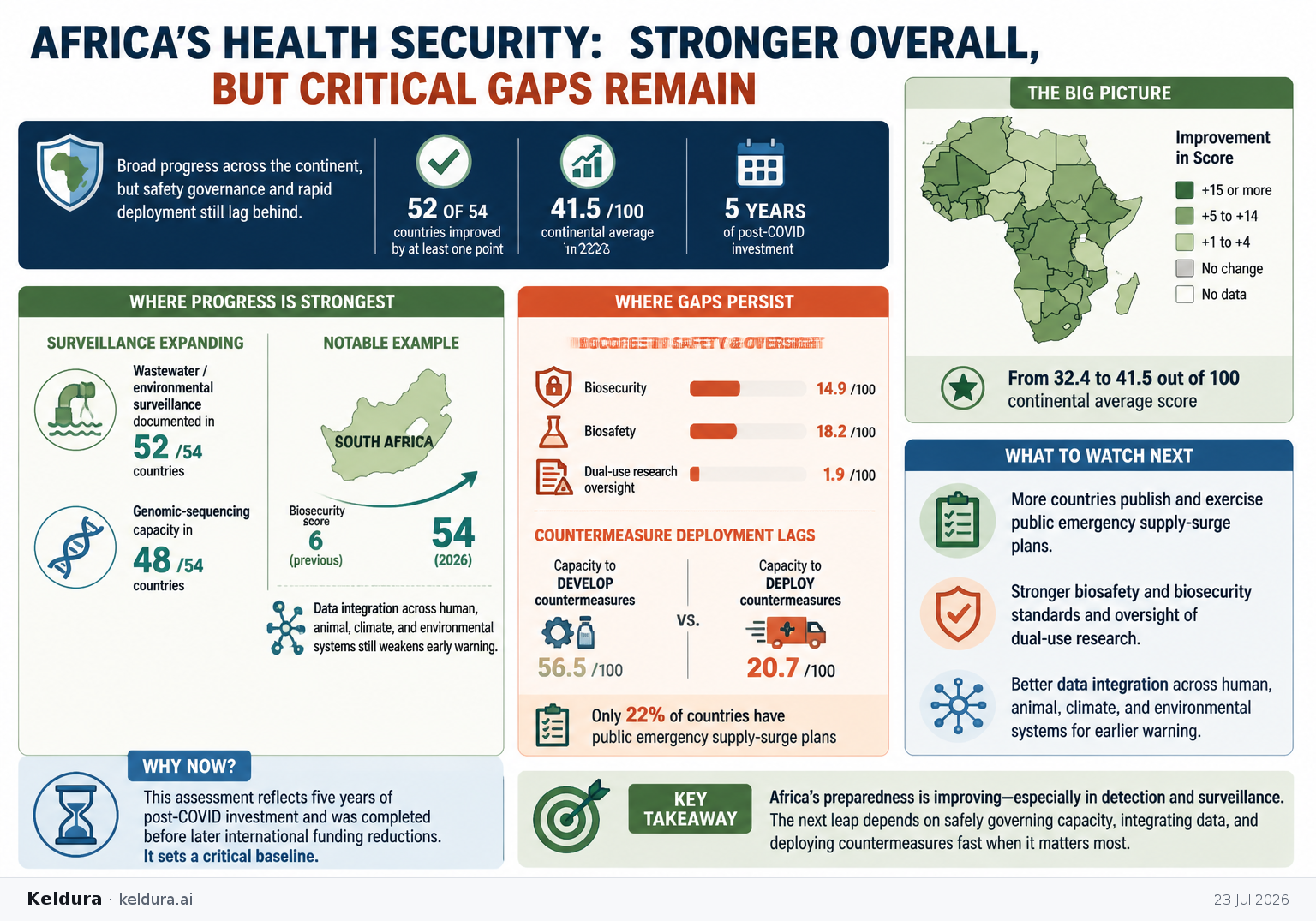
Key insights: Disease surveillance is the clearest area of progress, with wastewater or environmental surveillance documented in 52 countries and genomic-sequencing capacity in 48 [5]. | Average scores remain low for biosecurity (14.9), biosafety (18.2), and oversight of dual-use research (1.9) [5]. | South Africa’s biosecurity score rose from 6 to 54, but the article says data integration across human, animal, climate, and environmental systems still weakens early warning [5]. | Capacity to develop countermeasures is ahead of the capacity to deploy them, with development scoring 56.5 versus 20.7 for deployment; only 22% of countries have public emergency supply-surge plans [5].
Cheatsheet facts: What changed: Africa’s health security scores improved broadly, especially in detection and surveillance, but governance and deployment gaps remain [5]. | Why now: The assessment reflects five years of post-COVID investment and was completed before later international funding reductions, making the current baseline especially important [5]. | Watch next: Track whether countries publish emergency surge plans, strengthen biosafety/biosecurity oversight, and improve data integration for early warning [5].
The 2026 Africa Health Security Index reports broad improvement across the continent: 52 of 54 countries improved by at least one point, and the continental average rose from 32.4 to 41.5 out of 100 [5]. But the assessment also finds serious weaknesses in biosafety, biosecurity, dual-use oversight, and rapid deployment of medical countermeasures, even as laboratories, surveillance, and sequencing capacity expand [5].
Why it matters: This matters because the region’s preparedness gains now appear to be shifting from building capacity to safely governing it and getting it into use during emergencies [5]. The evidence suggests that stronger institutions, logistics, and coordination may matter as much as new infrastructure.
Key insights: Disease surveillance is the clearest area of progress, with wastewater or environmental surveillance documented in 52 countries and genomic-sequencing capacity in 48 [5]. | Average scores remain low for biosecurity (14.9), biosafety (18.2), and oversight of dual-use research (1.9) [5]. | South Africa’s biosecurity score rose from 6 to 54, but the article says data integration across human, animal, climate, and environmental systems still weakens early warning [5]. | Capacity to develop countermeasures is ahead of the capacity to deploy them, with development scoring 56.5 versus 20.7 for deployment; only 22% of countries have public emergency supply-surge plans [5].
Cheatsheet facts: What changed: Africa’s health security scores improved broadly, especially in detection and surveillance, but governance and deployment gaps remain [5]. | Why now: The assessment reflects five years of post-COVID investment and was completed before later international funding reductions, making the current baseline especially important [5]. | Watch next: Track whether countries publish emergency surge plans, strengthen biosafety/biosecurity oversight, and improve data integration for early warning [5].