How does CRISPR free a beta-thalassaemia patient from transfusions?
Charité treated a 19-year-old patient in May 2026 with Exagamglogene Autotemcel, or Casgevy, after harvesting his blood stem cells, editing.
Charité treated a 19-year-old patient in May 2026 with Exagamglogene Autotemcel, or Casgevy, after harvesting his blood stem cells, editing them to reactivate fetal globin and reinfusing more than 900 million modified cells following high-dose chemotherapy [4][5]. About 40 days after infusion, the…
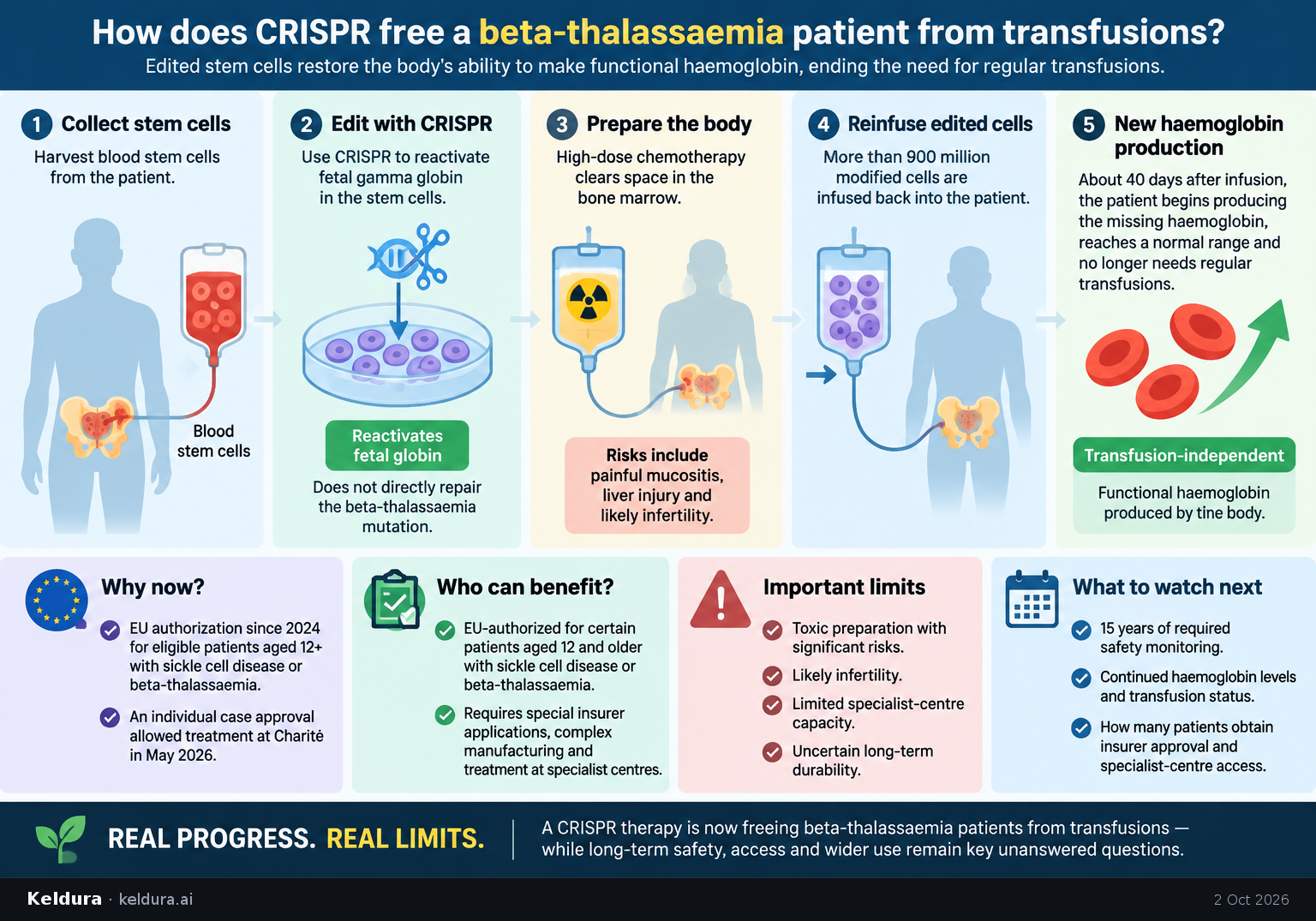
Charité treated a 19-year-old patient in May 2026 with Exagamglogene Autotemcel, or Casgevy, after harvesting his blood stem cells, editing them to reactivate fetal globin and reinfusing more than 900 million modified cells following high-dose chemotherapy [4][5]. About 40 days after infusion, the patient began producing the missing haemoglobin, reached a normal total haemoglobin range and stopped requiring regular transfusions [4].
Why it matters: The result shows an EU-authorized CRISPR therapy moving into patient care for a serious inherited blood disorder, but its toxic preparation, likely infertility, specialist logistics and uncertain long-term durability sharply limit who can benefit [4][5].
Key insights: Casgevy has been authorized in the European Union since 2024 for certain patients aged 12 and older with sickle cell disease or beta-thalassaemia [5]. | The editing does not directly repair the beta-thalassaemia mutation; it reactivates fetal gamma globin so the patient can produce functional haemoglobin [4]. | Patients must undergo high-dose chemotherapy to clear space in the bone marrow, creating risks including painful mucositis, liver injury and likely infertility [4]. | Regulators require 15 years of follow-up, while special insurer applications, complex manufacturing and limited specialist-center capacity constrain access [4].
Cheatsheet facts: What changed: Germany’s first reported recipient of the CRISPR-based medicine became transfusion-independent after edited stem cells restored haemoglobin production [4][5]. | Why now: EU authorization made treatment possible, while an individual case approval allowed Charité to perform the May 2026 infusion [4][5]. | Watch next: Follow the required 15-year safety monitoring, continued haemoglobin levels and transfusion status, along with how many patients obtain insurer approval and specialist-center access [4].
Charité treated a 19-year-old patient in May 2026 with Exagamglogene Autotemcel, or Casgevy, after harvesting his blood stem cells, editing them to reactivate fetal globin and reinfusing more than 900 million modified cells following high-dose chemotherapy [4][5]. About 40 days after infusion, the patient began producing the missing haemoglobin, reached a normal total haemoglobin range and stopped requiring regular transfusions [4].
Why it matters: The result shows an EU-authorized CRISPR therapy moving into patient care for a serious inherited blood disorder, but its toxic preparation, likely infertility, specialist logistics and uncertain long-term durability sharply limit who can benefit [4][5].
Key insights: Casgevy has been authorized in the European Union since 2024 for certain patients aged 12 and older with sickle cell disease or beta-thalassaemia [5]. | The editing does not directly repair the beta-thalassaemia mutation; it reactivates fetal gamma globin so the patient can produce functional haemoglobin [4]. | Patients must undergo high-dose chemotherapy to clear space in the bone marrow, creating risks including painful mucositis, liver injury and likely infertility [4]. | Regulators require 15 years of follow-up, while special insurer applications, complex manufacturing and limited specialist-center capacity constrain access [4].
Cheatsheet facts: What changed: Germany’s first reported recipient of the CRISPR-based medicine became transfusion-independent after edited stem cells restored haemoglobin production [4][5]. | Why now: EU authorization made treatment possible, while an individual case approval allowed Charité to perform the May 2026 infusion [4][5]. | Watch next: Follow the required 15-year safety monitoring, continued haemoglobin levels and transfusion status, along with how many patients obtain insurer approval and specialist-center access [4].