How Crew-13 set a U.S. launch-to-station speed record
SpaceX’s Crew-13 reached the International Space Station on Oct. 1 after the fastest U.S. spacecraft trip to the station.
NASA astronauts Jessica Watkins and Luke Delaney, CSA astronaut Joshua Kutryk and Roscosmos cosmonaut Sergey Teteryatnikov docked at the Harmony module at 7:05 p.m. EDT.[3] The journey took 7 hours and 55 minutes from launch to docking, compared with the 15-to-24-hour transfer typical of Crew Drago…
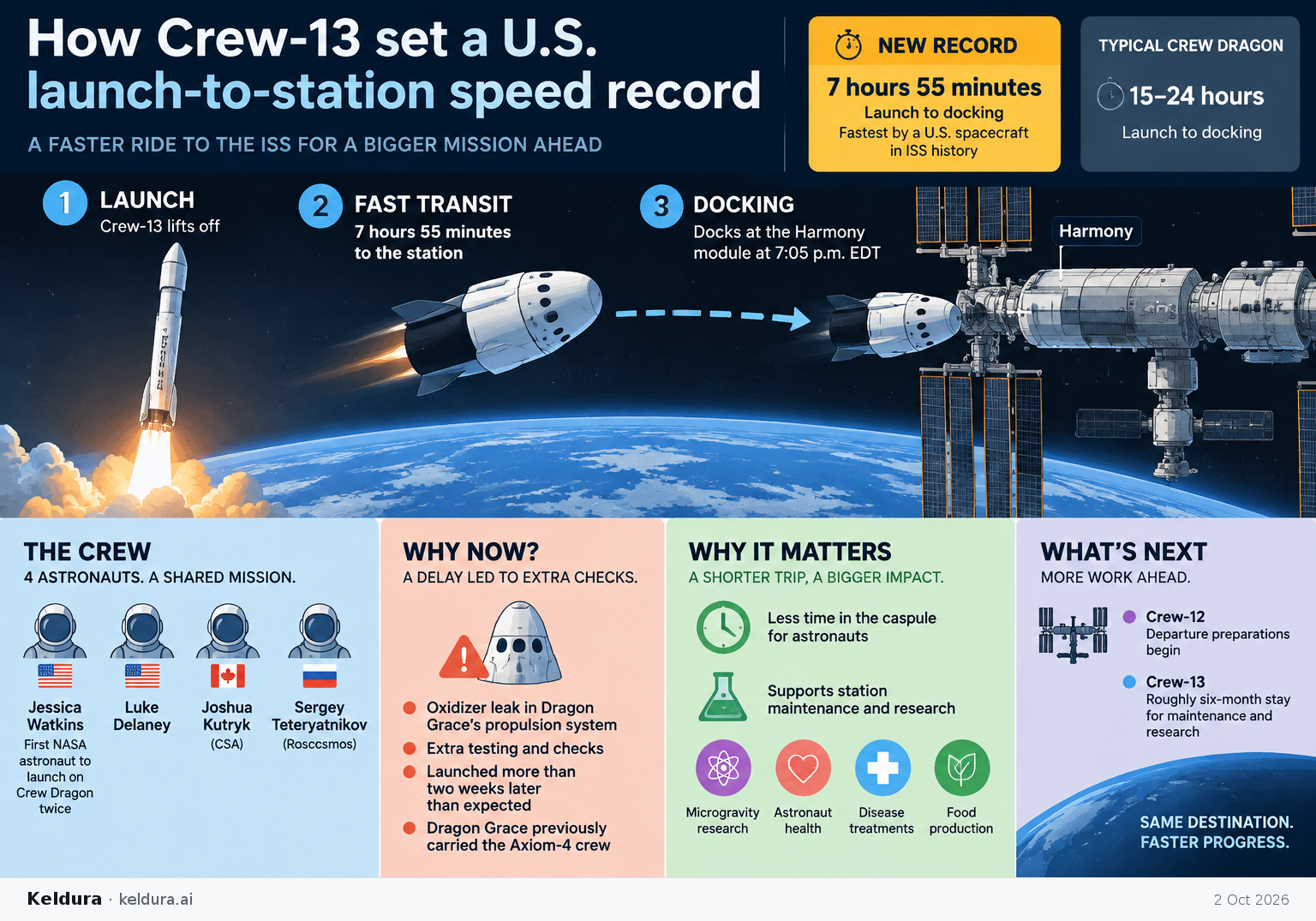
NASA astronauts Jessica Watkins and Luke Delaney, CSA astronaut Joshua Kutryk and Roscosmos cosmonaut Sergey Teteryatnikov docked at the Harmony module at 7:05 p.m. EDT.[3] The journey took 7 hours and 55 minutes from launch to docking, compared with the 15-to-24-hour transfer typical of Crew Dragon missions.[3][6]
Why it matters: A shorter rendezvous reduces the time astronauts spend confined in a capsule, while Crew-13’s roughly six-month stay will support station maintenance and research into microgravity, astronaut health, disease treatments and food production.[6]
Key insights: Crew-13 launched more than two weeks later than expected after an oxidizer leak in Dragon Grace’s propulsion system prompted additional checks and tests.[6] | Grace previously carried the private Axiom-4 crew to the station.[6] | Jessica Watkins became the first NASA astronaut to launch aboard Crew Dragon twice.[6] | Crew-13’s arrival begins departure preparations for Crew-12, whose mission was extended by the launch delay.[6]
Cheatsheet facts: What changed: Crew-13 completed the fastest launch-to-docking trip by a U.S. spacecraft in ISS history: 7 hours and 55 minutes.[3] | Why now: The mission flew after extra testing prompted by an oxidizer leak and a delay of more than two weeks.[6] | Watch next: Crew-12’s departure preparations and Crew-13’s planned maintenance and research program aboard the station.[6]
NASA astronauts Jessica Watkins and Luke Delaney, CSA astronaut Joshua Kutryk and Roscosmos cosmonaut Sergey Teteryatnikov docked at the Harmony module at 7:05 p.m. EDT.[3] The journey took 7 hours and 55 minutes from launch to docking, compared with the 15-to-24-hour transfer typical of Crew Dragon missions.[3][6]
Why it matters: A shorter rendezvous reduces the time astronauts spend confined in a capsule, while Crew-13’s roughly six-month stay will support station maintenance and research into microgravity, astronaut health, disease treatments and food production.[6]
Key insights: Crew-13 launched more than two weeks later than expected after an oxidizer leak in Dragon Grace’s propulsion system prompted additional checks and tests.[6] | Grace previously carried the private Axiom-4 crew to the station.[6] | Jessica Watkins became the first NASA astronaut to launch aboard Crew Dragon twice.[6] | Crew-13’s arrival begins departure preparations for Crew-12, whose mission was extended by the launch delay.[6]
Cheatsheet facts: What changed: Crew-13 completed the fastest launch-to-docking trip by a U.S. spacecraft in ISS history: 7 hours and 55 minutes.[3] | Why now: The mission flew after extra testing prompted by an oxidizer leak and a delay of more than two weeks.[6] | Watch next: Crew-12’s departure preparations and Crew-13’s planned maintenance and research program aboard the station.[6]