How Hera can turn an asteroid collision into a repeatable defence technique
On October 7, ESA reported that Hera had first sighted Didymos, two years after launch.
Hera photographed the Didymos binary asteroid system from approximately 236 500 km away, although its cameras cannot yet distinguish the two asteroids separately. NASA’s DART spacecraft struck Dimorphos in September 2022 and changed its orbit; Hera will investigate the impact site and measure the a…
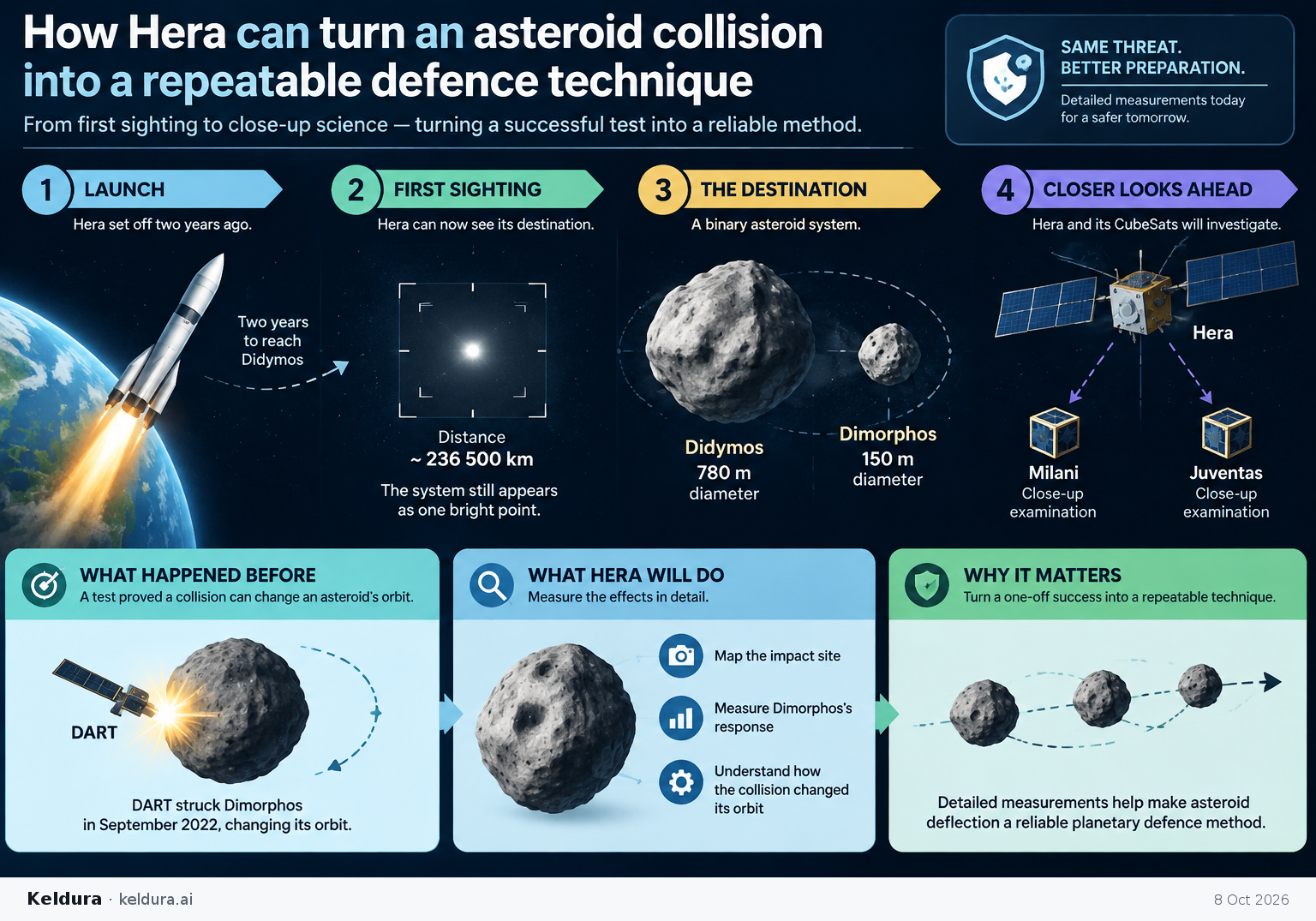
Hera photographed the Didymos binary asteroid system from approximately 236 500 km away, although its cameras cannot yet distinguish the two asteroids separately. NASA’s DART spacecraft struck Dimorphos in September 2022 and changed its orbit; Hera will investigate the impact site and measure the asteroid’s response. [5]
Why it matters: Demonstrating that a collision can change an asteroid’s orbit is different from understanding its effects well enough to repeat the technique. Hera’s close-up measurements are intended to bridge that gap for planetary defence. [5]
Key insights: The target has two components: 780-m-diameter Didymos and its 150-m-diameter companion, Dimorphos, which DART struck. [5] | First sighting is an approach milestone, not a close-up inspection: the system currently appears as one bright point. [5] | Hera’s two CubeSats, Milani and Juventas, will contribute to the investigation; ESA’s animated explainer previews their separate close-up examinations. [7]
Cheatsheet facts: What changed: Hera can now see its destination rather than relying solely on its calculated position. [5] | Why now: The first sighting comes exactly two years after launch, at approximately 236 500 km from the system. [5] | Watch next: Images that resolve Didymos and Dimorphos separately, followed by measurements of the impact site and Dimorphos’s response. [5]