How Smile will turn auroras into a map of space weather
Smile reached its science orbit on June 20 after launching on May 19, and its four instruments have now completed the commissioning needed.
Smile reached its science orbit on June 20 after launching on May 19, and its four instruments have now completed the commissioning needed for science operations.[4] The mission will combine soft X-ray and ultraviolet imaging with magnetic-field and charged-particle measurements to study how the so…
Smile reached its science orbit on June 20 after launching on May 19, and its four instruments have now completed the commissioning needed for science operations.[4] The mission will combine soft X-ray and ultraviolet imaging with magnetic-field and charged-particle measurements to study how the solar wind interacts with Earth’s magnetosphere.[4][15]
Why it matters: Space weather can affect electronic infrastructure on Earth and in orbit, so observing both the solar wind and Earth’s large-scale response could improve researchers’ understanding of how geomagnetic storms form and evolve.[4]
Key insights: Smile’s ultraviolet camera is the first since 2008 to capture the full ring of northern lights around the north pole in ultraviolet, with observing stretches lasting 45 hours.[12] | Its first released ultraviolet footage recorded an auroral substorm on July 24, when compressed magnetic-field lines released energetic particles toward the poles.[12] | The soft X-ray imager was tested on the supernova remnant N132D before beginning long-running observations of X-rays produced at the edge of Earth’s magnetosphere.[13] | The light ion analyser uses two sensors to measure the energies of solar-wind particles approaching Earth.[15]
Cheatsheet facts: What changed: Smile completed commissioning and was approved to begin science operations on September 23.[4] | Why now: The spacecraft has tested its four-instrument toolkit after reaching its target science orbit on June 20.[4] | Watch next: Watch for coordinated measurements from the soft X-ray imager, ultraviolet aurora imager, magnetometer, and light ion analyser during solar and geomagnetic activity.[4]
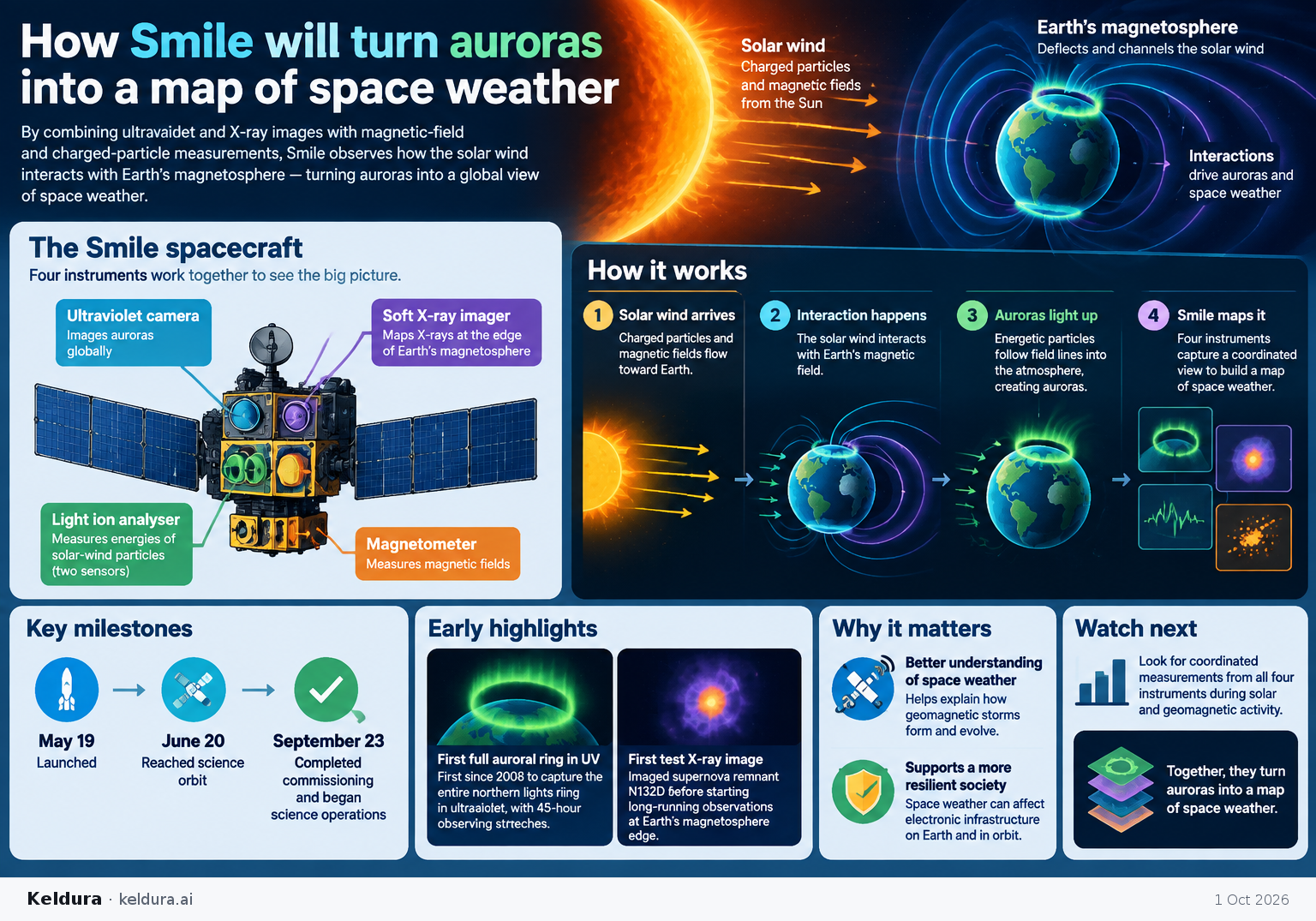
Smile reached its science orbit on June 20 after launching on May 19, and its four instruments have now completed the commissioning needed for science operations.[4] The mission will combine soft X-ray and ultraviolet imaging with magnetic-field and charged-particle measurements to study how the solar wind interacts with Earth’s magnetosphere.[4][15]
Why it matters: Space weather can affect electronic infrastructure on Earth and in orbit, so observing both the solar wind and Earth’s large-scale response could improve researchers’ understanding of how geomagnetic storms form and evolve.[4]
Key insights: Smile’s ultraviolet camera is the first since 2008 to capture the full ring of northern lights around the north pole in ultraviolet, with observing stretches lasting 45 hours.[12] | Its first released ultraviolet footage recorded an auroral substorm on July 24, when compressed magnetic-field lines released energetic particles toward the poles.[12] | The soft X-ray imager was tested on the supernova remnant N132D before beginning long-running observations of X-rays produced at the edge of Earth’s magnetosphere.[13] | The light ion analyser uses two sensors to measure the energies of solar-wind particles approaching Earth.[15]
Cheatsheet facts: What changed: Smile completed commissioning and was approved to begin science operations on September 23.[4] | Why now: The spacecraft has tested its four-instrument toolkit after reaching its target science orbit on June 20.[4] | Watch next: Watch for coordinated measurements from the soft X-ray imager, ultraviolet aurora imager, magnetometer, and light ion analyser during solar and geomagnetic activity.[4]
X copy pack
[4] ESA - Science begins for Smile — ESA News[15] ESA - Smile's light ion analyser working well in space — ESA News[12] ESA - Smile’s first ultraviolet footage shows auroral substorm — ESA News[13] ESA - Smile's first test X-ray image shows supernova remnant in Large Magellanic Cloud — ESA NewsRead in BriefingsPost to X