What must Starship prove on its first orbital attempt?
SpaceX plans to send Starship into orbit for the first time on September 28 while deploying its first batch of Starlink V3 satellites.
The FAA authorized launch and reentry operations for Starship’s 14th test flight on September 26, clearing a 75-minute launch window beginning at 8:15 a.m. ET from Starbase, Texas.[1] Unlike the previous 13 suborbital tests, this mission is designed to circle Earth about six times, deploy 26 Starli…
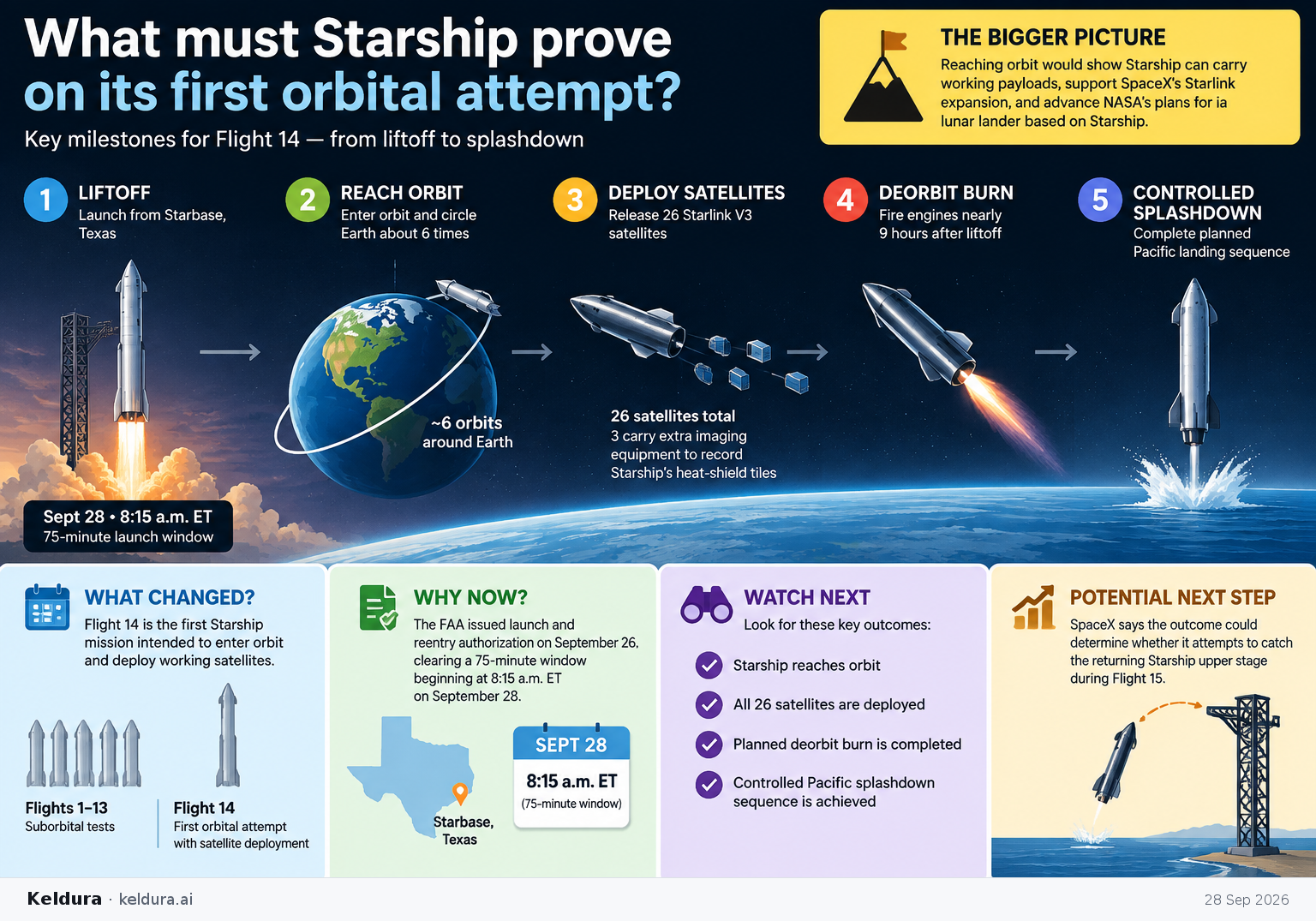
The FAA authorized launch and reentry operations for Starship’s 14th test flight on September 26, clearing a 75-minute launch window beginning at 8:15 a.m. ET from Starbase, Texas.[1] Unlike the previous 13 suborbital tests, this mission is designed to circle Earth about six times, deploy 26 Starlink V3 satellites and conduct a deorbit burn nearly nine hours after liftoff.[1][2][4]
Why it matters: Reaching orbit would test Starship as an operational payload carrier rather than only an experimental vehicle, with implications for SpaceX’s Starlink expansion and NASA’s plan to use a Starship-derived lander for future lunar missions.[1][9]
Key insights: The 124-meter Starship-Super Heavy stack is attempting orbit 18 years after SpaceX’s Falcon 1 first reached orbit.[2] | SpaceX selected 26 Starlink V3 satellites for this flight even though it has previously said future Starship missions could carry as many as 60.[2] | Three satellites carry extra imaging equipment intended to record the Ship’s heat-shield tiles during flight.[2] | SpaceX says the outcome could determine whether it attempts to catch the returning Starship upper stage during Flight 15.[2]
Cheatsheet facts: What changed: Flight 14 is the first Starship mission intended to enter orbit and deploy working satellites; all 13 prior flights were suborbital tests.[1][4] | Why now: The FAA issued launch and reentry authorization on September 26, and SpaceX scheduled a 75-minute window opening at 8:15 a.m. ET on September 28.[1] | Watch next: Watch whether Starship reaches orbit, deploys all 26 satellites, completes its planned deorbit burn and achieves the controlled Pacific splashdown sequence.[2][4]
The FAA authorized launch and reentry operations for Starship’s 14th test flight on September 26, clearing a 75-minute launch window beginning at 8:15 a.m. ET from Starbase, Texas.[1] Unlike the previous 13 suborbital tests, this mission is designed to circle Earth about six times, deploy 26 Starlink V3 satellites and conduct a deorbit burn nearly nine hours after liftoff.[1][2][4]
Why it matters: Reaching orbit would test Starship as an operational payload carrier rather than only an experimental vehicle, with implications for SpaceX’s Starlink expansion and NASA’s plan to use a Starship-derived lander for future lunar missions.[1][9]
Key insights: The 124-meter Starship-Super Heavy stack is attempting orbit 18 years after SpaceX’s Falcon 1 first reached orbit.[2] | SpaceX selected 26 Starlink V3 satellites for this flight even though it has previously said future Starship missions could carry as many as 60.[2] | Three satellites carry extra imaging equipment intended to record the Ship’s heat-shield tiles during flight.[2] | SpaceX says the outcome could determine whether it attempts to catch the returning Starship upper stage during Flight 15.[2]
Cheatsheet facts: What changed: Flight 14 is the first Starship mission intended to enter orbit and deploy working satellites; all 13 prior flights were suborbital tests.[1][4] | Why now: The FAA issued launch and reentry authorization on September 26, and SpaceX scheduled a 75-minute window opening at 8:15 a.m. ET on September 28.[1] | Watch next: Watch whether Starship reaches orbit, deploys all 26 satellites, completes its planned deorbit burn and achieves the controlled Pacific splashdown sequence.[2][4]
X copy pack
[1] SpaceX prepares to send Starship rocket to orbit for first time — cnbc.com[2] Live coverage: SpaceX to launch first Starlink V3 satellites to orbit on Starship – Spaceflight Now — spaceflightnow.com[4] SpaceX's Starship megarocket launching to orbit for 1st time ever on Sept. 28: Watch it live | Space — Space.com[9] SpaceX’s Starship is headed for orbit. Here’s what’s at stake | CNN — cnn.comRead in BriefingsPost to X