How a Fresh Lunar Crater Became a Natural Impact Laboratory
McGetchin crater formed between April 11 and May 22, 2024, when an asteroid or comet fragment struck the Moon, leaving a cavity about 222.
McGetchin crater formed between April 11 and May 22, 2024, when an asteroid or comet fragment struck the Moon, leaving a cavity about 222 meters across and 43 meters deep.[4] It is the largest newly formed impact crater identified by NASA's Lunar Reconnaissance Orbiter and is roughly three times wi…
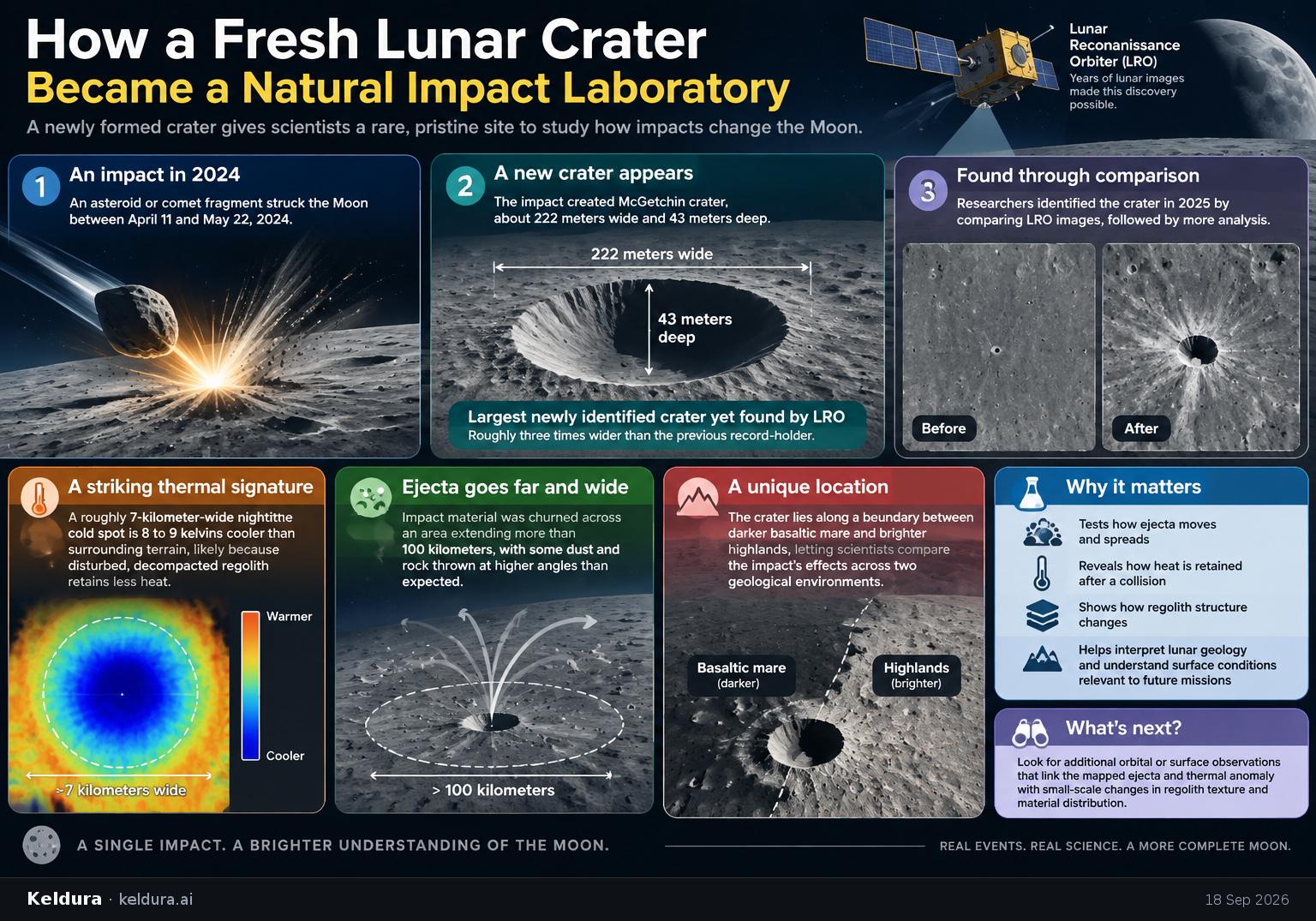
McGetchin crater formed between April 11 and May 22, 2024, when an asteroid or comet fragment struck the Moon, leaving a cavity about 222 meters across and 43 meters deep.[4] It is the largest newly formed impact crater identified by NASA's Lunar Reconnaissance Orbiter and is roughly three times wider than the mission's previous record-holder.[4][5]
Why it matters: LRO's long observational record gives researchers rare before-and-after measurements of a large, pristine impact site, helping them test how ejecta, heat retention and regolith structure change after a collision.[4] Those effects matter for interpreting lunar geology and understanding surface conditions relevant to future landed missions.[4][5]
Key insights: Researchers identified the crater in 2025 by comparing LRO images; more detailed observations followed, and the discovery was confirmed in early 2026.[4][5] | The impact produced a roughly 7-kilometer-wide nighttime cold spot that is 8 to 9 kelvins cooler than nearby terrain, probably because disturbed, decompacted regolith retains less heat.[4] | Material was churned across an area extending more than 100 kilometers, while some dust and rock were thrown at higher angles than researchers expected.[5] | The crater lies along a boundary between darker basaltic mare and brighter highlands, allowing scientists to compare the impact's effects across two geological environments.[4]
Cheatsheet facts: What changed: A 2024 impact created the 222-meter-wide, 43-meter-deep McGetchin crater, the largest fresh crater yet identified by LRO.[4] | Why now: Two studies published Sept. 16 combined crater imagery and thermal measurements with LRO's more than 17-year record of the lunar surface.[4] | Watch next: Watch for additional orbital or surface observations that connect the mapped ejecta and thermal anomaly with small-scale changes in regolith texture and material distribution.[4]
McGetchin crater formed between April 11 and May 22, 2024, when an asteroid or comet fragment struck the Moon, leaving a cavity about 222 meters across and 43 meters deep.[4] It is the largest newly formed impact crater identified by NASA's Lunar Reconnaissance Orbiter and is roughly three times wider than the mission's previous record-holder.[4][5]
Why it matters: LRO's long observational record gives researchers rare before-and-after measurements of a large, pristine impact site, helping them test how ejecta, heat retention and regolith structure change after a collision.[4] Those effects matter for interpreting lunar geology and understanding surface conditions relevant to future landed missions.[4][5]
Key insights: Researchers identified the crater in 2025 by comparing LRO images; more detailed observations followed, and the discovery was confirmed in early 2026.[4][5] | The impact produced a roughly 7-kilometer-wide nighttime cold spot that is 8 to 9 kelvins cooler than nearby terrain, probably because disturbed, decompacted regolith retains less heat.[4] | Material was churned across an area extending more than 100 kilometers, while some dust and rock were thrown at higher angles than researchers expected.[5] | The crater lies along a boundary between darker basaltic mare and brighter highlands, allowing scientists to compare the impact's effects across two geological environments.[4]
Cheatsheet facts: What changed: A 2024 impact created the 222-meter-wide, 43-meter-deep McGetchin crater, the largest fresh crater yet identified by LRO.[4] | Why now: Two studies published Sept. 16 combined crater imagery and thermal measurements with LRO's more than 17-year record of the lunar surface.[4] | Watch next: Watch for additional orbital or surface observations that connect the mapped ejecta and thermal anomaly with small-scale changes in regolith texture and material distribution.[4]
X copy pack
[4] A NASA spacecraft just found a giant new crater on the moon. Here's why everyone's talking about the 'once-in-a-century' discovery | Space — Space.com[5] NASA discovers Moon crater bigger than Rome’s Colosseum — rare impact went unnoticed for 2 years, occurs once every 132 years - The Economic Times — economictimes.indiatimes.comRead in BriefingsPost to X