Why are Chariklo’s two rings changing in opposite ways?
Researchers reported on Sept. 9 that JWST observations had revealed structural changes in the two rings around Chariklo.
During an October 2022 stellar occultation, JWST measured starlight passing behind Chariklo, a roughly 250-kilometer-wide Centaur orbiting between Saturn and Uranus.[1][2][3] Comparison with a decade of earlier occultations indicated that the inner ring had become more opaque while the outer ring h…
During an October 2022 stellar occultation, JWST measured starlight passing behind Chariklo, a roughly 250-kilometer-wide Centaur orbiting between Saturn and Uranus.[1][2][3] Comparison with a decade of earlier occultations indicated that the inner ring had become more opaque while the outer ring had become less opaque.[1][2][3] Because Chariklo is too small and distant for direct imaging, astronomers infer its rings’ properties from the brief changes in background starlight.[2][3]
Why it matters: The opposing changes challenge the assumption that rings around small bodies are relatively stable and could help researchers identify the processes that form, redistribute and preserve ring material across the solar system.[1][2][3] The observation also demonstrates that JWST can execute precisely timed occultation studies using orbital and positional data from Gaia.[1][2][3]
Key insights: The physical cause remains unresolved; proposed explanations include particle transfer between the rings, gravitational sculpting by an unseen shepherd moon and wavelength-dependent light scattering.[2] | The observation required precise knowledge of Chariklo’s orbit, the background star’s position and JWST’s trajectory around the L2 region.[1][3] | Chariklo moved at about 2.5 kilometers per second relative to JWST during the occultation, slow enough for the telescope to resolve the rings in exceptional detail.[2][3] | Multi-wavelength follow-up could help distinguish an actual redistribution of ring mass from changes caused by grain-size-dependent optical properties.[2]
Cheatsheet facts: What changed: Chariklo’s inner ring became significantly more opaque while its outer ring became less opaque relative to earlier occultation measurements.[1][2][3] | Why now: JWST’s October 2022 NIRSpec occultation was compared with ground-based observations collected since the rings’ 2013 discovery.[1][2][3] | Watch next: Targeted occultations and multi-wavelength monitoring will test whether the opacity shifts are temporary optical effects or persistent redistribution of ring material.[2]
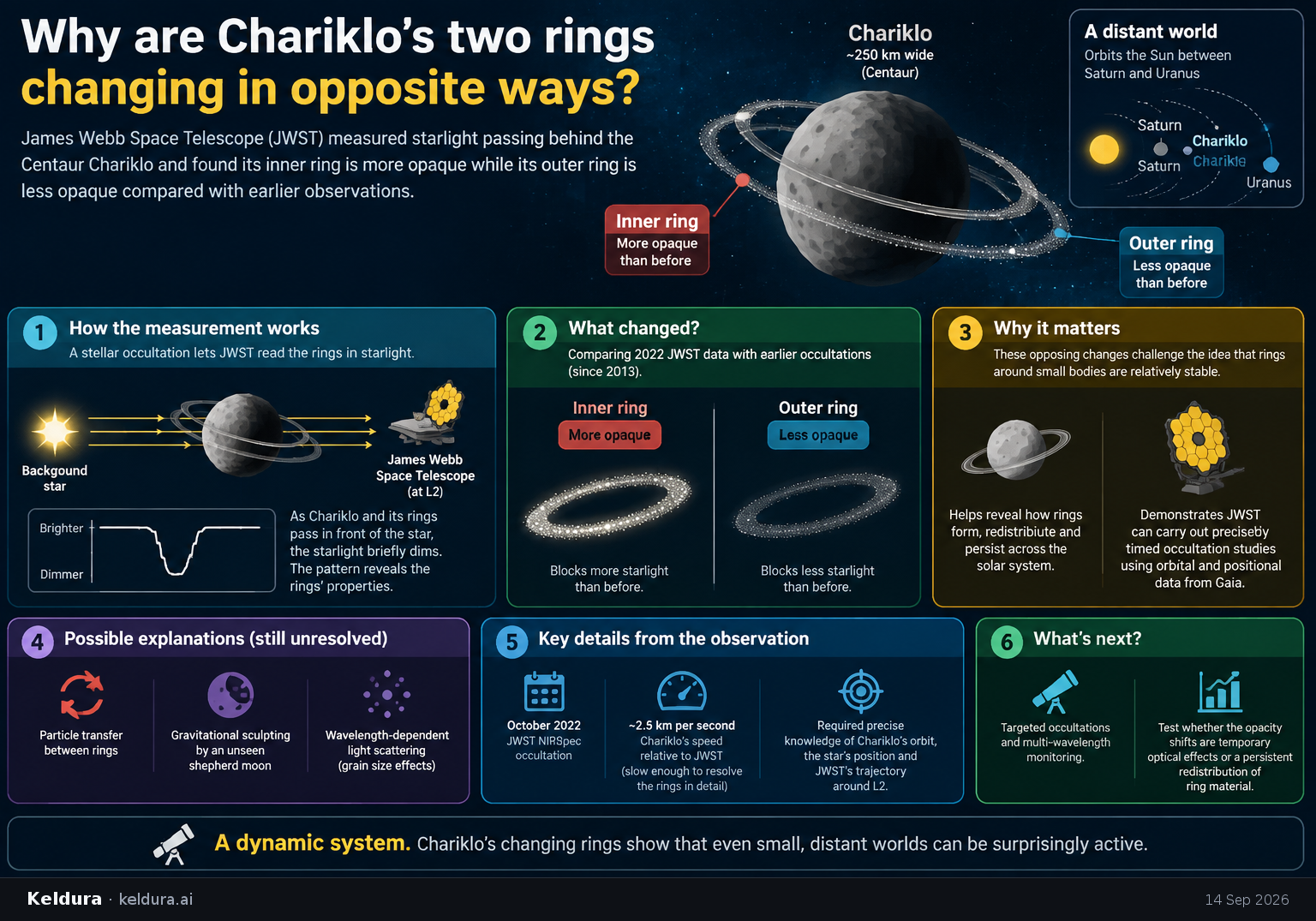
During an October 2022 stellar occultation, JWST measured starlight passing behind Chariklo, a roughly 250-kilometer-wide Centaur orbiting between Saturn and Uranus.[1][2][3] Comparison with a decade of earlier occultations indicated that the inner ring had become more opaque while the outer ring had become less opaque.[1][2][3] Because Chariklo is too small and distant for direct imaging, astronomers infer its rings’ properties from the brief changes in background starlight.[2][3]
Why it matters: The opposing changes challenge the assumption that rings around small bodies are relatively stable and could help researchers identify the processes that form, redistribute and preserve ring material across the solar system.[1][2][3] The observation also demonstrates that JWST can execute precisely timed occultation studies using orbital and positional data from Gaia.[1][2][3]
Key insights: The physical cause remains unresolved; proposed explanations include particle transfer between the rings, gravitational sculpting by an unseen shepherd moon and wavelength-dependent light scattering.[2] | The observation required precise knowledge of Chariklo’s orbit, the background star’s position and JWST’s trajectory around the L2 region.[1][3] | Chariklo moved at about 2.5 kilometers per second relative to JWST during the occultation, slow enough for the telescope to resolve the rings in exceptional detail.[2][3] | Multi-wavelength follow-up could help distinguish an actual redistribution of ring mass from changes caused by grain-size-dependent optical properties.[2]
Cheatsheet facts: What changed: Chariklo’s inner ring became significantly more opaque while its outer ring became less opaque relative to earlier occultation measurements.[1][2][3] | Why now: JWST’s October 2022 NIRSpec occultation was compared with ground-based observations collected since the rings’ 2013 discovery.[1][2][3] | Watch next: Targeted occultations and multi-wavelength monitoring will test whether the opacity shifts are temporary optical effects or persistent redistribution of ring material.[2]
X copy pack
[1] James Webb Space Telescope discovers the rings of tiny solar system body Chariklo are changing - Top Tech News — toptech.news[2] Webb Telescope Detects Structural Changes in Asteroid Chariklo Rings — zonaintegritas.news[3] James Webb Space Telescope discovers the rings of tiny solar system body Chariklo are changing | Space — Space.comRead in BriefingsPost to X