NASA funds a multiworld mineral-survey spacecraft study
NASA’s Innovative Advanced Concepts program has awarded Phase 1 funding to Interworld Slingshot Resource Surveys, a concept for bringing “Landsat-style mineral intelligence” to destinations beyond Earth.[7] The study will assess whether one small spacecraft and remote-sensing instrument could surve…
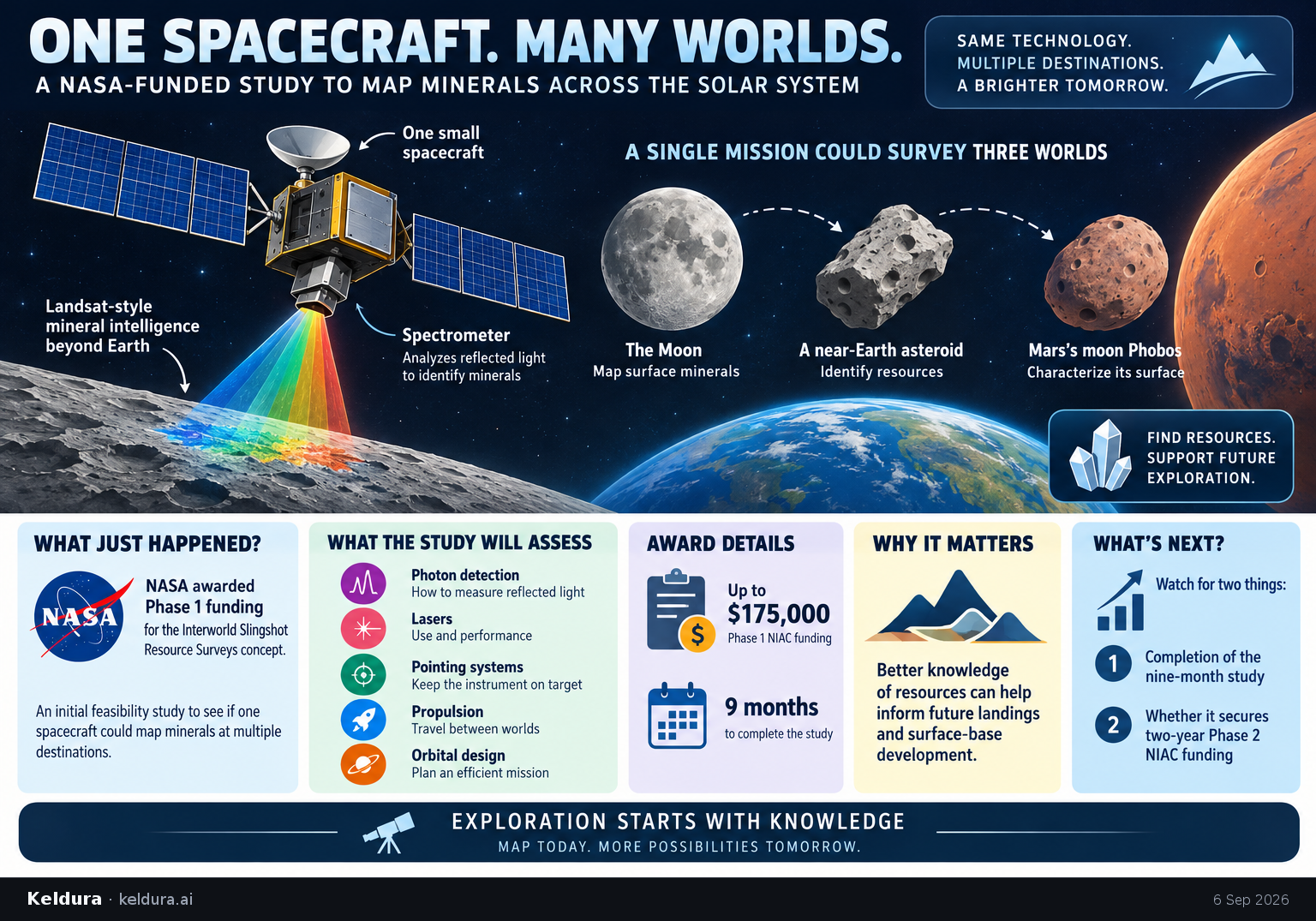
NASA’s Innovative Advanced Concepts program has awarded Phase 1 funding to Interworld Slingshot Resource Surveys, a concept for bringing “Landsat-style mineral intelligence” to destinations beyond Earth.[7] The study will assess whether one small spacecraft and remote-sensing instrument could survey the Moon, a near-Earth asteroid and Mars’s moon Phobos during a single mission.[7]
Why it matters: A reusable approach to mapping resources across several worlds could improve advance knowledge of potential landing sites and accessible minerals, although the project remains an early-stage concept rather than an approved flight mission.[7]
Key insights: The proposed spacecraft would move between worlds while using a spectrometer to characterize their surfaces.[7] | Phase 1 work will examine photon detection, lasers, pointing systems, propulsion and orbital design.[7] | The project can receive up to $175,000 over nine months under its current NIAC award.[7]
Cheatsheet facts: What changed: NASA funded an initial feasibility study for a spacecraft that could map minerals at multiple Solar System destinations.[7] | Why now: Future lunar and planetary activities would benefit from resource surveys conducted before landings and surface-base development.[7] | Watch next: Watch whether the concept completes its nine-month study and secures two-year Phase 2 NIAC funding.[7]
X copy pack
Edition complete
You've reached the end of this edition.