Starship delivers 26 satellites but loses booster recovery
Starship delivered its satellites, but can its upper stage return from orbit into the launch tower’s arms?
On November 13, SpaceX launched Starship’s 15th test from Texas and deployed 26 Starlink satellites, but aborted recovery of its Super Heavy booster.
SpaceX’s Starship reached orbit and deployed all 26 Starlink V3 satellites on its 15th test flight, completing the mission’s primary payload objective. [6] An automatic abort prevented recovery of the Super Heavy booster, leaving a possible November 14 catch of the upper stage as the remaining reco…
Open original (5 sources):
- [6] Starship flight 15 powers to orbit—setting up a possible catch on Saturday - Ars Technica — arstechnica.com
- [2] SpaceX launches 15th Starship flight with hopes of achieving first round trip - The Hindu — thehindu.com
- [3] SpaceX launches Starship on ambitious 22-hour Flight 15 test, but aborts booster 'chopsticks' catch (video) | Space — space.com
- [4] Starship launches on 15th test, calls off booster catch - SpaceNews — spacenews.com
- [8] SpaceX's Starship soars into orbit after booster malfunction thwarts double catch attempt | PBS News — pbs.org
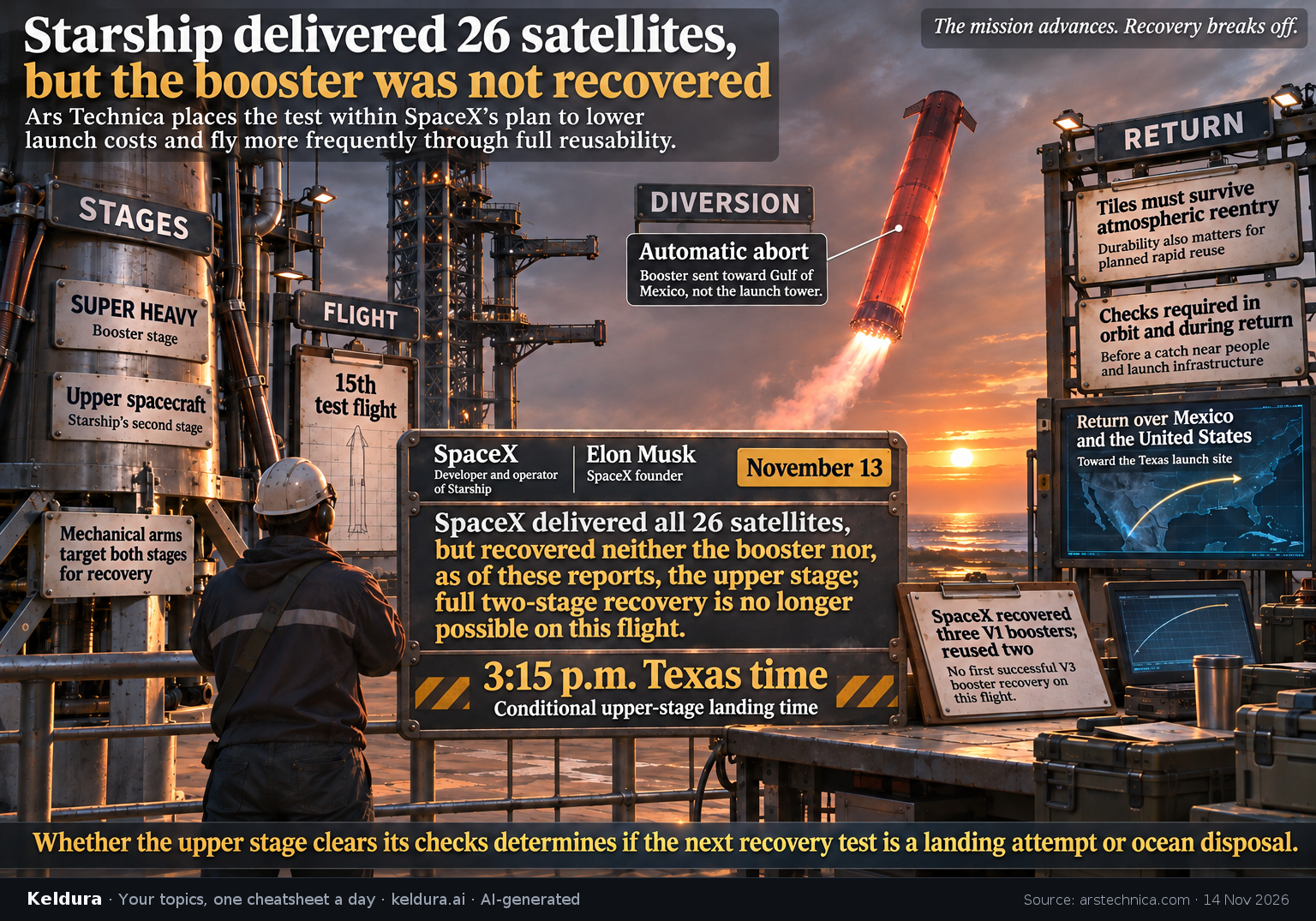
SpaceX’s Starship reached orbit and deployed all 26 Starlink V3 satellites on its 15th test flight, completing the mission’s primary payload objective. [6] An automatic abort prevented recovery of the Super Heavy booster, leaving a possible November 14 catch of the upper stage as the remaining recovery test. [2][3][4][8]
Why it matters: Recovering hardware is central to SpaceX’s plan to reduce launch costs and fly more frequently; losing the booster means this flight cannot demonstrate recovery of both stages. The upper stage must also pass safety checks before returning over parts of Mexico and the United States toward the Texas launch site. [2][6][8]
Key insights: Satellite delivery and rocket recovery are separate results: all 26 payloads reached orbit even though the booster was not recovered. [6] | SpaceX had previously recovered three V1 Super Heavy boosters and reused two, but this flight did not deliver the first successful recovery of a V3 booster. [3] | The upper stage’s heat shield must survive atmospheric reentry, and its tiles must also be durable enough for SpaceX’s planned rapid reuse. [6] | Reports differ on the planned orbit count: Reuters gives 14 orbits, while Associated Press gives 15, so neither count establishes the return schedule by itself. [2][8]
Cheatsheet facts: What happened: Starship deployed 26 satellites, but an automatic abort sent its booster toward the Gulf of Mexico instead of the launch tower. [6][8] | Background: Starship has two stages: the Super Heavy booster and an upper spacecraft; SpaceX wants to recover both using the launch tower’s mechanical arms. [2][8] | Why: SpaceX is developing full reusability to lower spaceflight costs and support more frequent launches. [2][8] | The catch: The upper stage must pass checks in orbit and during return before SpaceX will risk a catch near people and launch infrastructure. [6] | What's next: A successful series of checks would allow a November 14 landing at about 3:15 p.m. Texas time, or 21:15 UTC; otherwise, SpaceX has earlier ocean-disposal options. [6]