Can a new council turn tennis player pressure into lasting power?
The four Grand Slams have established a Grand Slam Player Advisory Council through which players can be consulted and negotiate.
The four Grand Slams have established a Grand Slam Player Advisory Council through which players can be consulted and negotiate on an ongoing basis.[2] The players still seek 22% of tournament revenue as prize money, stronger representation, improved health options and pensions, but they reserve th…
The four Grand Slams have established a Grand Slam Player Advisory Council through which players can be consulted and negotiate on an ongoing basis.[2] The players still seek 22% of tournament revenue as prize money, stronger representation, improved health options and pensions, but they reserve the right to restart their public campaign if the council does not deliver.[2][9]
Why it matters: The dispute is moving from public pressure and threatened disruption toward a permanent governance mechanism, but the central revenue-sharing demand remains unresolved.[2][9] The council’s effectiveness will therefore be measured by whether consultation produces enforceable financial and welfare commitments.[2]
Key insights: The organized campaign began in March 2025 and sought a greater voice in Grand Slam decisions, more welfare funding and a larger share of tournament revenue.[9] | Players had limited media appearances at the French Open and Wimbledon, while Aryna Sabalenka and Coco Gauff were among those who raised the possibility of a boycott before the French Open.[2] | Prize money across the listed 2025 and 2026 Grand Slam editions reached $415.6 million, with players estimating that more than $30 million represented growth above the earlier trend.[2] | The Australian Open, French Open and US Open are operated by nonprofit governing bodies, while Wimbledon is run by the private All England Club, complicating any uniform commercial settlement.[2]
Cheatsheet facts: What changed: Players stopped campaigning publicly and moved their demands into the Grand Slam Player Advisory Council.[2][9] | Why now: The four majors created the council after sustained pressure over revenue, representation and welfare, while prize money increased beyond its prior growth trend.[2][9] | Watch next: Look for a formal revenue-sharing agreement, movement toward the requested 22% share, and concrete commitments on health options, pensions and representation.[2][9]
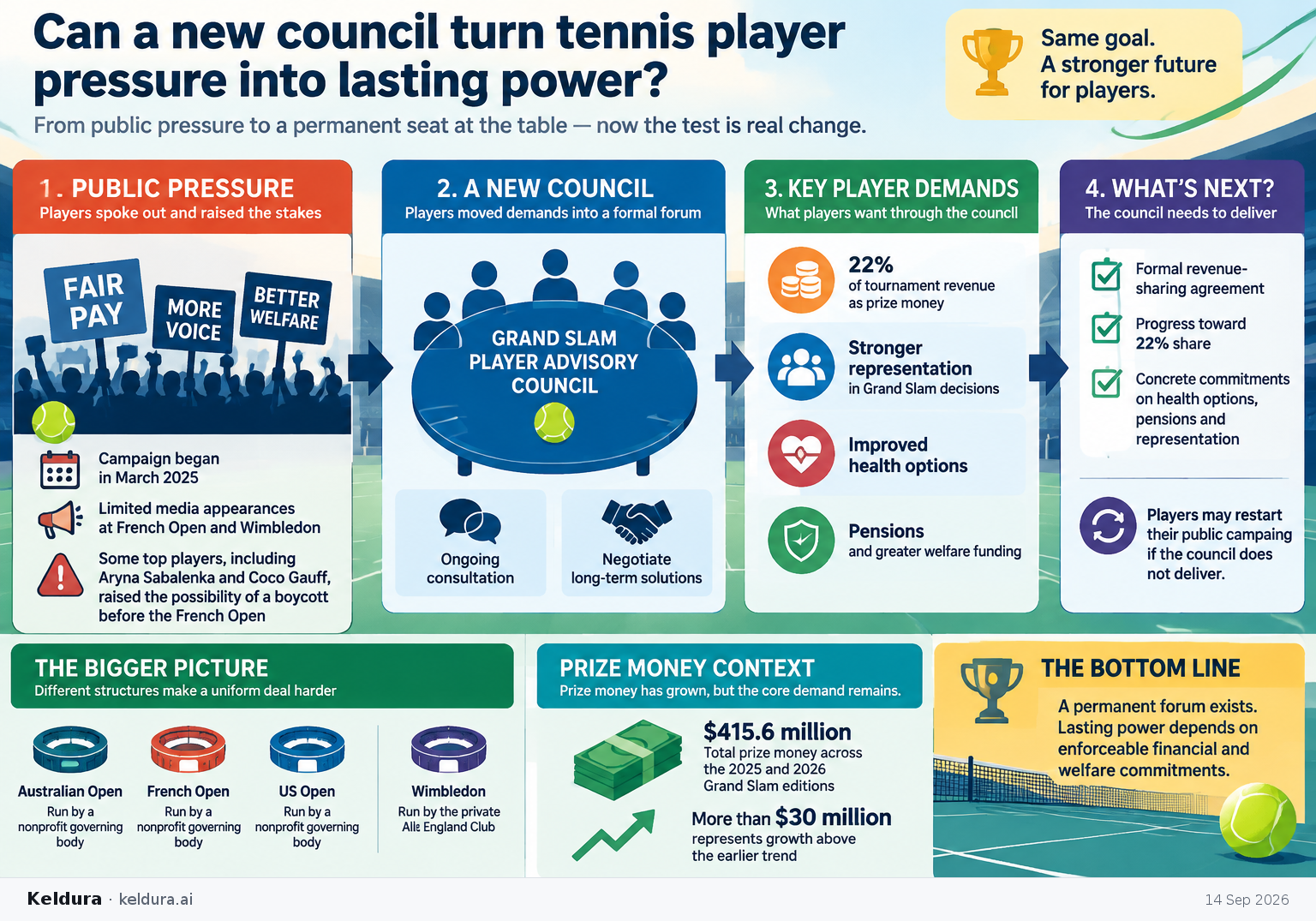
The four Grand Slams have established a Grand Slam Player Advisory Council through which players can be consulted and negotiate on an ongoing basis.[2] The players still seek 22% of tournament revenue as prize money, stronger representation, improved health options and pensions, but they reserve the right to restart their public campaign if the council does not deliver.[2][9]
Why it matters: The dispute is moving from public pressure and threatened disruption toward a permanent governance mechanism, but the central revenue-sharing demand remains unresolved.[2][9] The council’s effectiveness will therefore be measured by whether consultation produces enforceable financial and welfare commitments.[2]
Key insights: The organized campaign began in March 2025 and sought a greater voice in Grand Slam decisions, more welfare funding and a larger share of tournament revenue.[9] | Players had limited media appearances at the French Open and Wimbledon, while Aryna Sabalenka and Coco Gauff were among those who raised the possibility of a boycott before the French Open.[2] | Prize money across the listed 2025 and 2026 Grand Slam editions reached $415.6 million, with players estimating that more than $30 million represented growth above the earlier trend.[2] | The Australian Open, French Open and US Open are operated by nonprofit governing bodies, while Wimbledon is run by the private All England Club, complicating any uniform commercial settlement.[2]
Cheatsheet facts: What changed: Players stopped campaigning publicly and moved their demands into the Grand Slam Player Advisory Council.[2][9] | Why now: The four majors created the council after sustained pressure over revenue, representation and welfare, while prize money increased beyond its prior growth trend.[2][9] | Watch next: Look for a formal revenue-sharing agreement, movement toward the requested 22% share, and concrete commitments on health options, pensions and representation.[2][9]