Vertu is betting that executives will pay for an AI agent, not just a luxury phone
Vertu’s Alphafold is positioned as a luxury foldable for affluent buyers, especially chief executives, with prices starting at $6,880 and a pre-installed Hermes Agent that can analyze files, automate tasks across apps, remember conversations, and hand off requests to a human concierge [5]. In hands…
Vertu’s Alphafold is positioned as a luxury foldable for affluent buyers, especially chief executives, with prices starting at $6,880 and a pre-installed Hermes Agent that can analyze files, automate tasks across apps, remember conversations, and hand off requests to a human concierge [5]. In hands-on testing, the agent was good at some local-file and spreadsheet tasks and more willing than Samsung’s Gemini to automate multi-step workflows, but it also produced incomplete workflows, incorrect outputs, and inconsistent behavior [5].
Why it matters: This is a concrete sign that the premium-phone market is shifting from hardware status signaling to paid AI labor-saving features [5]. The review also highlights a broader product question for agentic AI: more autonomy can increase usefulness, but it can also raise reliability and user-control concerns [5].
Key insights: Vertu is explicitly targeting executives who want the phone to function as a working tool as much as a status object [5]. | Hermes performed better than Gemini on some local-file and spreadsheet tasks in the reviewer’s testing [5]. | The same autonomy that made Hermes feel more agent-like also led to errors and unfinished actions, showing the trade-off between independence and oversight [5]. | The company appears to be actively updating the platform, so buyer experience may change quickly after launch [5].
Cheatsheet facts: What changed: Vertu launched an executive-focused foldable with an AI agent at the center of the pitch, starting at $6,880 [5]. | Why now: Phone makers are racing to turn AI into a consumer differentiator, and Vertu is aiming above the mainstream market [5]. | Watch next: Whether Vertu’s Hermes Agent gains consistency across updates and whether buyers treat the AI feature as worth the premium [5].
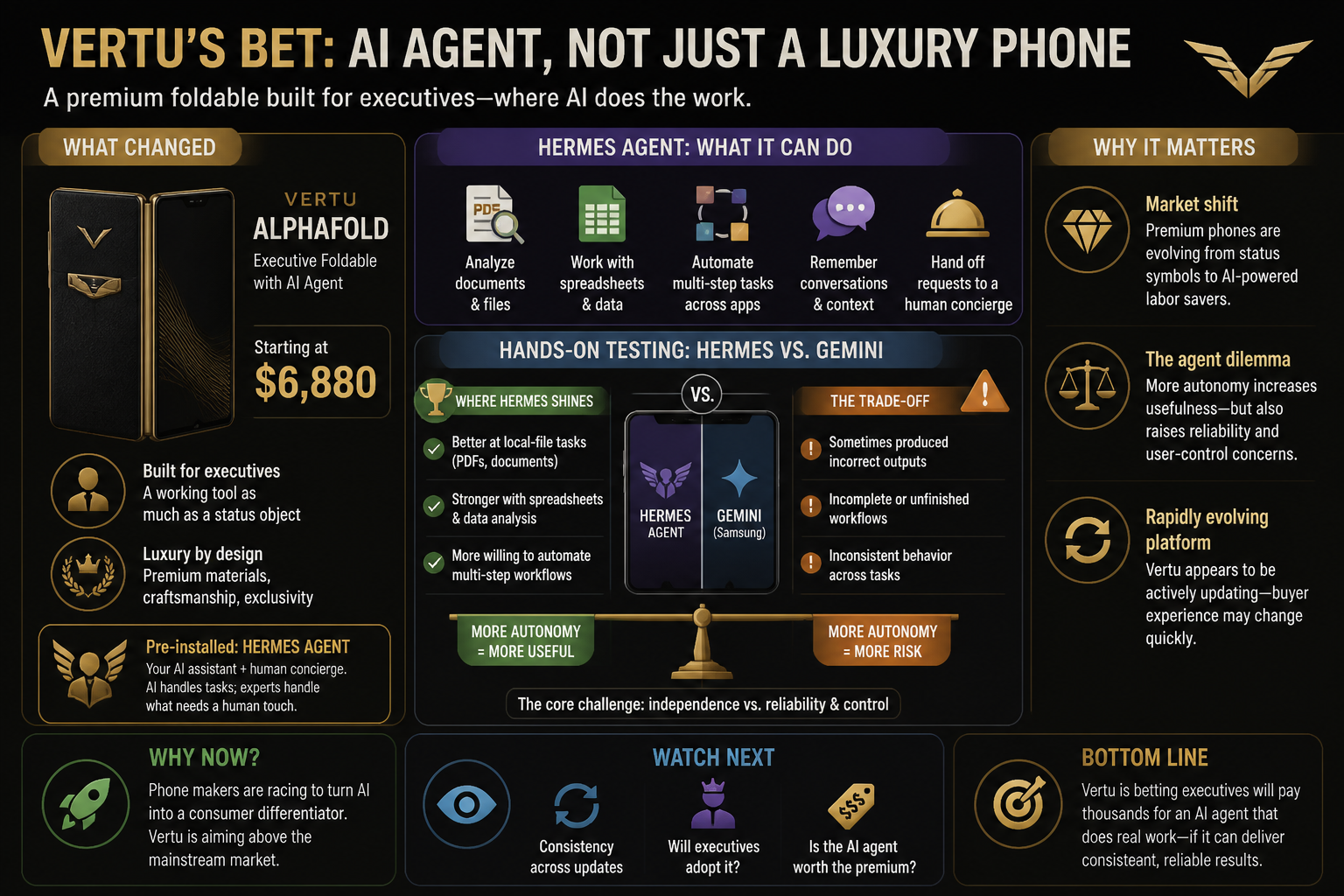
Vertu’s Alphafold is positioned as a luxury foldable for affluent buyers, especially chief executives, with prices starting at $6,880 and a pre-installed Hermes Agent that can analyze files, automate tasks across apps, remember conversations, and hand off requests to a human concierge [5]. In hands-on testing, the agent was good at some local-file and spreadsheet tasks and more willing than Samsung’s Gemini to automate multi-step workflows, but it also produced incomplete workflows, incorrect outputs, and inconsistent behavior [5].
Why it matters: This is a concrete sign that the premium-phone market is shifting from hardware status signaling to paid AI labor-saving features [5]. The review also highlights a broader product question for agentic AI: more autonomy can increase usefulness, but it can also raise reliability and user-control concerns [5].
Key insights: Vertu is explicitly targeting executives who want the phone to function as a working tool as much as a status object [5]. | Hermes performed better than Gemini on some local-file and spreadsheet tasks in the reviewer’s testing [5]. | The same autonomy that made Hermes feel more agent-like also led to errors and unfinished actions, showing the trade-off between independence and oversight [5]. | The company appears to be actively updating the platform, so buyer experience may change quickly after launch [5].
Cheatsheet facts: What changed: Vertu launched an executive-focused foldable with an AI agent at the center of the pitch, starting at $6,880 [5]. | Why now: Phone makers are racing to turn AI into a consumer differentiator, and Vertu is aiming above the mainstream market [5]. | Watch next: Whether Vertu’s Hermes Agent gains consistency across updates and whether buyers treat the AI feature as worth the premium [5].