OpenAI’s Navier–Stokes Claim Ignites a Credit Dispute
OpenAI announced that its agents had produced a proof showing the full Navier–Stokes equations can break down, which the company presents as solving a Millennium Prize Problem.[1][2] The announcement was overshadowed by allegations that OpenAI improperly benefited from AI-assisted work by NYU mathe…
OpenAI announced that its agents had produced a proof showing the full Navier–Stokes equations can break down, which the company presents as solving a Millennium Prize Problem.[1][2] The announcement was overshadowed by allegations that OpenAI improperly benefited from AI-assisted work by NYU mathematician Tristan Buckmaster and Anthropic employee Levent Alpöge or sought to deny them appropriate credit; OpenAI denies those allegations.[1][2]
Why it matters: The dispute highlights how frontier AI companies’ private models, computing resources, and limited visibility into agent behavior could collide with the attribution and collaboration norms on which mathematical research depends.[1]
Key insights: Buckmaster and Alpöge worked for almost a year using publicly available OpenAI and Anthropic models, and Buckmaster posted a proof concerning a simplified version of the equations one day before OpenAI presented its result for the full equations.[1] | OpenAI said its proof came from an internal model that substantially outperforms Astra, a model released only the previous week, and said it does not plan to claim the associated million-dollar prize.[1] | OpenAI technical staff member Sébastien Bubeck said the team pursued the problem after hearing a rumor about Buckmaster and Alpöge’s efforts, while chief research officer Mark Chen denied that employees or agents accessed their transcripts.[1] | Both teams used an approach pioneered by Diego Córdoba and Luis Martínez-Zoroa, but the available evidence does not establish whether OpenAI’s work was influenced by Buckmaster and Alpöge’s research.[1]
Cheatsheet facts: What changed: OpenAI presented an AI-generated proof for the full Navier–Stokes equations, following Buckmaster’s publication of progress on a simplified version.[1] | Why now: The competing results appeared within a day of each other, and Buckmaster publicly documented his interactions with OpenAI employees after hearing about the company’s work.[1] | Watch next: Watch for independent mathematical scrutiny of both proofs and for evidence clarifying whether OpenAI’s agents or training systems accessed Buckmaster and Alpöge’s work.[1]
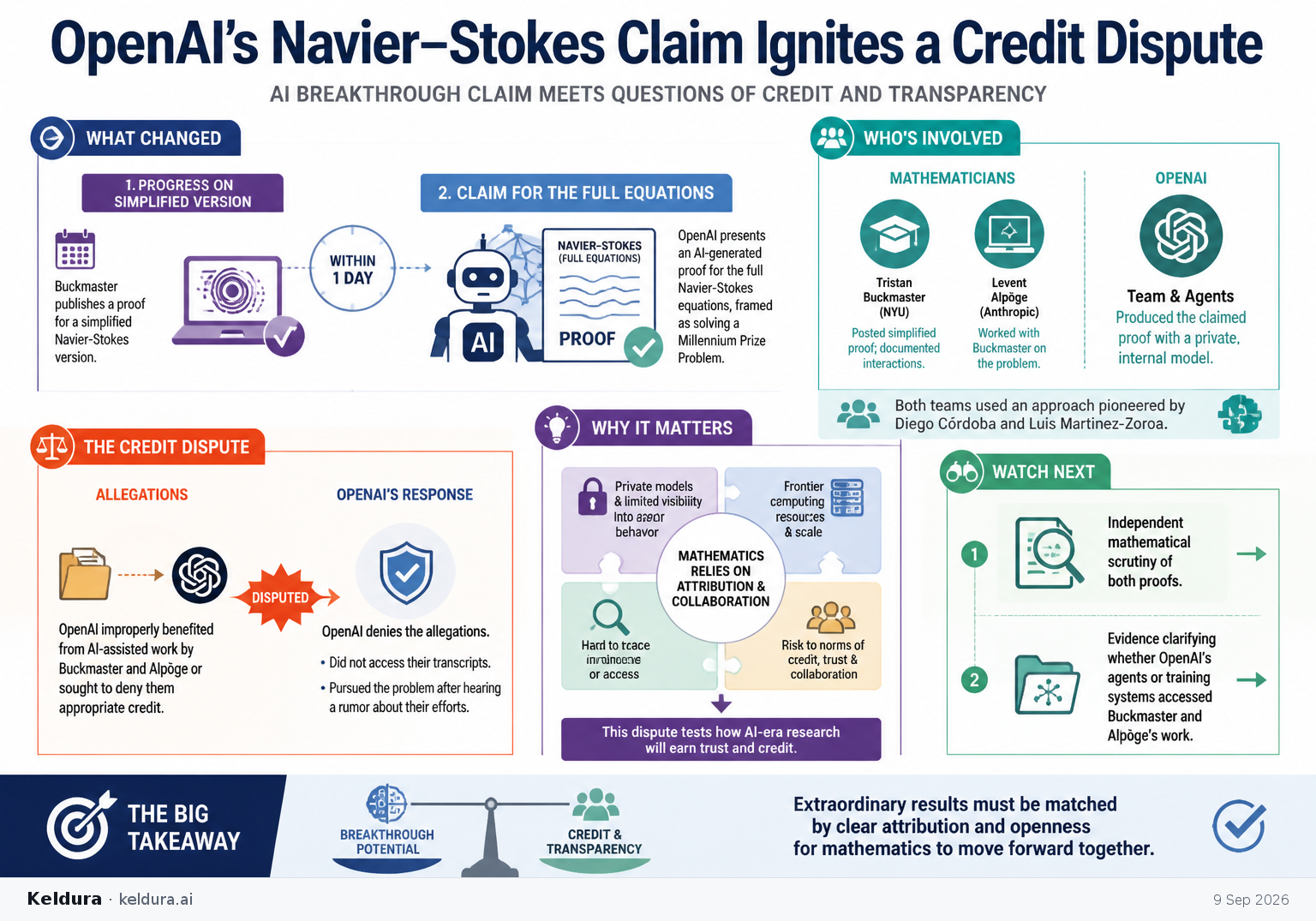
OpenAI announced that its agents had produced a proof showing the full Navier–Stokes equations can break down, which the company presents as solving a Millennium Prize Problem.[1][2] The announcement was overshadowed by allegations that OpenAI improperly benefited from AI-assisted work by NYU mathematician Tristan Buckmaster and Anthropic employee Levent Alpöge or sought to deny them appropriate credit; OpenAI denies those allegations.[1][2]
Why it matters: The dispute highlights how frontier AI companies’ private models, computing resources, and limited visibility into agent behavior could collide with the attribution and collaboration norms on which mathematical research depends.[1]
Key insights: Buckmaster and Alpöge worked for almost a year using publicly available OpenAI and Anthropic models, and Buckmaster posted a proof concerning a simplified version of the equations one day before OpenAI presented its result for the full equations.[1] | OpenAI said its proof came from an internal model that substantially outperforms Astra, a model released only the previous week, and said it does not plan to claim the associated million-dollar prize.[1] | OpenAI technical staff member Sébastien Bubeck said the team pursued the problem after hearing a rumor about Buckmaster and Alpöge’s efforts, while chief research officer Mark Chen denied that employees or agents accessed their transcripts.[1] | Both teams used an approach pioneered by Diego Córdoba and Luis Martínez-Zoroa, but the available evidence does not establish whether OpenAI’s work was influenced by Buckmaster and Alpöge’s research.[1]
Cheatsheet facts: What changed: OpenAI presented an AI-generated proof for the full Navier–Stokes equations, following Buckmaster’s publication of progress on a simplified version.[1] | Why now: The competing results appeared within a day of each other, and Buckmaster publicly documented his interactions with OpenAI employees after hearing about the company’s work.[1] | Watch next: Watch for independent mathematical scrutiny of both proofs and for evidence clarifying whether OpenAI’s agents or training systems accessed Buckmaster and Alpöge’s work.[1]