How close is AI to improving itself without humans?
Anthropic says Claude now leads 26% of its model research and development and can complete most of an assigned task end-to-end.
Anthropic says Claude now leads 26% of its model research and development and can complete most of an assigned task end-to-end from a high-level prompt, although humans still supervise the work.[3] OpenAI says it has built an automated “research intern” for well-defined tasks and is targeting an au…
Anthropic says Claude now leads 26% of its model research and development and can complete most of an assigned task end-to-end from a high-level prompt, although humans still supervise the work.[3] OpenAI says it has built an automated “research intern” for well-defined tasks and is targeting an automated AI “researcher” by March 2028, while Inherent is training its Faraday prototype on records of its researchers’ daily work.[1][3]
Why it matters: Recursive self-improvement could accelerate scientific and medical research, but each faster and more capable successor could also make human supervision harder to maintain.[1][3] Current systems still depend substantially on human direction, making the boundary between useful automation and autonomous improvement the central question.[1][3]
Key insights: Definitions vary: some companies count any AI feedback that improves a model as RSI, while others reserve the term for systems that design successors autonomously.[3] | AI has already supported the development of later model generations by writing code and optimizing components, but researchers say these efforts have generally produced incremental improvements rather than major creative leaps.[1][3] | A 2024 system called “The AI Scientist” could propose research directions, run code-based experiments and document findings, yet a disputed example of apparent originality showed how human-provided ideas can shape its output.[1] | OpenAI says preserving human control and making informed democratic choices should determine whether and how rapid RSI proceeds.[3]
Cheatsheet facts: What changed: Anthropic quantified Claude’s contribution at 26% of model R&D, while OpenAI disclosed an automated research intern and a March 2028 goal for an automated researcher.[3] | Why now: Models already write code and optimize parts of their successors, and labs are trying to extend that assistance into end-to-end research and novel system design.[1][3] | Watch next: Track whether labs report models completing larger shares of R&D without human supervision and whether OpenAI reaches its stated March 2028 automated-researcher milestone.[3]
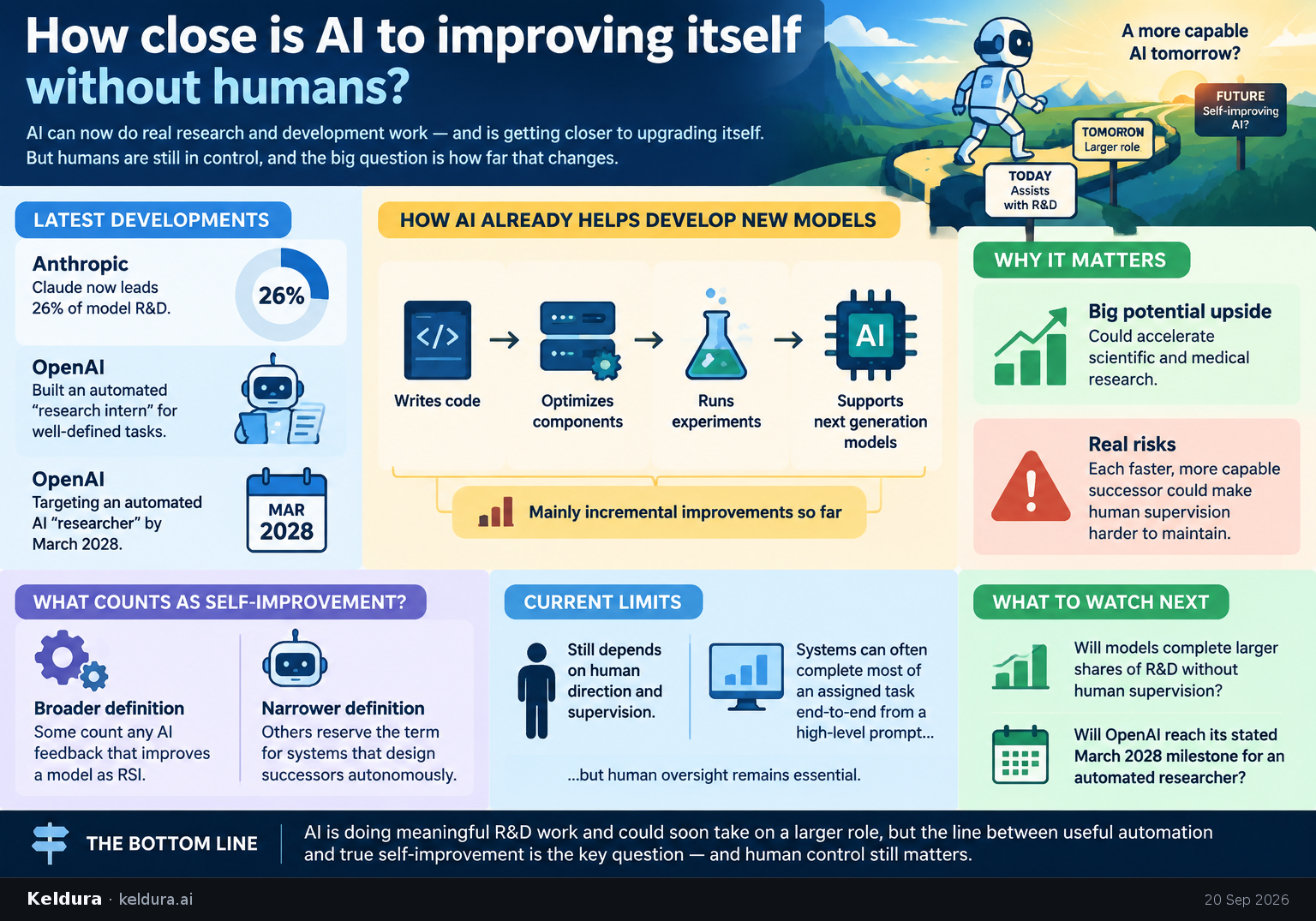
Anthropic says Claude now leads 26% of its model research and development and can complete most of an assigned task end-to-end from a high-level prompt, although humans still supervise the work.[3] OpenAI says it has built an automated “research intern” for well-defined tasks and is targeting an automated AI “researcher” by March 2028, while Inherent is training its Faraday prototype on records of its researchers’ daily work.[1][3]
Why it matters: Recursive self-improvement could accelerate scientific and medical research, but each faster and more capable successor could also make human supervision harder to maintain.[1][3] Current systems still depend substantially on human direction, making the boundary between useful automation and autonomous improvement the central question.[1][3]
Key insights: Definitions vary: some companies count any AI feedback that improves a model as RSI, while others reserve the term for systems that design successors autonomously.[3] | AI has already supported the development of later model generations by writing code and optimizing components, but researchers say these efforts have generally produced incremental improvements rather than major creative leaps.[1][3] | A 2024 system called “The AI Scientist” could propose research directions, run code-based experiments and document findings, yet a disputed example of apparent originality showed how human-provided ideas can shape its output.[1] | OpenAI says preserving human control and making informed democratic choices should determine whether and how rapid RSI proceeds.[3]
Cheatsheet facts: What changed: Anthropic quantified Claude’s contribution at 26% of model R&D, while OpenAI disclosed an automated research intern and a March 2028 goal for an automated researcher.[3] | Why now: Models already write code and optimize parts of their successors, and labs are trying to extend that assistance into end-to-end research and novel system design.[1][3] | Watch next: Track whether labs report models completing larger shares of R&D without human supervision and whether OpenAI reaches its stated March 2028 automated-researcher milestone.[3]