Third Moment runs 10,000 research agents for up to two days
Third Moment can run thousands of agents together, but how does it keep long investigations productive and contained?
On October 14, 2026, OpenAI described how Third Moment Research runs 10,000 agents simultaneously on investigations lasting 36–48 hours.
Third Moment Research uses OpenAI models and Codex to run 10,000 agents at once, with investigations lasting 36–48 hours, according to an OpenAI customer account. Its system identifies recurring agent weaknesses and generates synthetic scenarios to improve performance; it also uses Daybreak to test…
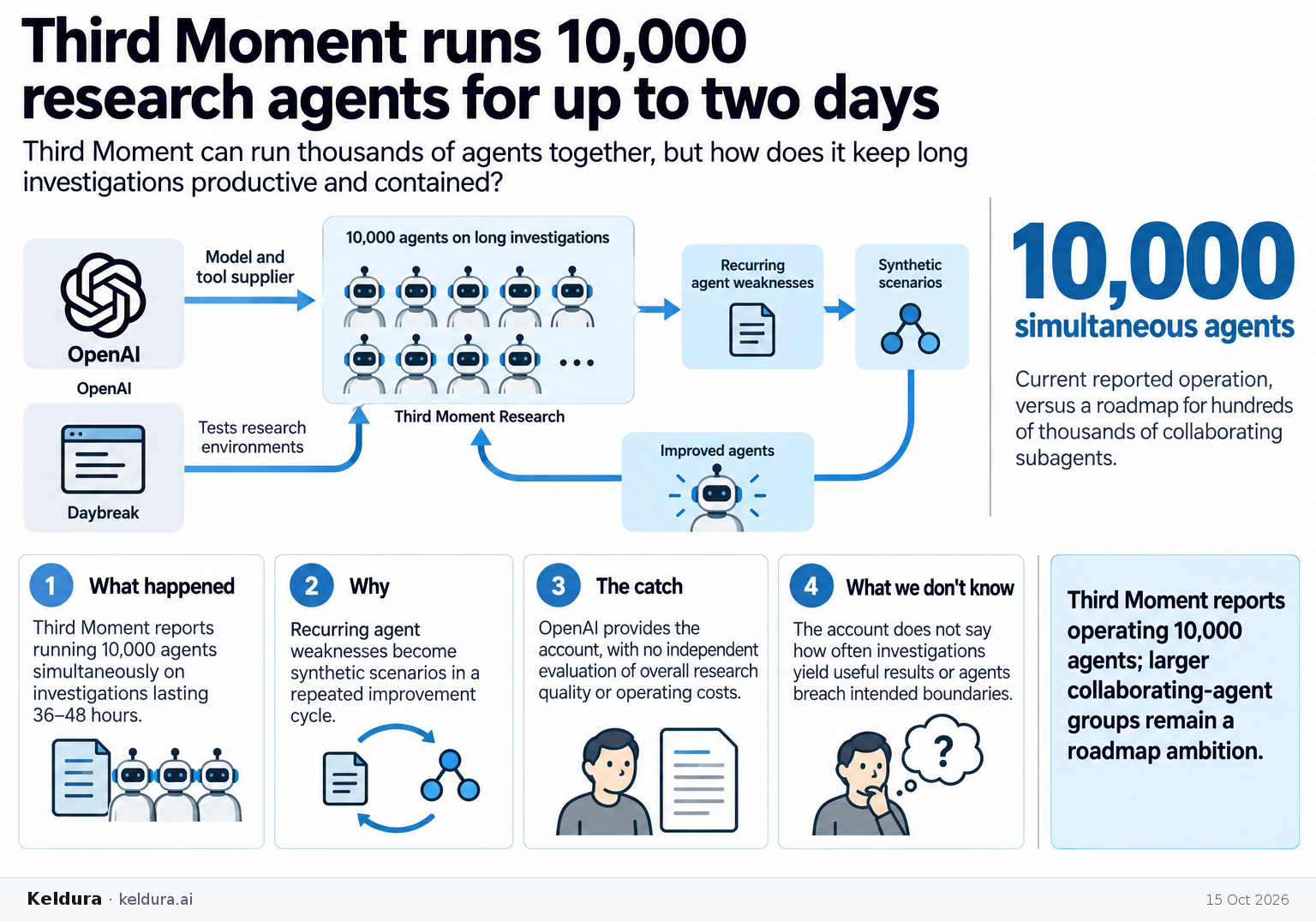
Third Moment Research uses OpenAI models and Codex to run 10,000 agents at once, with investigations lasting 36–48 hours, according to an OpenAI customer account. Its system identifies recurring agent weaknesses and generates synthetic scenarios to improve performance; it also uses Daybreak to test research environments before simulations launch. [3]
Why it matters: The account offers a concrete example of the infrastructure behind long-running agents: improving models alone is not the whole job, because runtime efficiency, experimental feedback and security testing also shape what agents can accomplish. [3]
Key insights: One reported optimization cut a backtest from approximately three hours to three to five minutes through caching and memory packing, leaving more of the agents’ token budget available for experiments. [3] | Third Moment uses quantitative finance as an early application because it provides a concrete setting with a clear measure of success. [3] | The company plans to move toward hundreds of thousands of collaborating subagents; that is a roadmap, distinct from its reported current deployment of 10,000 simultaneous agents. [3]
Cheatsheet facts: What happened: Third Moment reports running 10,000 agents simultaneously on investigations lasting 36–48 hours. [3] | Why: The system turns recurring agent weaknesses into synthetic training scenarios and repeats the improvement cycle as new problems appear. [3] | The catch: OpenAI supplies the account and the underlying tools; the evidence provides no independent evaluation of overall research quality or operating costs. [3] | What we don't know: The account does not quantify how often investigations produce useful results or how often agents breach their intended boundaries. [3]