OpenAI returns to shared storage for global scale
OpenAI is sharing database capacity across products, but how does it stop one workload from slowing the others?
On October 23, OpenAI detailed its return to shared database containers in Habitat, its storage platform serving more than one billion users.
OpenAI says Habitat now serves more than one billion users across 40 geographic regions and holds more than 500 petabytes of data. Its Azure Cosmos DB design moved from shared containers to dedicated containers and then back to shared containers by default, balancing resource efficiency against wor…
Open original · [7] Rapidly scaling online storage to serve over 1 billion ChatGPT users (Part II) | OpenAI — OpenAI Blog
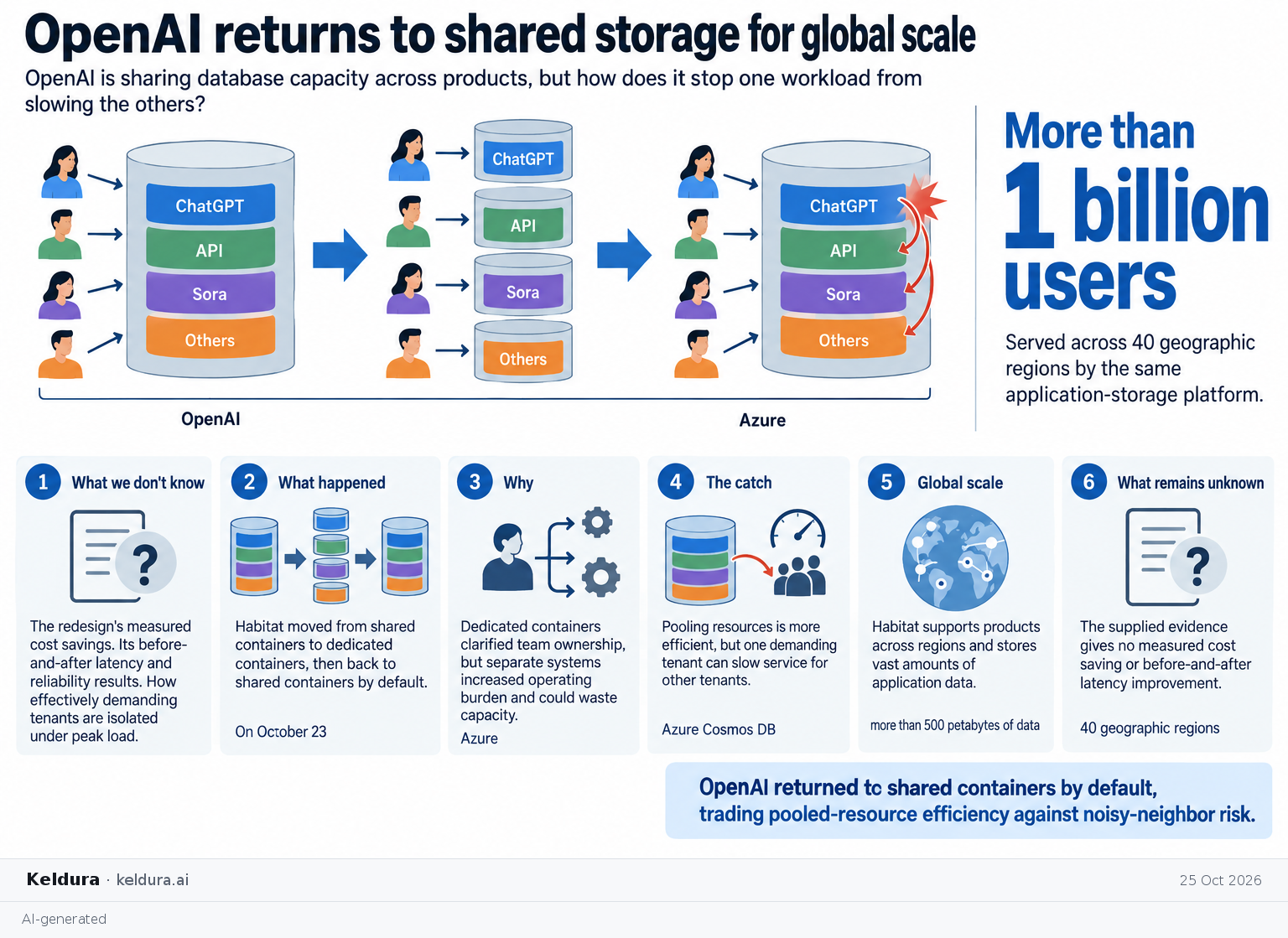
OpenAI says Habitat now serves more than one billion users across 40 geographic regions and holds more than 500 petabytes of data. Its Azure Cosmos DB design moved from shared containers to dedicated containers and then back to shared containers by default, balancing resource efficiency against workload isolation. [7]
Why it matters: Supporting AI products at this scale requires more than model-serving capacity: application data must remain quickly accessible across products and regions. OpenAI's storage design illustrates the trade-off between pooling resources efficiently and protecting one workload from another's demand. [7]
Key insights: Dedicated containers give product teams clearer ownership and workload isolation, but can require excess capacity and separate planning for each team. [7] | Shared containers centralize provisioning expertise, but introduce a noisy-neighbor problem when one tenant consumes resources needed by others. [7] | Habitat also handles authorization, data residency, encryption, caching, and request shaping, making the database part of a wider application-storage system. [7]
Cheatsheet facts: What happened: Habitat returned to multi-tenant Azure Cosmos DB containers by default after an intermediate move to dedicated containers. [7] | Why: Separate product-team systems became expensive to operate and could lead to significant over-provisioning. [7] | The catch: Sharing capacity can let an unusually demanding tenant degrade service for other tenants. [7] | What we don't know: The supplied evidence gives no measured cost saving or before-and-after latency improvement for the redesign. [7]
X copy pack
Edition complete
You've reached the end of this edition.