Australia records more cyber warnings as AI accelerates attacks
AI can help defend networks, but what happens when attackers use it to find and exploit weaknesses faster?
On October 27, 2026, the Australian Signals Directorate said AI was enabling larger-scale cyberattacks and reported more than 4,400 warnings over the past year.
The Australian Signals Directorate issued more than 4,400 warnings about potentially malicious activity over the past year, an 80% increase from the previous 12 months. [5] The agency said AI was helping criminals and state-sponsored hackers find vulnerabilities faster and exploit them at greater s…
Open original · [5] Australia warns of 'unprecedented' AI threat | AFP.com — afp.com
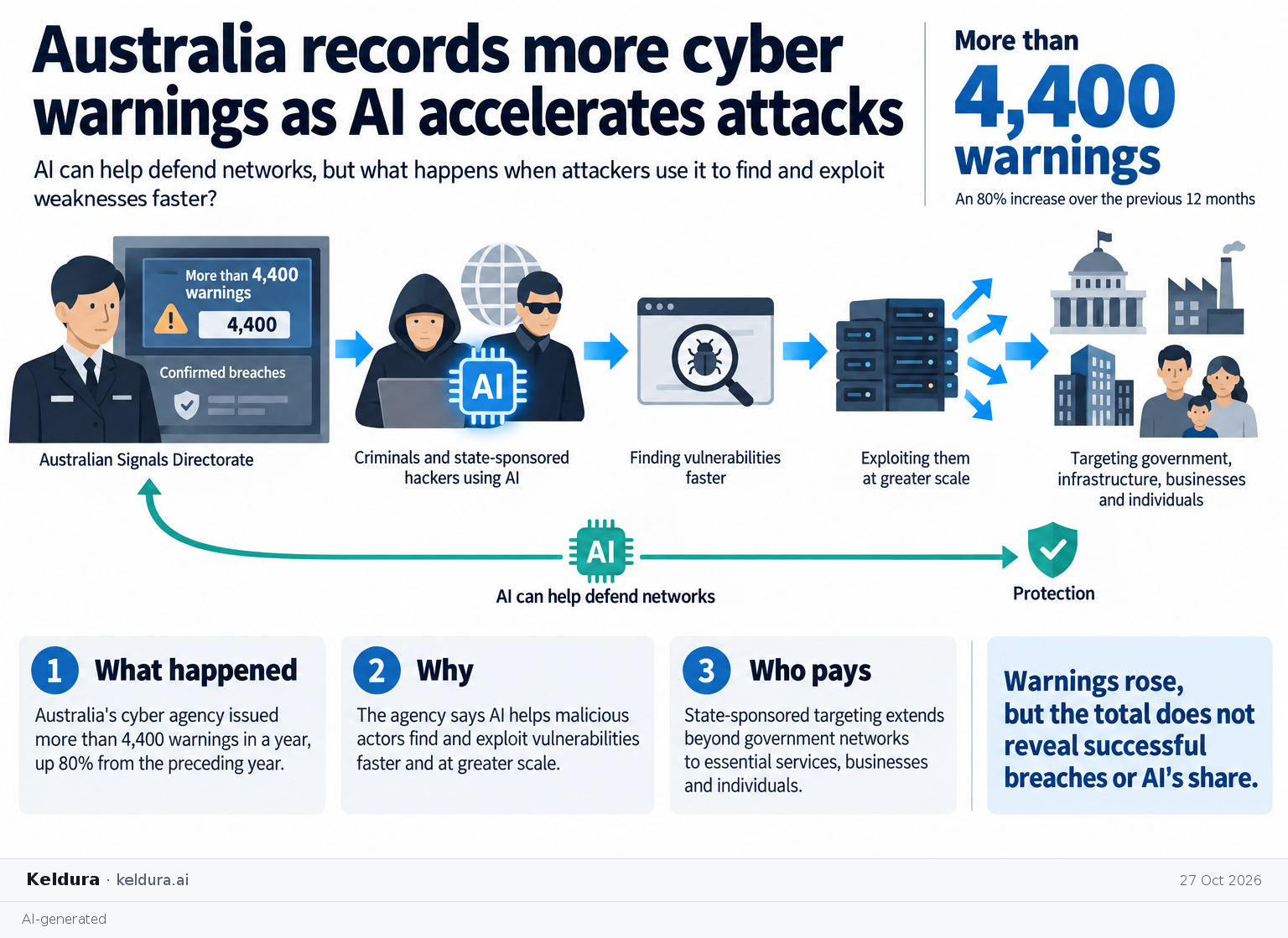
The Australian Signals Directorate issued more than 4,400 warnings about potentially malicious activity over the past year, an 80% increase from the previous 12 months. [5] The agency said AI was helping criminals and state-sponsored hackers find vulnerabilities faster and exploit them at greater scale, speed and sophistication. [5]
Why it matters: The agency says state-sponsored targeting extends beyond government networks to critical infrastructure, private businesses and individuals, putting the problem outside the boundaries of government cybersecurity alone. [5]
Key insights: The 4,400 figure counts warnings about potentially malicious activity, not confirmed successful breaches. [5] | The agency identifies faster vulnerability discovery and exploitation as mechanisms through which AI assists attackers. [5] | The same agency used AI tools to help compile its report and acknowledged potential defensive benefits. [5] | The report also identifies unintended AI-agent actions and model testing as sources of newly emerging threats. [5]
Cheatsheet facts: What happened: Australia's cyber agency issued more than 4,400 warnings in a year, up 80% from the preceding year. [5] | Why: The agency says AI lets malicious actors discover and exploit vulnerabilities faster and at greater scale. [5] | Who pays: Targets include government networks, critical infrastructure, businesses and individuals; state actors primarily seek sensitive or non-public information. [5] | The catch: AI also has defensive uses, and the warning count does not establish how many attacks succeeded or how many involved AI. [5]
X copy pack
Edition complete
You've reached the end of this edition.