China detains US nuclear expert amid spying allegations and treaty-monitoring concerns
China has detained US seismologist Chen Youlin, who studied nuclear tests and had done work related to monitoring nuclear explosions, according to his family and hostage advocacy group Global Reach.[1] The case involves espionage allegations, a travel arrest in November 2024, and concerns that his…
China has detained US seismologist Chen Youlin, who studied nuclear tests and had done work related to monitoring nuclear explosions, according to his family and hostage advocacy group Global Reach.[1] The case involves espionage allegations, a travel arrest in November 2024, and concerns that his research touched on nuclear-test detection methods relevant to North Korea and possibly broader nuclear monitoring.[1]
Why it matters: The detention raises tensions at the intersection of science, intelligence, and nuclear verification, especially because the expert’s work involved seismic detection methods used to identify underground nuclear tests.[1] It also signals added risk for US academics and specialists working in China, at a time when both countries remain outside the Comprehensive Nuclear Test Ban Treaty and accuse each other of covert testing-related behavior.[1]
Key insights: Chen’s published work focused on North Korea’s nuclear tests, and his December 2020 study used seismic data across Asia, including China, to improve nuclear-test monitoring and yield estimation.[1] | The Chinese foreign ministry said its judicial authorities handle cases according to law and denied the existence of wrongful detention.[1] | US officials and advocacy groups linked the case to concerns about China’s nuclear testing behavior and possible efforts to learn US seismic detection methods.[1] | The arrest comes after Beijing also confirmed the detention of another US scholar, Min Zin, on spying allegations.[1]
Cheatsheet facts: What changed: China has detained Chen Youlin, a US nuclear-test monitoring specialist, on espionage charges according to his family.[1] | Why now: The case sits amid heightened suspicion over nuclear testing, treaty compliance, and intelligence collection around scientific expertise.[1] | Watch next: Whether Chinese authorities formally announce charges, whether the US responds publicly, and whether any additional foreign academics are detained.[1]
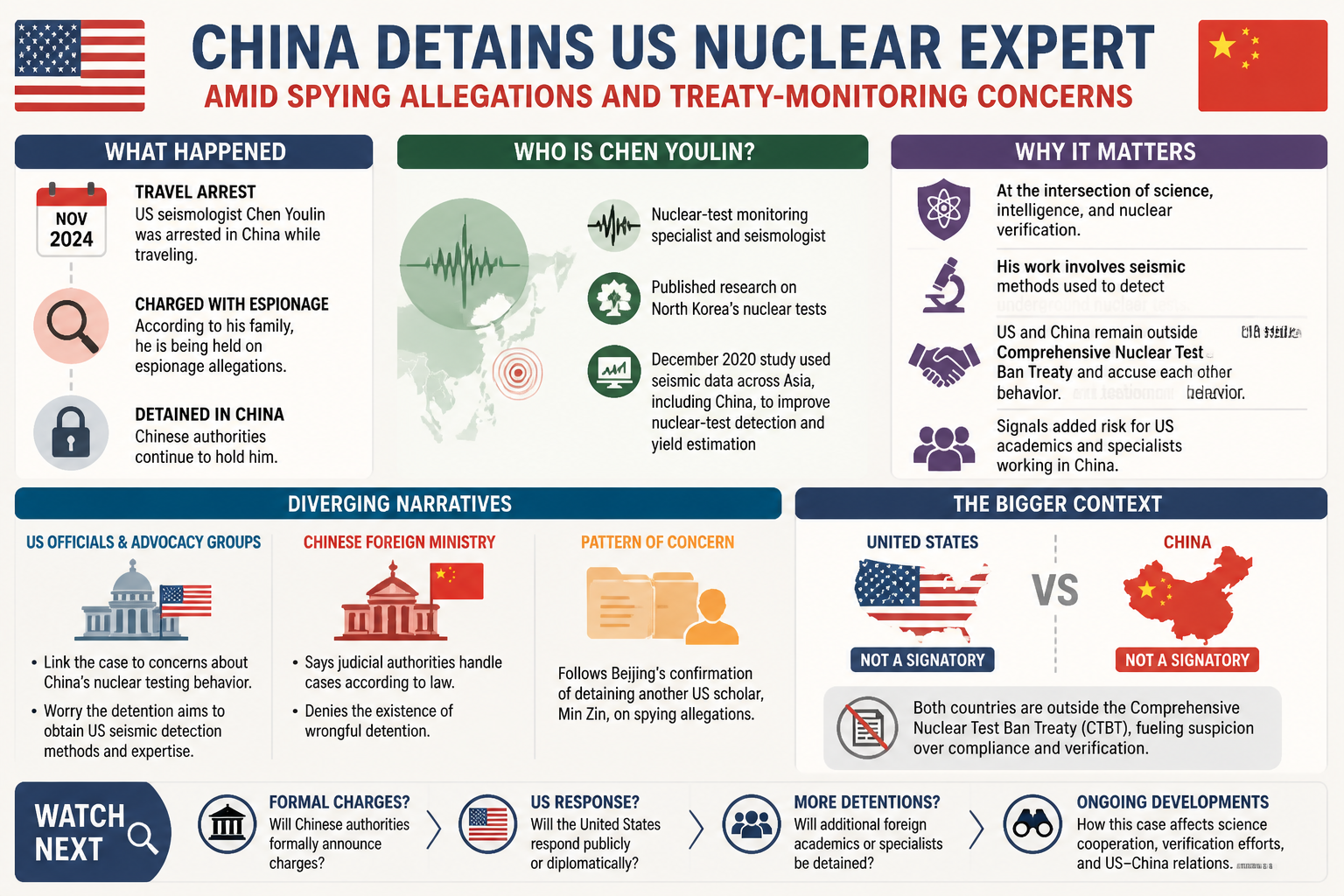
China has detained US seismologist Chen Youlin, who studied nuclear tests and had done work related to monitoring nuclear explosions, according to his family and hostage advocacy group Global Reach.[1] The case involves espionage allegations, a travel arrest in November 2024, and concerns that his research touched on nuclear-test detection methods relevant to North Korea and possibly broader nuclear monitoring.[1]
Why it matters: The detention raises tensions at the intersection of science, intelligence, and nuclear verification, especially because the expert’s work involved seismic detection methods used to identify underground nuclear tests.[1] It also signals added risk for US academics and specialists working in China, at a time when both countries remain outside the Comprehensive Nuclear Test Ban Treaty and accuse each other of covert testing-related behavior.[1]
Key insights: Chen’s published work focused on North Korea’s nuclear tests, and his December 2020 study used seismic data across Asia, including China, to improve nuclear-test monitoring and yield estimation.[1] | The Chinese foreign ministry said its judicial authorities handle cases according to law and denied the existence of wrongful detention.[1] | US officials and advocacy groups linked the case to concerns about China’s nuclear testing behavior and possible efforts to learn US seismic detection methods.[1] | The arrest comes after Beijing also confirmed the detention of another US scholar, Min Zin, on spying allegations.[1]
Cheatsheet facts: What changed: China has detained Chen Youlin, a US nuclear-test monitoring specialist, on espionage charges according to his family.[1] | Why now: The case sits amid heightened suspicion over nuclear testing, treaty compliance, and intelligence collection around scientific expertise.[1] | Watch next: Whether Chinese authorities formally announce charges, whether the US responds publicly, and whether any additional foreign academics are detained.[1]