China condemns UK nationalisation of British Steel, raising bilateral tensions
China’s commerce ministry said it “firmly opposes and is strongly dissatisfied” with the UK government’s decision to nationalise British Steel, arguing it infringed Jingye’s rights and hurt confidence in Chinese investment in the UK [7]. The UK said the move was needed to protect jobs and a “vital…
China’s commerce ministry said it “firmly opposes and is strongly dissatisfied” with the UK government’s decision to nationalise British Steel, arguing it infringed Jingye’s rights and hurt confidence in Chinese investment in the UK [7]. The UK said the move was needed to protect jobs and a “vital national capability,” after Parliament passed legislation enabling public ownership under a public interest test [7].
Why it matters: This is a direct state-to-state economic dispute with security overtones, because control of steel capacity is being framed as both an industrial-policy issue and a national-security issue [7]. It also has wider implications for foreign investment, supply-chain resilience, and how the incoming UK leadership manages relations with China [7].
Key insights: Beijing is treating the nationalisation as a treaty and investment-protection issue, not just a commercial dispute [7]. | The UK is explicitly justifying intervention on public-interest and national-security grounds, showing how strategic industry policy is tightening [7]. | British Steel’s scale matters because the plant employs around 2,700 people and supports thousands more in the supply chain [7]. | The case could become a test of how willing the UK is to balance Chinese investment against domestic industrial and security priorities [7].
Cheatsheet facts: What changed: The UK nationalised British Steel and China publicly condemned the move [7]. | Why now: Parliament enabled public ownership under a public-interest test, and the government says the plant’s future had become urgent [7]. | Watch next: Look for any formal Chinese diplomatic, legal, or investment-response language, and for UK statements on compensation or the plant’s long-term ownership model [7].
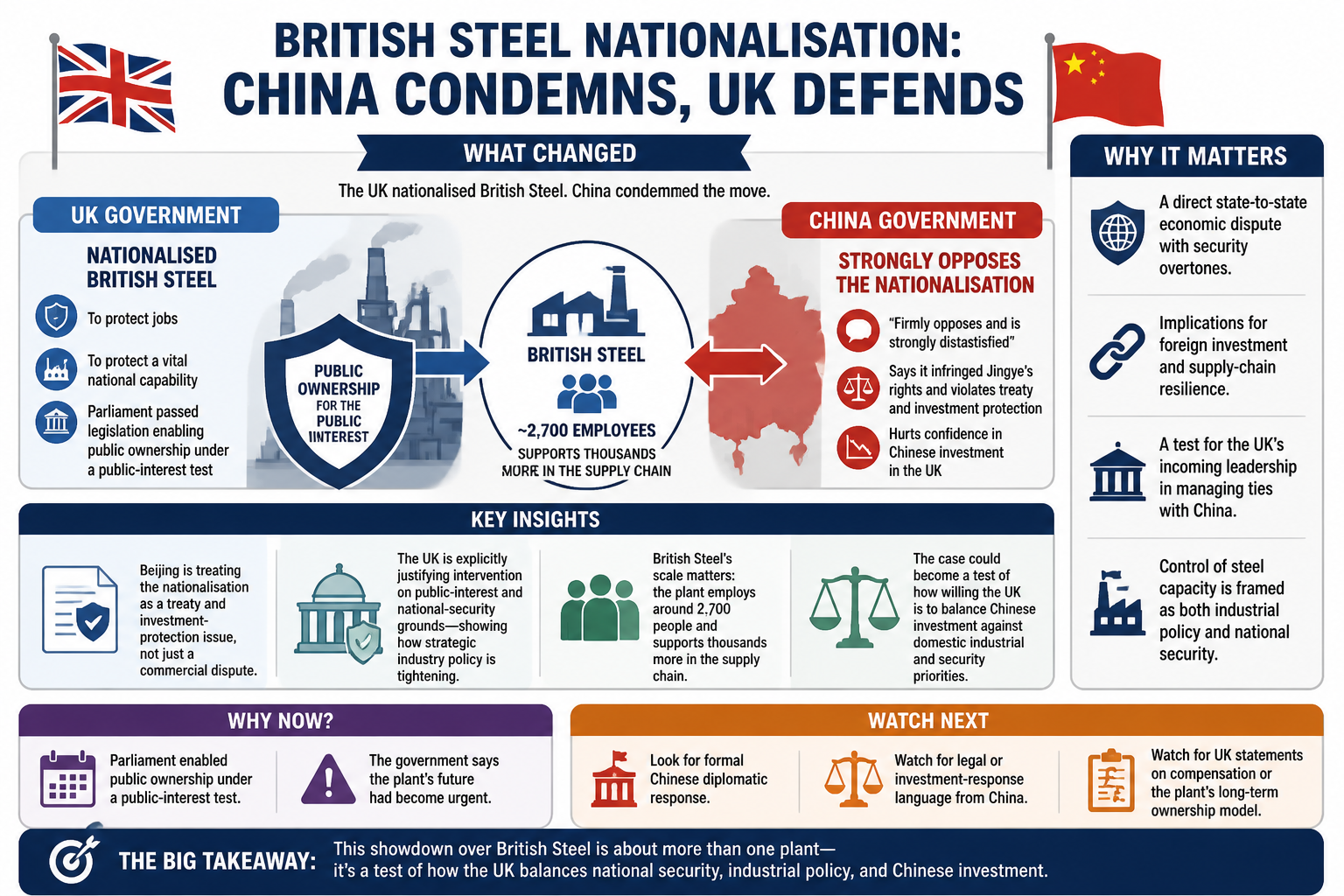
China’s commerce ministry said it “firmly opposes and is strongly dissatisfied” with the UK government’s decision to nationalise British Steel, arguing it infringed Jingye’s rights and hurt confidence in Chinese investment in the UK [7]. The UK said the move was needed to protect jobs and a “vital national capability,” after Parliament passed legislation enabling public ownership under a public interest test [7].
Why it matters: This is a direct state-to-state economic dispute with security overtones, because control of steel capacity is being framed as both an industrial-policy issue and a national-security issue [7]. It also has wider implications for foreign investment, supply-chain resilience, and how the incoming UK leadership manages relations with China [7].
Key insights: Beijing is treating the nationalisation as a treaty and investment-protection issue, not just a commercial dispute [7]. | The UK is explicitly justifying intervention on public-interest and national-security grounds, showing how strategic industry policy is tightening [7]. | British Steel’s scale matters because the plant employs around 2,700 people and supports thousands more in the supply chain [7]. | The case could become a test of how willing the UK is to balance Chinese investment against domestic industrial and security priorities [7].
Cheatsheet facts: What changed: The UK nationalised British Steel and China publicly condemned the move [7]. | Why now: Parliament enabled public ownership under a public-interest test, and the government says the plant’s future had become urgent [7]. | Watch next: Look for any formal Chinese diplomatic, legal, or investment-response language, and for UK statements on compensation or the plant’s long-term ownership model [7].