US-Iran retaliation puts Strait of Hormuz oil traffic at renewed risk
U.S. Central Command said American forces struck three Iranian oil carriers after the Islamic Revolutionary Guard Corps launched ballistic missiles at two U.S. Navy ships; Iran subsequently claimed attacks on six vessels, including three tankers using what it called an “unauthorised route” through…
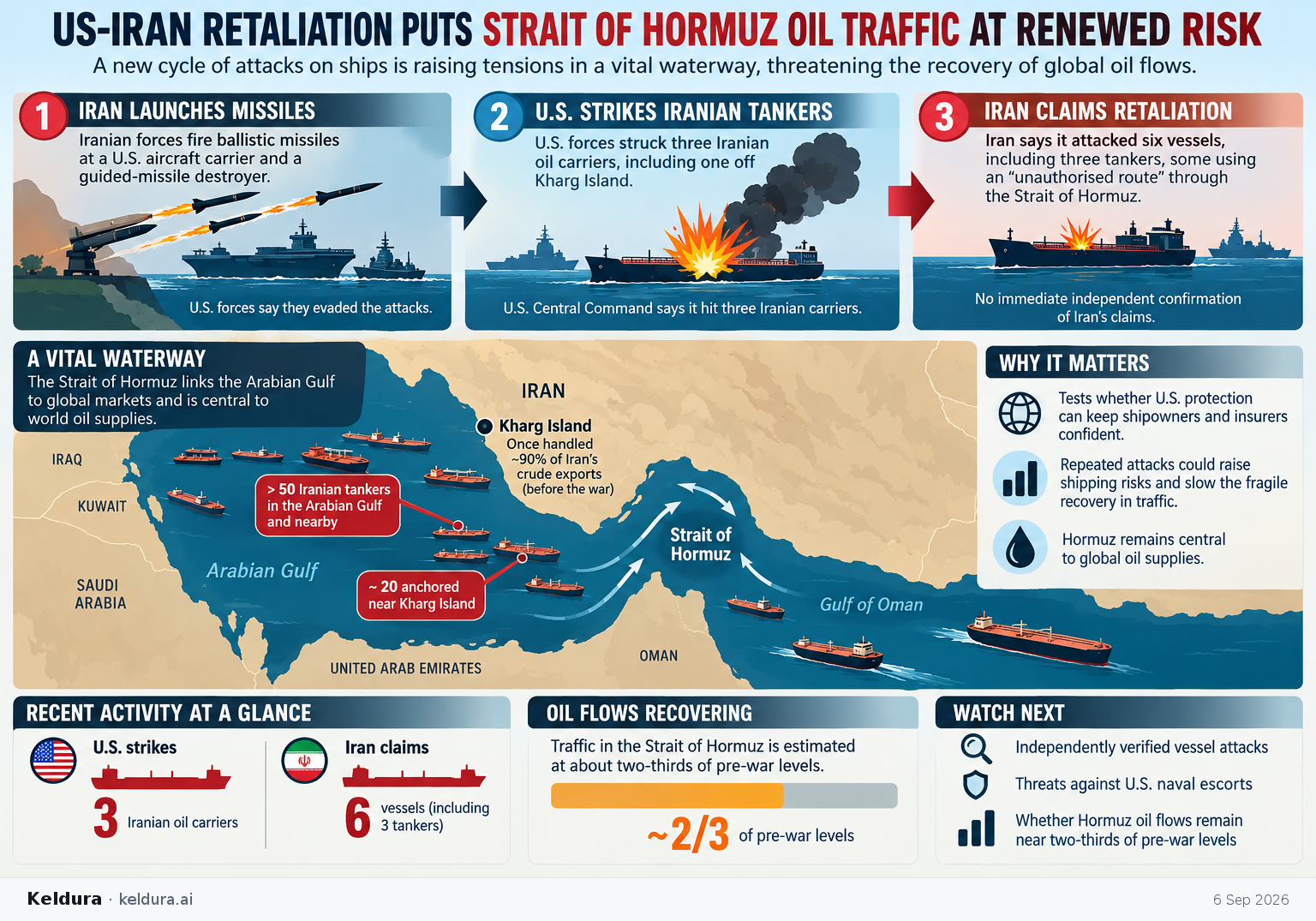
U.S. Central Command said American forces struck three Iranian oil carriers after the Islamic Revolutionary Guard Corps launched ballistic missiles at two U.S. Navy ships; Iran subsequently claimed attacks on six vessels, including three tankers using what it called an “unauthorised route” through the Strait of Hormuz.[1][3] There was no immediate independent confirmation of Iran’s claims, but the exchanges have opened a ship-for-ship phase of the confrontation as oil flows recover to an estimated two-thirds of pre-war levels.[1]
Why it matters: The confrontation is testing whether US protection can give shipowners and insurers enough confidence to keep using a waterway central to global oil supplies; repeated attacks could raise shipping risks and slow the fragile recovery in traffic even without a successful strike on a US warship.[1]
Key insights: The US strikes included an Iranian carrier off Kharg Island, near the hub that handled roughly 90 per cent of Iran’s crude exports before the war.[1][3] | US Defence Secretary Pete Hegseth warned that Washington would destroy Iranian tankers if Tehran continued firing on US Navy vessels, directly linking military escalation to Iran’s oil revenue.[1] | More than 50 Iranian tankers were reported in the Arabian Gulf and nearby Gulf of Oman, including nearly 20 anchored near Kharg Island.[1] | Iran’s warning against routes it has not approved shows that the contest concerns authority over passage through Hormuz, not only whether the strait is physically open.[1]
Cheatsheet facts: What changed: US forces struck three Iranian oil carriers, while Iran claimed retaliatory attacks on six vessels.[1][3] | Why now: The strikes followed Iranian ballistic-missile launches toward a US aircraft carrier and guided-missile destroyer, which U.S. Central Command said evaded the attacks.[1] | Watch next: Monitor independently verified vessel attacks, threats against US naval escorts and whether Hormuz oil flows remain near two-thirds of pre-war levels.[1]