How tanker-for-tanker retaliation creates an escalation trap
Iran said on Wednesday that it attacked 10 ships near the Strait of Hormuz after the United States sank five Iranian oil tankers.
The attacks were the largest wave against shipping by both sides in the six-month war, pushing Brent crude above $100 a barrel and leaving at least one seafarer dead and another missing.[4] The emerging cycle links Iranian attacks on naval and commercial targets to US strikes against oil-export ass…
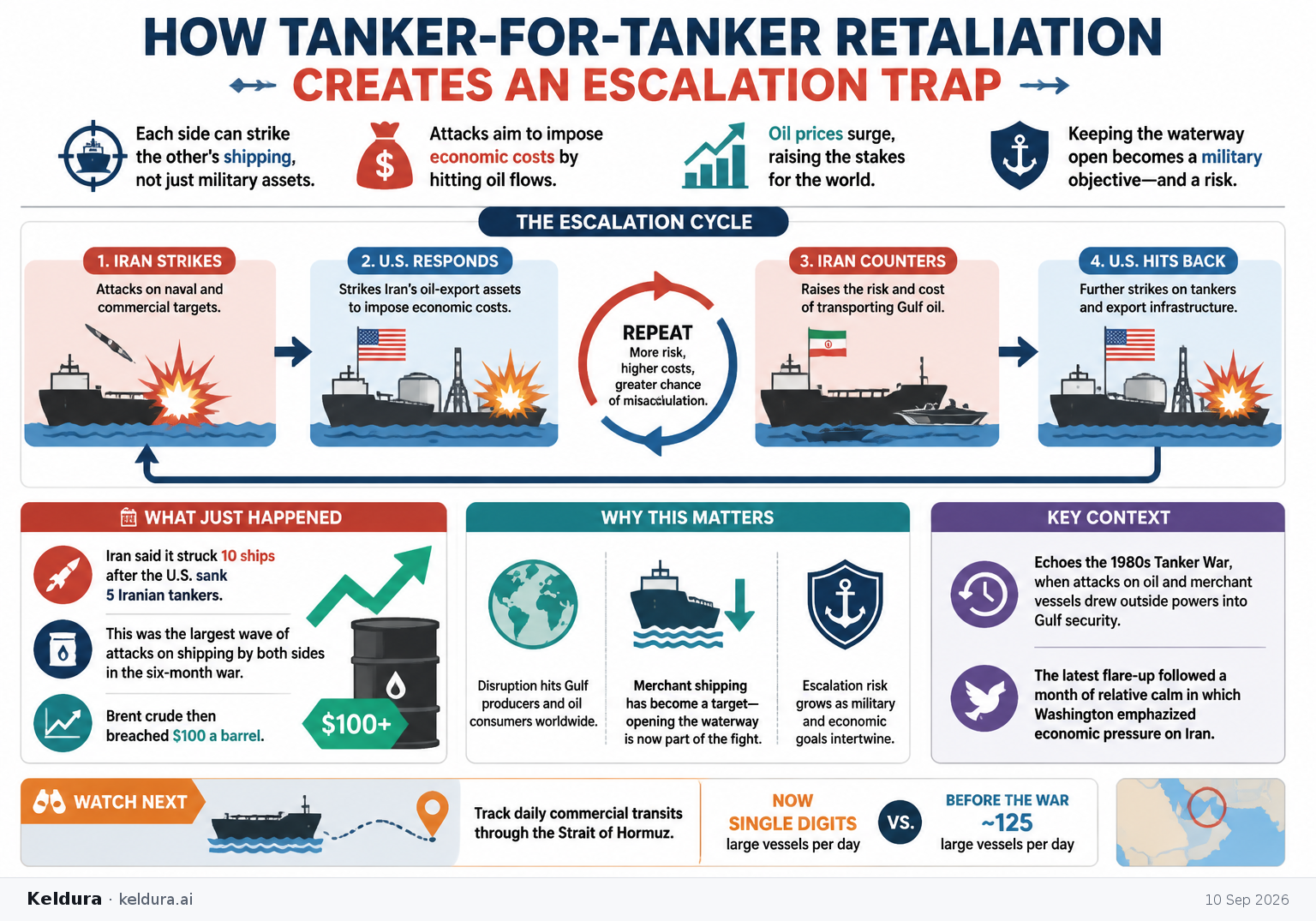
The attacks were the largest wave against shipping by both sides in the six-month war, pushing Brent crude above $100 a barrel and leaving at least one seafarer dead and another missing.[4] The emerging cycle links Iranian attacks on naval and commercial targets to US strikes against oil-export assets that help finance Iran’s war effort.[9]
Why it matters: Commercial traffic through the energy chokepoint has fallen to single digits per day, compared with roughly 125 large vessels before the war, raising the economic stakes for Gulf producers and oil consumers well beyond the combatants.[9] Once merchant shipping becomes a target, keeping the waterway open can itself become a military objective and another source of escalation.[9]
Key insights: The US response is designed to impose economic costs by striking tankers rather than only the military assets involved in an Iranian attack.[9] | Iran can answer by increasing the cost and risk of transporting Gulf oil, meaning each side possesses a different lever over the same shipping system.[9] | The pattern resembles the 1980s Tanker War, when attacks on oil and merchant vessels progressively drew outside powers into Gulf security.[9] | The latest flare-up followed a month of relative calm in which Washington had emphasized economic pressure on Iran.[4]
Cheatsheet facts: What changed: Iran said it struck 10 ships after the US sank five Iranian tankers; Brent crude then breached $100 a barrel.[4] | Why now: A tanker-for-tanker policy is connecting attacks on US forces with retaliation against Iran’s exposed oil-export capacity.[9] | Watch next: Track daily commercial transits through the Strait of Hormuz, which are already in single digits versus about 125 large vessels before the war.[9]
The attacks were the largest wave against shipping by both sides in the six-month war, pushing Brent crude above $100 a barrel and leaving at least one seafarer dead and another missing.[4] The emerging cycle links Iranian attacks on naval and commercial targets to US strikes against oil-export assets that help finance Iran’s war effort.[9]
Why it matters: Commercial traffic through the energy chokepoint has fallen to single digits per day, compared with roughly 125 large vessels before the war, raising the economic stakes for Gulf producers and oil consumers well beyond the combatants.[9] Once merchant shipping becomes a target, keeping the waterway open can itself become a military objective and another source of escalation.[9]
Key insights: The US response is designed to impose economic costs by striking tankers rather than only the military assets involved in an Iranian attack.[9] | Iran can answer by increasing the cost and risk of transporting Gulf oil, meaning each side possesses a different lever over the same shipping system.[9] | The pattern resembles the 1980s Tanker War, when attacks on oil and merchant vessels progressively drew outside powers into Gulf security.[9] | The latest flare-up followed a month of relative calm in which Washington had emphasized economic pressure on Iran.[4]
Cheatsheet facts: What changed: Iran said it struck 10 ships after the US sank five Iranian tankers; Brent crude then breached $100 a barrel.[4] | Why now: A tanker-for-tanker policy is connecting attacks on US forces with retaliation against Iran’s exposed oil-export capacity.[9] | Watch next: Track daily commercial transits through the Strait of Hormuz, which are already in single digits versus about 125 large vessels before the war.[9]