BepiColombo Clears a Key Step Toward Mercury Orbit
ESA confirmed that BepiColombo’s Mercury Transfer Module separated successfully after nearly eight years of travel through the inner Solar System, with telemetry indicating nominal systems and charging solar panels.[6] The spacecraft stack is scheduled to enter Mercury orbit on November 21, 2026, b…
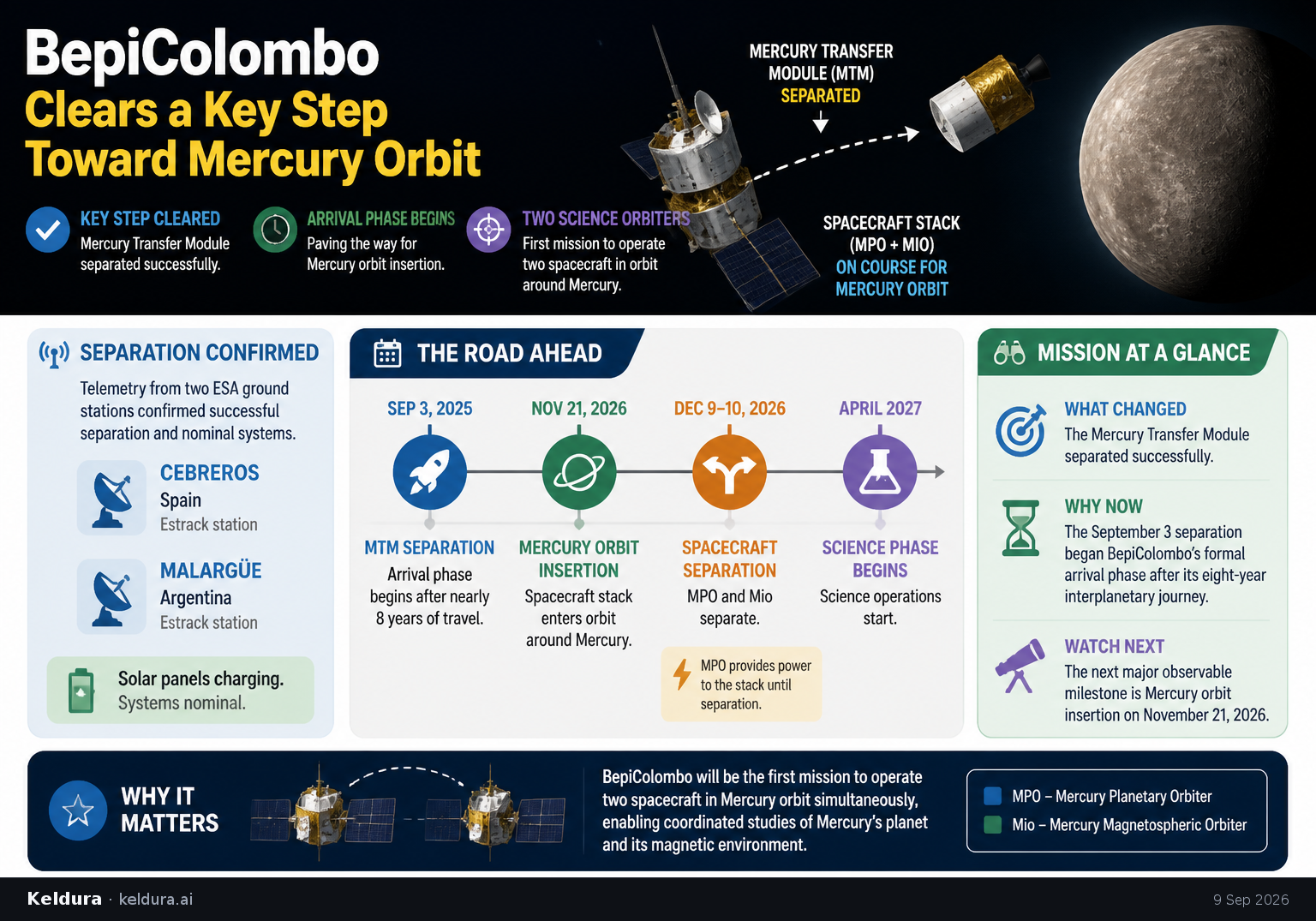
ESA confirmed that BepiColombo’s Mercury Transfer Module separated successfully after nearly eight years of travel through the inner Solar System, with telemetry indicating nominal systems and charging solar panels.[6] The spacecraft stack is scheduled to enter Mercury orbit on November 21, 2026, before ESA’s MPO and JAXA’s Mio separate on December 9–10.[6]
Why it matters: BepiColombo will be the first mission to operate two spacecraft in Mercury orbit simultaneously, enabling coordinated study by the Mercury Planetary Orbiter and Mercury Magnetospheric Orbiter.[6]
Key insights: Two Estrack antennas, in Cebreros, Spain, and Malargüe, Argentina, acquired the signal confirming transfer-module separation.[6] | MPO will power the spacecraft stack until Mio separates in December 2026.[6] | The mission’s science phase is scheduled to begin in April 2027.[6]
Cheatsheet facts: What changed: The Mercury Transfer Module separated successfully, leaving the two science orbiters headed toward orbit insertion.[6] | Why now: The September 3 separation began BepiColombo’s formal arrival phase after its eight-year interplanetary journey.[6] | Watch next: The next major observable milestone is Mercury orbit insertion scheduled for November 21, 2026.[6]
ESA confirmed that BepiColombo’s Mercury Transfer Module separated successfully after nearly eight years of travel through the inner Solar System, with telemetry indicating nominal systems and charging solar panels.[6] The spacecraft stack is scheduled to enter Mercury orbit on November 21, 2026, before ESA’s MPO and JAXA’s Mio separate on December 9–10.[6]
Why it matters: BepiColombo will be the first mission to operate two spacecraft in Mercury orbit simultaneously, enabling coordinated study by the Mercury Planetary Orbiter and Mercury Magnetospheric Orbiter.[6]
Key insights: Two Estrack antennas, in Cebreros, Spain, and Malargüe, Argentina, acquired the signal confirming transfer-module separation.[6] | MPO will power the spacecraft stack until Mio separates in December 2026.[6] | The mission’s science phase is scheduled to begin in April 2027.[6]
Cheatsheet facts: What changed: The Mercury Transfer Module separated successfully, leaving the two science orbiters headed toward orbit insertion.[6] | Why now: The September 3 separation began BepiColombo’s formal arrival phase after its eight-year interplanetary journey.[6] | Watch next: The next major observable milestone is Mercury orbit insertion scheduled for November 21, 2026.[6]