Hubble Spots a Decagon Around Saturn’s South Pole
Recent Hubble observations revealed a 10-sided cloud pattern around Saturn’s South Pole, contrasting with the long-known hexagon surrounding its North Pole.[7] The decagon is most prominent in dark inner regions of the cloud bands and may arise from interactions between faster- and slower-moving at…
Recent Hubble observations revealed a 10-sided cloud pattern around Saturn’s South Pole, contrasting with the long-known hexagon surrounding its North Pole.[7] The decagon is most prominent in dark inner regions of the cloud bands and may arise from interactions between faster- and slower-moving atmospheric gas.[7]
Why it matters: The northern hexagon has remained stable for more than 40 years, making continued observation of the southern decagon useful for determining whether it is similarly persistent and for testing explanations of Saturn’s geometric atmospheric patterns.[7]
Key insights: Saturn’s northern hexagon was discovered in Voyager data in 1987.[7] | The southern feature appears in a Hubble composite made from observations taken in 2025.[7] | Wave activity produced where gas streams with different speeds interact is one possible explanation for the geometric boundaries.[7]
Cheatsheet facts: What changed: Hubble imagery disclosed a decagonal cloud structure around Saturn’s South Pole.[7] | Why now: Recent observations provided a clear view of the pattern, particularly within the darker inner cloud regions.[7] | Watch next: Continued observations can establish whether the southern decagon remains stable over time.[7]
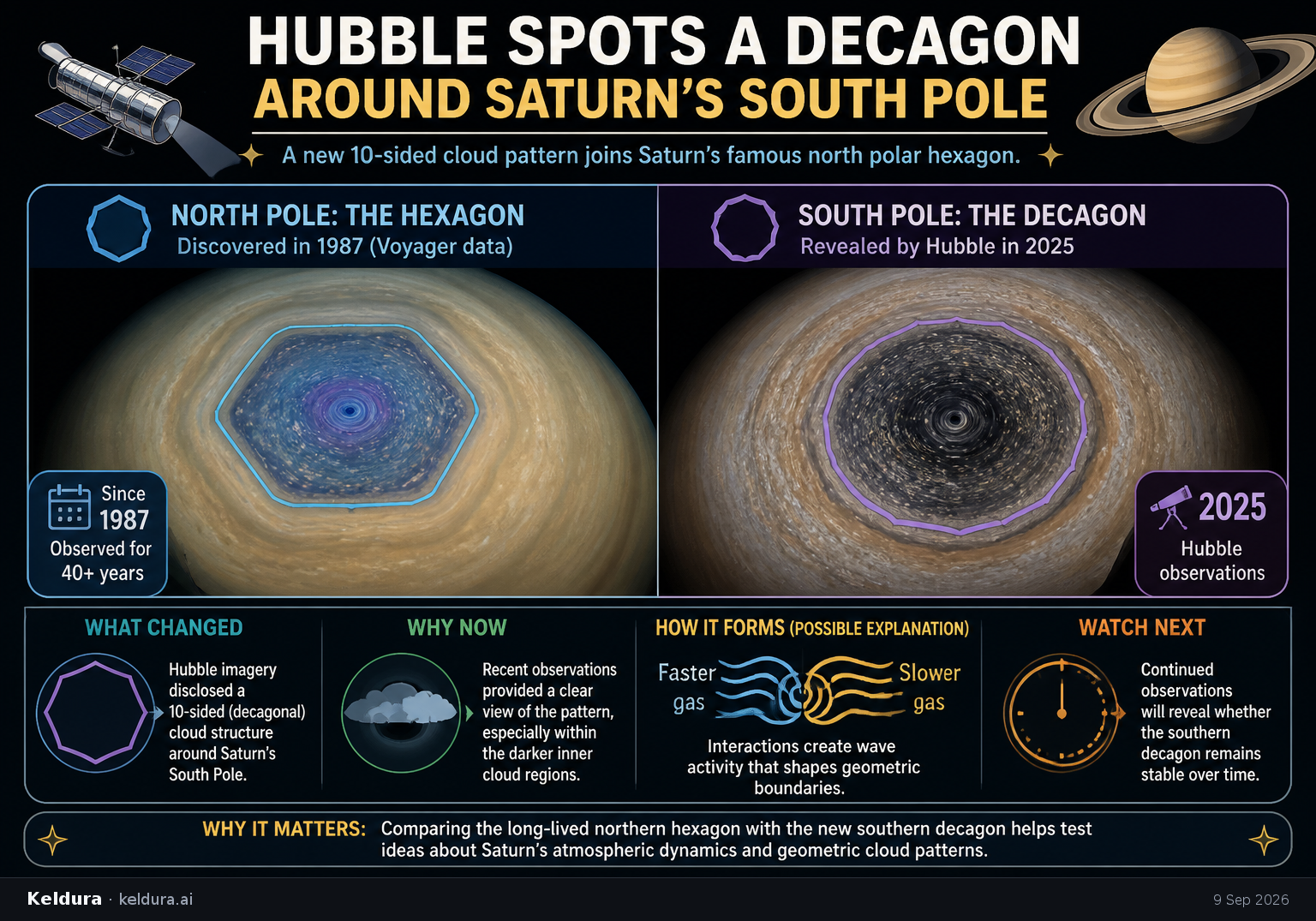
Recent Hubble observations revealed a 10-sided cloud pattern around Saturn’s South Pole, contrasting with the long-known hexagon surrounding its North Pole.[7] The decagon is most prominent in dark inner regions of the cloud bands and may arise from interactions between faster- and slower-moving atmospheric gas.[7]
Why it matters: The northern hexagon has remained stable for more than 40 years, making continued observation of the southern decagon useful for determining whether it is similarly persistent and for testing explanations of Saturn’s geometric atmospheric patterns.[7]
Key insights: Saturn’s northern hexagon was discovered in Voyager data in 1987.[7] | The southern feature appears in a Hubble composite made from observations taken in 2025.[7] | Wave activity produced where gas streams with different speeds interact is one possible explanation for the geometric boundaries.[7]
Cheatsheet facts: What changed: Hubble imagery disclosed a decagonal cloud structure around Saturn’s South Pole.[7] | Why now: Recent observations provided a clear view of the pattern, particularly within the darker inner cloud regions.[7] | Watch next: Continued observations can establish whether the southern decagon remains stable over time.[7]