Hotter Theia Could Have Produced the Moon Within Hours
New collision simulations indicate that the Moon could have formed within roughly five hours after a giant impact between the young Earth and the Mars-size protoplanet Theia.[1] The models incorporate the colliding bodies’ internal temperatures and material strengths, factors that influence deforma…
New collision simulations indicate that the Moon could have formed within roughly five hours after a giant impact between the young Earth and the Mars-size protoplanet Theia.[1] The models incorporate the colliding bodies’ internal temperatures and material strengths, factors that influence deformation, momentum absorption and the distribution of lunar-forming debris.[1]
Why it matters: The results potentially strengthen the rapid-formation version of the leading giant-impact hypothesis and show that the thermal state of young worlds can substantially change simulated planetary collisions.[1]
Key insights: A warmer, weaker Theia striking less than 60 million years after planet formation could be obliterated while producing conditions for rapid Moon formation.[1] | A colder, stronger Theia colliding roughly 100–150 million years after planet formation would leave more material intact and favor gradual lunar accretion from a debris ring.[1] | The temperature of Theia’s outer few hundred miles affected how it deformed and absorbed impact momentum, altering how debris spread around Earth.[1]
Cheatsheet facts: What changed: Detailed simulations that include temperature-dependent material strength lend support to a Moon forming in hours rather than through prolonged accretion.[1] | Why now: Earlier models did not fully capture how the residual heat of recently formed protoplanets changed their mechanical behavior during the impact.[1] | Watch next: Further model results can be assessed by whether warmer, weaker impactors continue to produce rapid formation while colder, stronger impactors yield gradual accretion.[1]
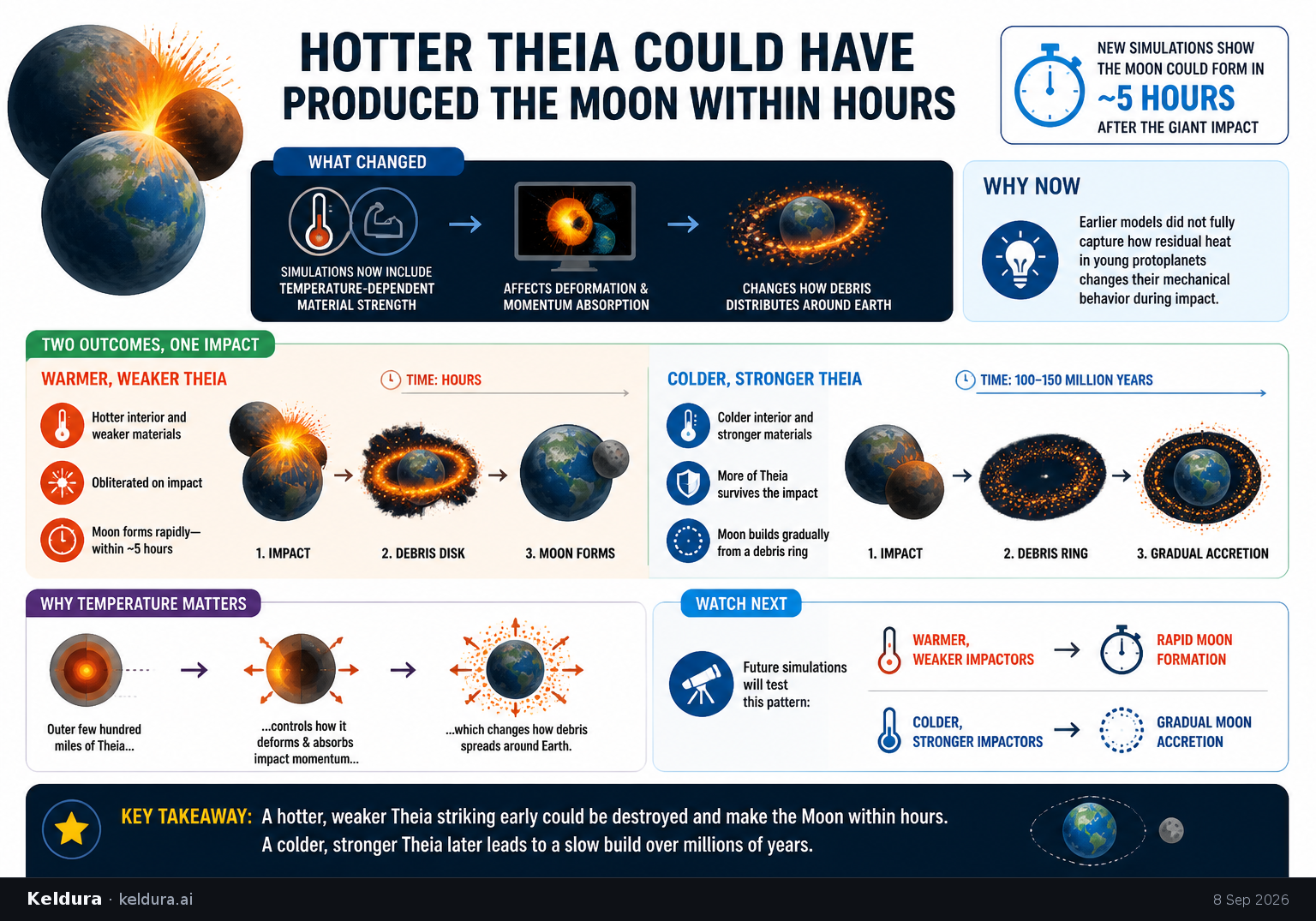
New collision simulations indicate that the Moon could have formed within roughly five hours after a giant impact between the young Earth and the Mars-size protoplanet Theia.[1] The models incorporate the colliding bodies’ internal temperatures and material strengths, factors that influence deformation, momentum absorption and the distribution of lunar-forming debris.[1]
Why it matters: The results potentially strengthen the rapid-formation version of the leading giant-impact hypothesis and show that the thermal state of young worlds can substantially change simulated planetary collisions.[1]
Key insights: A warmer, weaker Theia striking less than 60 million years after planet formation could be obliterated while producing conditions for rapid Moon formation.[1] | A colder, stronger Theia colliding roughly 100–150 million years after planet formation would leave more material intact and favor gradual lunar accretion from a debris ring.[1] | The temperature of Theia’s outer few hundred miles affected how it deformed and absorbed impact momentum, altering how debris spread around Earth.[1]
Cheatsheet facts: What changed: Detailed simulations that include temperature-dependent material strength lend support to a Moon forming in hours rather than through prolonged accretion.[1] | Why now: Earlier models did not fully capture how the residual heat of recently formed protoplanets changed their mechanical behavior during the impact.[1] | Watch next: Further model results can be assessed by whether warmer, weaker impactors continue to produce rapid formation while colder, stronger impactors yield gradual accretion.[1]