Meteorite Minerals Preserve Evidence of a Powerful Early Solar Magnetic Field
Researchers found a definitive paleomagnetic signal in calcium-aluminium-rich inclusions from the Dominion Range 08006 carbonaceous chondrite, offering a view of the terrestrial planet-forming region during the solar system’s first 500,000 years.[4] Nanometre-scale iron-nickel grains recorded estim…
Researchers found a definitive paleomagnetic signal in calcium-aluminium-rich inclusions from the Dominion Range 08006 carbonaceous chondrite, offering a view of the terrestrial planet-forming region during the solar system’s first 500,000 years.[4] Nanometre-scale iron-nickel grains recorded estimated fields of 150–600 µT, compared with approximately 30–60 µT at Earth today.[4]
Why it matters: The measurements suggest magnetic fields cannot be omitted from realistic planet-formation simulations and may have been a dominant influence on the evolution of the protoplanetary disc.[4]
Key insights: Calcium-aluminium-rich inclusions are the oldest known solar system solids and formed before Earth existed.[4] | The team used anhysteric remanent magnetization because heating meteorites above iron-nickel’s roughly 1050 K Curie temperature can rapidly oxidize samples and compromise calibration.[4] | The evidence comes from five inclusions in one meteorite, making replication across other chondrites essential.[4]
Cheatsheet facts: What changed: A carbonaceous chondrite yielded the first definitive paleomagnetic signal of its kind and field estimates multiple times higher than previous estimates.[4] | Why now: Researchers identified magnetic iron-nickel grains in ancient inclusions and applied a method that avoided damaging laboratory heating.[4] | Watch next: The team is examining other carbonaceous and non-carbonaceous chondrites to test whether the signal is reproducible and reflects the wider solar nebula rather than a localized record.[4]
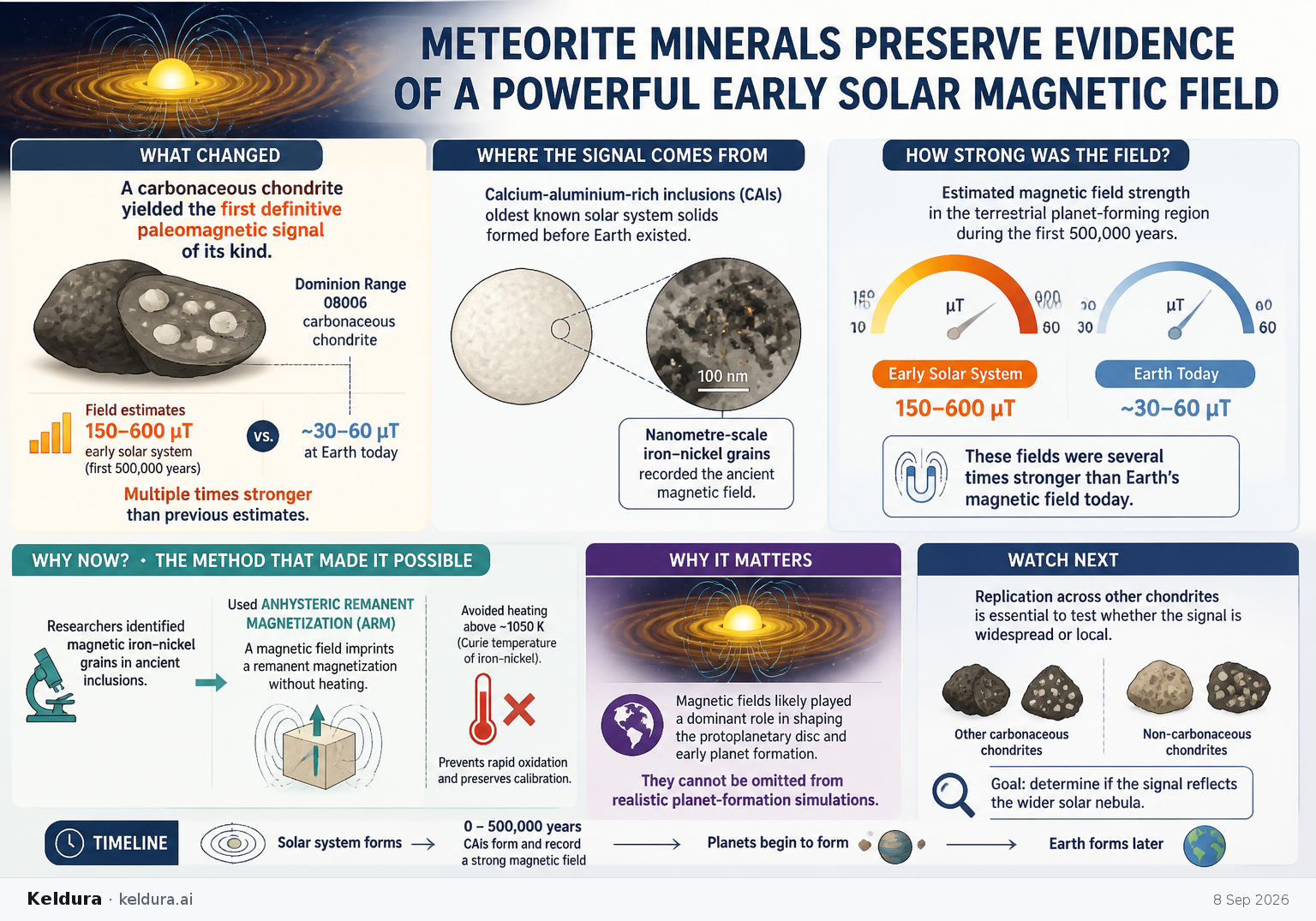
Researchers found a definitive paleomagnetic signal in calcium-aluminium-rich inclusions from the Dominion Range 08006 carbonaceous chondrite, offering a view of the terrestrial planet-forming region during the solar system’s first 500,000 years.[4] Nanometre-scale iron-nickel grains recorded estimated fields of 150–600 µT, compared with approximately 30–60 µT at Earth today.[4]
Why it matters: The measurements suggest magnetic fields cannot be omitted from realistic planet-formation simulations and may have been a dominant influence on the evolution of the protoplanetary disc.[4]
Key insights: Calcium-aluminium-rich inclusions are the oldest known solar system solids and formed before Earth existed.[4] | The team used anhysteric remanent magnetization because heating meteorites above iron-nickel’s roughly 1050 K Curie temperature can rapidly oxidize samples and compromise calibration.[4] | The evidence comes from five inclusions in one meteorite, making replication across other chondrites essential.[4]
Cheatsheet facts: What changed: A carbonaceous chondrite yielded the first definitive paleomagnetic signal of its kind and field estimates multiple times higher than previous estimates.[4] | Why now: Researchers identified magnetic iron-nickel grains in ancient inclusions and applied a method that avoided damaging laboratory heating.[4] | Watch next: The team is examining other carbonaceous and non-carbonaceous chondrites to test whether the signal is reproducible and reflects the wider solar nebula rather than a localized record.[4]