Axionlike Particles May Explain an Impossible Cosmic Photon
Physicists have proposed that hypothetical axionlike particles could explain how a roughly 300-tera-electron-volt photon from the 2022 “BOAT” gamma-ray burst survived a two-billion-light-year journey to Earth.[3] Standard physics indicates that such a photon should have collided with background lig…
Physicists have proposed that hypothetical axionlike particles could explain how a roughly 300-tera-electron-volt photon from the 2022 “BOAT” gamma-ray burst survived a two-billion-light-year journey to Earth.[3] Standard physics indicates that such a photon should have collided with background light and been destroyed, but the new model would allow exceptionally energetic particles to avoid that absorption.[3]
Why it matters: If future observations support the scenario, cosmic events could provide tests of quantum-gravity-related physics at energies far beyond those available in terrestrial accelerators.[3]
Key insights: Russia’s Carpet detector recorded the photon, which was the most energetic photon observed from a gamma-ray burst.[3] | The proposed mechanism combines axionlike particles with unusual behavior arising at the photon’s extreme energy.[3] | The theory predicts an arrival delay of about one hour, consistent with a Chinese observatory detecting less energetic photons roughly an hour earlier.[3]
Cheatsheet facts: What changed: A new Physical Review Letters paper offers a mechanism for the anomalous photon’s survival and delayed arrival.[3] | Why now: The model links two previously separate ideas and matches the reported timing difference between lower- and higher-energy detections.[3] | Watch next: Watch for future high-energy gamma-ray observations that reproduce the predicted energy-dependent delay.[3]
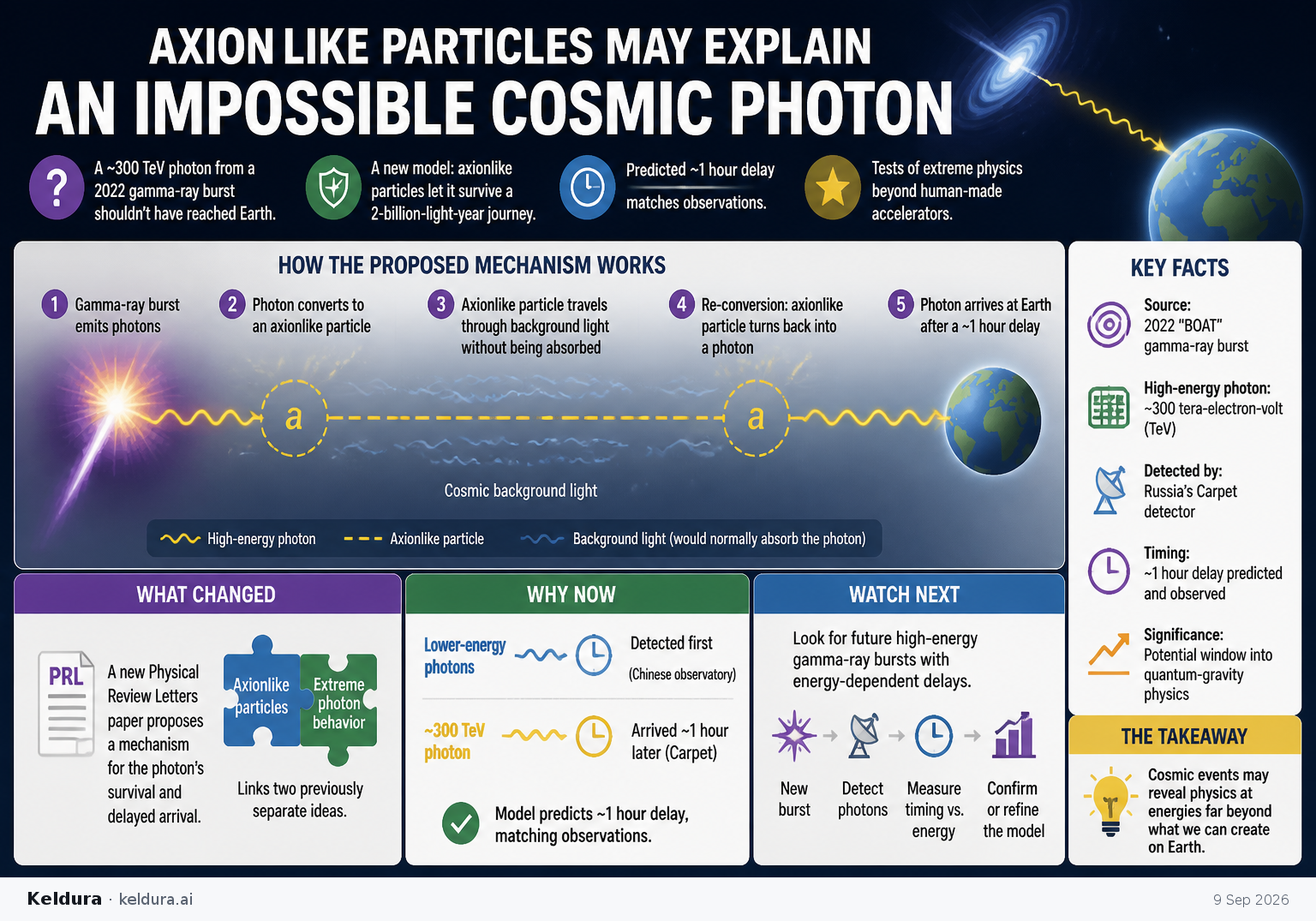
Physicists have proposed that hypothetical axionlike particles could explain how a roughly 300-tera-electron-volt photon from the 2022 “BOAT” gamma-ray burst survived a two-billion-light-year journey to Earth.[3] Standard physics indicates that such a photon should have collided with background light and been destroyed, but the new model would allow exceptionally energetic particles to avoid that absorption.[3]
Why it matters: If future observations support the scenario, cosmic events could provide tests of quantum-gravity-related physics at energies far beyond those available in terrestrial accelerators.[3]
Key insights: Russia’s Carpet detector recorded the photon, which was the most energetic photon observed from a gamma-ray burst.[3] | The proposed mechanism combines axionlike particles with unusual behavior arising at the photon’s extreme energy.[3] | The theory predicts an arrival delay of about one hour, consistent with a Chinese observatory detecting less energetic photons roughly an hour earlier.[3]
Cheatsheet facts: What changed: A new Physical Review Letters paper offers a mechanism for the anomalous photon’s survival and delayed arrival.[3] | Why now: The model links two previously separate ideas and matches the reported timing difference between lower- and higher-energy detections.[3] | Watch next: Watch for future high-energy gamma-ray observations that reproduce the predicted energy-dependent delay.[3]