Quantum Free Fall Passes a New Test of Einstein’s Gravity
An international team measured a predicted quantum phase associated with freely falling atoms for the first time, and the result matched the value expected from Einstein’s equivalence principle.[2] The experiment shows that the principle remains consistent with quantum mechanics at the low masses a…
An international team measured a predicted quantum phase associated with freely falling atoms for the first time, and the result matched the value expected from Einstein’s equivalence principle.[2] The experiment shows that the principle remains consistent with quantum mechanics at the low masses and energies tested, but it neither produces a unified theory nor establishes that gravity itself is quantum.[2]
Why it matters: The work turns a previously equation-bound effect into a measurable laboratory signal, creating a new experimental route for probing the boundary between quantum mechanics and gravity.[2]
Key insights: The measurement came from an interference signal produced after two atomic paths were recombined.[2] | The study was led by researchers at Ben-Gurion University of the Negev, the University of Ulm and the University of Oxford and was published in Science Advances on September 2, 2026.[2] | The result supports the equivalence principle only under the experiment’s tested low-mass and low-energy conditions.[2]
Cheatsheet facts: What changed: Scientists directly measured a tiny quantum phase caused by free fall and found agreement with theory.[2] | Why now: The team developed an experimental setup capable of extracting the phase difference from atomic interference.[2] | Watch next: Look for experiments using larger quantum objects and more demanding conditions.[2]
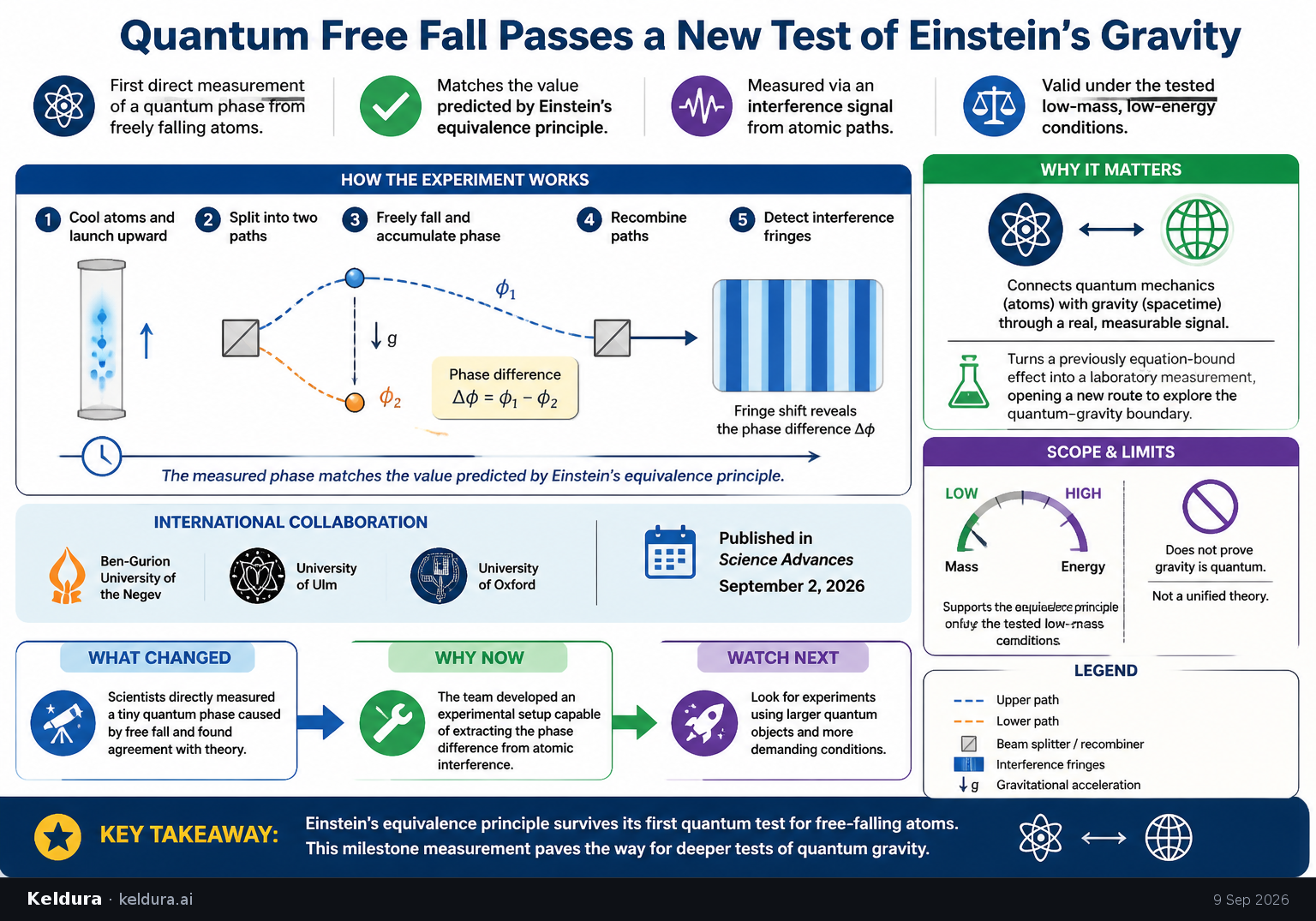
An international team measured a predicted quantum phase associated with freely falling atoms for the first time, and the result matched the value expected from Einstein’s equivalence principle.[2] The experiment shows that the principle remains consistent with quantum mechanics at the low masses and energies tested, but it neither produces a unified theory nor establishes that gravity itself is quantum.[2]
Why it matters: The work turns a previously equation-bound effect into a measurable laboratory signal, creating a new experimental route for probing the boundary between quantum mechanics and gravity.[2]
Key insights: The measurement came from an interference signal produced after two atomic paths were recombined.[2] | The study was led by researchers at Ben-Gurion University of the Negev, the University of Ulm and the University of Oxford and was published in Science Advances on September 2, 2026.[2] | The result supports the equivalence principle only under the experiment’s tested low-mass and low-energy conditions.[2]
Cheatsheet facts: What changed: Scientists directly measured a tiny quantum phase caused by free fall and found agreement with theory.[2] | Why now: The team developed an experimental setup capable of extracting the phase difference from atomic interference.[2] | Watch next: Look for experiments using larger quantum objects and more demanding conditions.[2]