How India found BRICS language that Iran and Gulf states could accept
The BRICS members and Saudi Arabia agreed on language urging restraint and avoidance of actions that could further aggravate the conflict.
The BRICS members and Saudi Arabia agreed on language urging restraint and avoidance of actions that could further aggravate the conflict, while expressing concern about attacks on civilian infrastructure and nuclear facilities.[4] Iran and the United Arab Emirates backed the declaration, and Irani…
The BRICS members and Saudi Arabia agreed on language urging restraint and avoidance of actions that could further aggravate the conflict, while expressing concern about attacks on civilian infrastructure and nuclear facilities.[4] Iran and the United Arab Emirates backed the declaration, and Iranian President Masoud Pezeshkian met the Crown Prince of Abu Dhabi in their countries’ highest-level encounter since the conflict began.[7]
Why it matters: The agreement demonstrates that BRICS can keep adversarial states at the same negotiating table, but experts cautioned that common language alone was unlikely to alter the war’s trajectory.[7] It also tests whether a bloc seeking greater influence over international institutions can translate internal consensus into concrete diplomatic action.[7]
Key insights: The declaration avoided naming responsible countries, enabling governments on opposing sides of the Persian Gulf conflict to endorse it.[4] | Negotiations continued into the early hours and had to reconcile the positions of Iran, Saudi Arabia and the United Arab Emirates.[4] | The Iran-UAE bilateral meeting covered de-escalation, stability and regional peace, but the official account identified no resolution.[7] | The declaration connected civilian protection and state sovereignty with global trade, energy flows, supply chains and maritime security.[7]
Cheatsheet facts: What changed: Iran, the UAE and other BRICS participants accepted a joint call for maximum restraint, while the Iranian and Abu Dhabi leaders held a high-level bilateral meeting.[4][7] | Why now: Host India sought consensus as U.S.-Iran strikes continued and divisions between Iran and the UAE threatened to expose the bloc’s diplomatic limits.[7] | Watch next: Watch for any concrete ceasefire or maritime-security initiative following the declaration, particularly after Modi urged BRICS to turn consensus into results and Xi offered China a peacemaking role.[7]
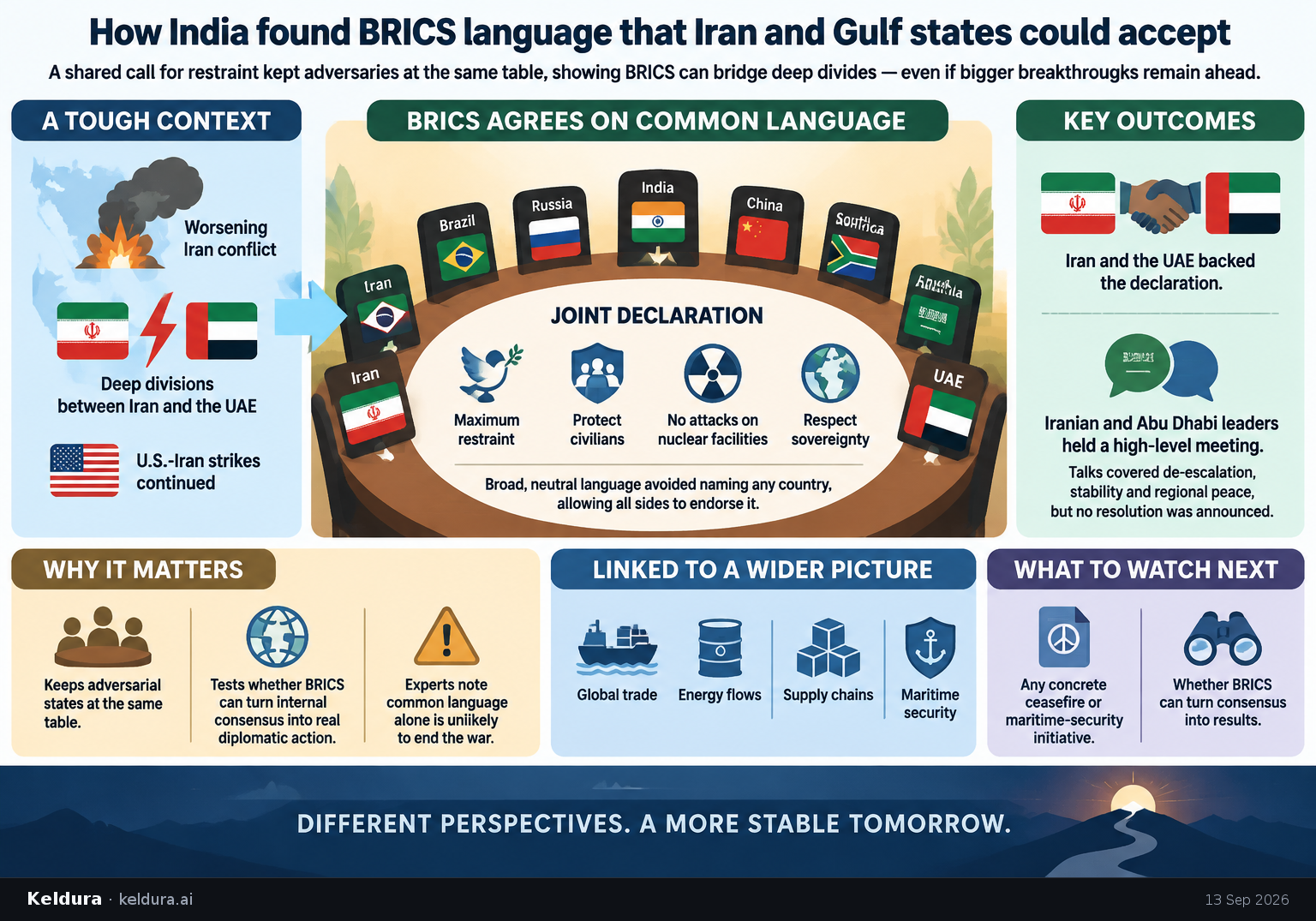
The BRICS members and Saudi Arabia agreed on language urging restraint and avoidance of actions that could further aggravate the conflict, while expressing concern about attacks on civilian infrastructure and nuclear facilities.[4] Iran and the United Arab Emirates backed the declaration, and Iranian President Masoud Pezeshkian met the Crown Prince of Abu Dhabi in their countries’ highest-level encounter since the conflict began.[7]
Why it matters: The agreement demonstrates that BRICS can keep adversarial states at the same negotiating table, but experts cautioned that common language alone was unlikely to alter the war’s trajectory.[7] It also tests whether a bloc seeking greater influence over international institutions can translate internal consensus into concrete diplomatic action.[7]
Key insights: The declaration avoided naming responsible countries, enabling governments on opposing sides of the Persian Gulf conflict to endorse it.[4] | Negotiations continued into the early hours and had to reconcile the positions of Iran, Saudi Arabia and the United Arab Emirates.[4] | The Iran-UAE bilateral meeting covered de-escalation, stability and regional peace, but the official account identified no resolution.[7] | The declaration connected civilian protection and state sovereignty with global trade, energy flows, supply chains and maritime security.[7]
Cheatsheet facts: What changed: Iran, the UAE and other BRICS participants accepted a joint call for maximum restraint, while the Iranian and Abu Dhabi leaders held a high-level bilateral meeting.[4][7] | Why now: Host India sought consensus as U.S.-Iran strikes continued and divisions between Iran and the UAE threatened to expose the bloc’s diplomatic limits.[7] | Watch next: Watch for any concrete ceasefire or maritime-security initiative following the declaration, particularly after Modi urged BRICS to turn consensus into results and Xi offered China a peacemaking role.[7]