Ethiopia invokes self-defense over alleged Eritrean troop incursions
Ethiopia says Eritrean troops occupy its territory, but what action does its self-defense declaration authorize in practice?
On October 9, Ethiopia’s Foreign Minister Gedion Timothewos told the U.N. Security Council that Ethiopia was taking measures in self-defense against Eritrea.
In a letter obtained by AP, Ethiopia accused Eritrea of sending infantry and mechanized units across the border and occupying parts of northern Ethiopia. [3] Foreign Minister Gedion Timothewos invoked Article 51 of the U.N. Charter, but did not identify the occupied areas, provide supporting eviden…
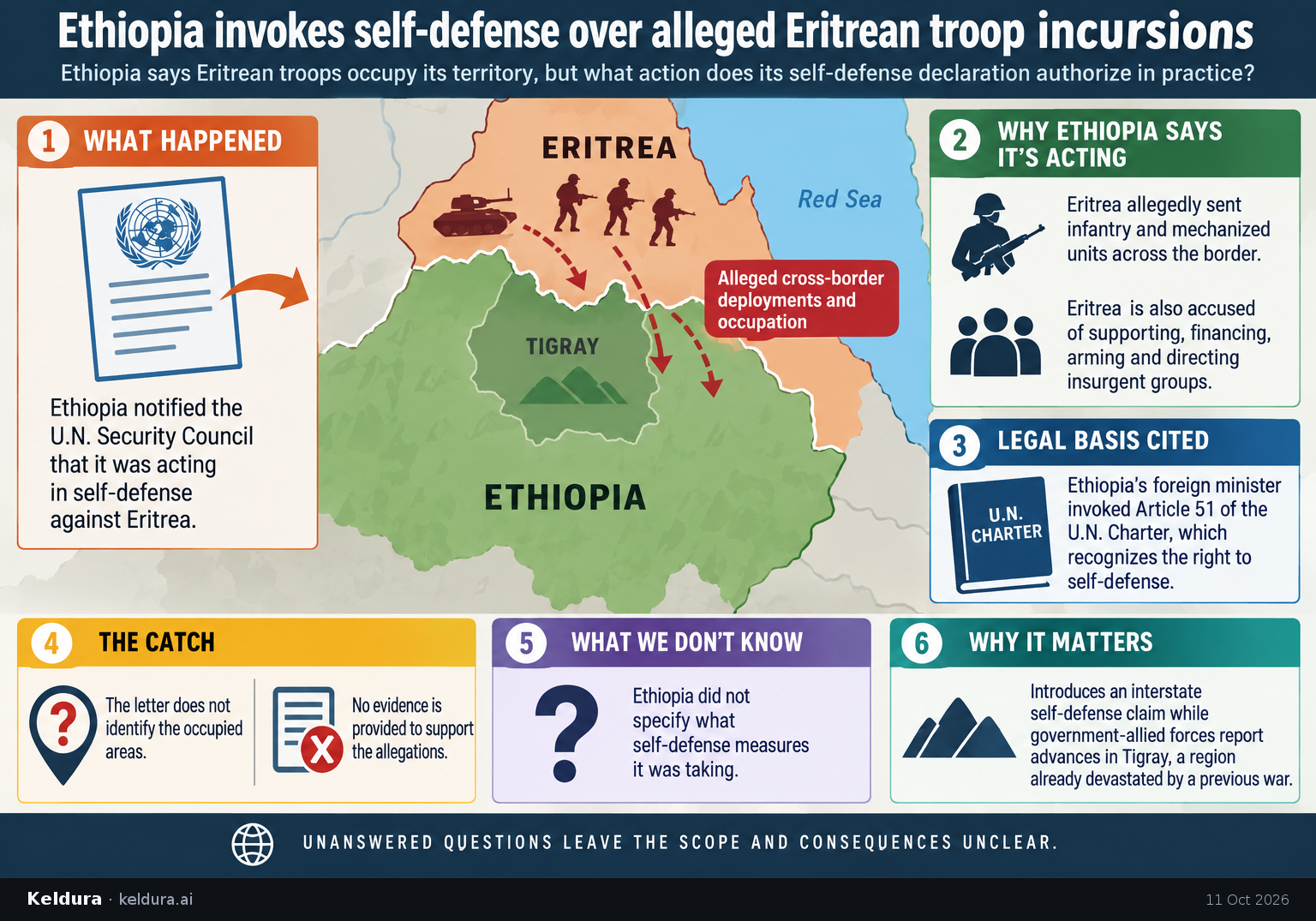
In a letter obtained by AP, Ethiopia accused Eritrea of sending infantry and mechanized units across the border and occupying parts of northern Ethiopia. [3] Foreign Minister Gedion Timothewos invoked Article 51 of the U.N. Charter, but did not identify the occupied areas, provide supporting evidence or specify Ethiopia’s measures. [3]
Why it matters: The declaration introduces an interstate self-defense claim while government-allied forces report advances in Tigray, a region already devastated by a previous war. [3]
Key insights: The letter presents Ethiopia’s actions as a response to foreign military involvement, not only an internal insurgency. [3] | Ethiopia also accuses Eritrea of supporting, financing, arming and directing insurgent groups. [3] | The missing locations and unspecified measures prevent readers from judging the geographic scope or practical consequences of the declaration. [3]
Cheatsheet facts: What happened: Ethiopia notified the Security Council that it was acting in self-defense against Eritrea. [3] | Why: Its foreign minister alleges cross-border deployments, occupation and Eritrean support for insurgents. [3] | The catch: The letter does not identify occupied areas or provide evidence supporting the allegations. [3] | What we don't know: Ethiopia did not specify what self-defense measures it was taking. [3]