Russian laboratory worker’s death prompts extensive pathogen testing
A laboratory worker’s fatal pneumonia triggered extensive testing, but what caused the illness?
On October 10, WHO detailed the investigation into an Irkutsk Antiplague Research Institute employee who died on October 2 after hospitalization for severe pneumonia.
A laboratory worker in Irkutsk died after hospitalization for severe pneumonia, prompting WHO to seek verification of media reports suggesting pneumonic plague and occupational exposure. [3] Russian authorities reported more than 5,500 laboratory tests without detecting high-consequence or dangerou…
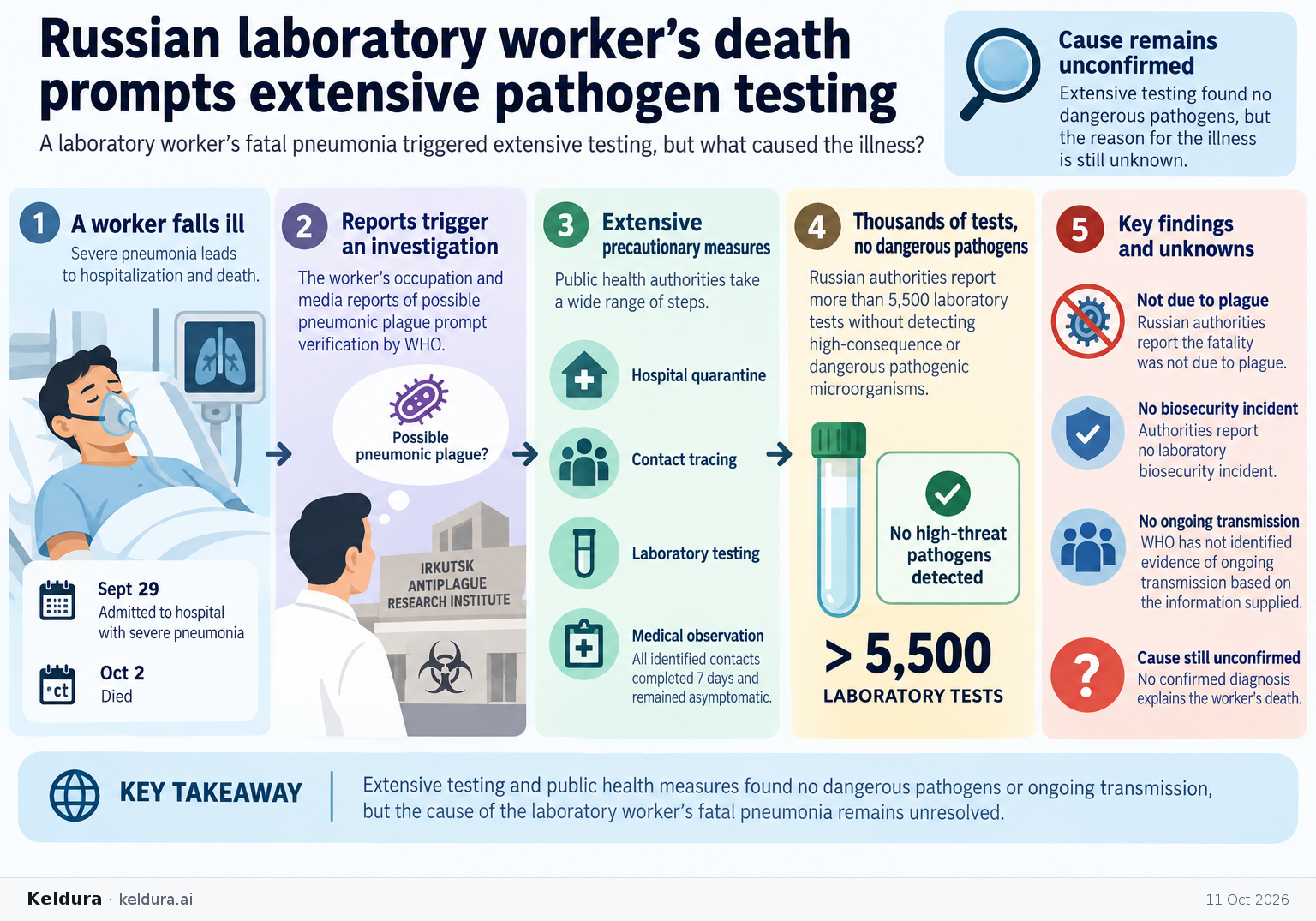
A laboratory worker in Irkutsk died after hospitalization for severe pneumonia, prompting WHO to seek verification of media reports suggesting pneumonic plague and occupational exposure. [3] Russian authorities reported more than 5,500 laboratory tests without detecting high-consequence or dangerous pathogenic microorganisms, but the deceased worker’s diagnosis remained unconfirmed. [1][3]
Why it matters: The investigation separates a suspected laboratory-associated infection from established findings: WHO has not identified evidence of ongoing transmission based on the information supplied, while the cause of the fatal illness remains unresolved. [3]
Key insights: Russian authorities said the fatality was not due to plague and reported no laboratory biosecurity incident; these are official findings supplied to WHO, not confirmation of an alternative diagnosis. [3] | Precautionary measures included hospital quarantine, contact tracing, laboratory testing and medical observation because of the patient’s occupation. [3] | Authorities reported that all identified contacts completed seven days of medical observation and remained asymptomatic. [3]
Cheatsheet facts: What happened: An Irkutsk Antiplague Research Institute employee died on October 2 after admission for severe pneumonia on September 29. [3] | Why: The worker’s occupation and media reports of possible pneumonic plague prompted verification and precautionary public-health measures. [3] | The catch: Authorities reported negative testing for high-threat pathogens, but no confirmed diagnosis explains the worker’s death. [1][3] | What we don't know: The evidence does not establish which pathogen or other cause produced the fatal pneumonia. [3]