China and EU pursue trade rebalancing without a clear breakthrough
The EU wants a smaller trade imbalance, but can talks advance while China presses for access to restricted chipmaking equipment?
On October 9, 2026, China and EU trade envoys were wrapping up two days of negotiations in Beijing over growing trade imbalances.
China and EU trade envoys were concluding two days of talks aimed at easing tensions over a growing imbalance between their economies. [7] EU trade chief Maros Sefcovic called for “tangible outcomes,” while China sought an end to restrictions on advanced computer chipmaking machines; AP said it rem…
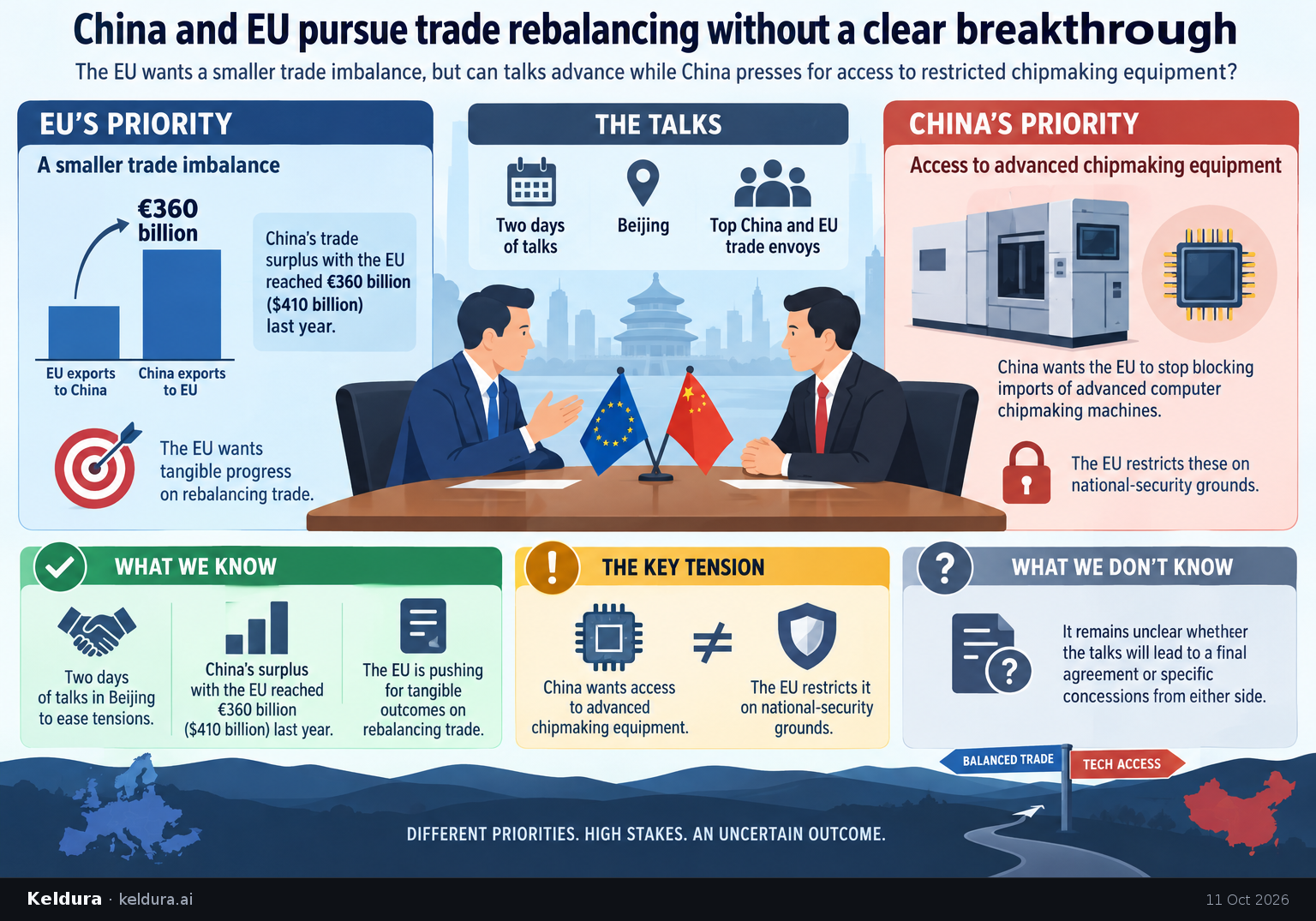
China and EU trade envoys were concluding two days of talks aimed at easing tensions over a growing imbalance between their economies. [7] EU trade chief Maros Sefcovic called for “tangible outcomes,” while China sought an end to restrictions on advanced computer chipmaking machines; AP said it remained unclear whether the underlying disputes would be resolved. [7]
Why it matters: The negotiations bring together two competing priorities: the EU wants to rebalance trade after China's surplus reached 360 billion euros last year, while China wants access to technology restricted on national-security grounds. [7]
Key insights: China's trade surplus with the EU reached 360 billion euros ($410 billion) last year, giving the negotiations a concrete economic scale. [7] | China is pressing the EU to stop blocking imports of advanced computer chipmaking machines. [7] | AP describes those technology restrictions as imposed on national-security grounds at Washington's behest, adding a security dimension to the trade dispute. [7]
Cheatsheet facts: What happened: Top China and EU trade envoys held two days of talks in Beijing to ease tensions. [7] | Why: China's surplus with the EU reached 360 billion euros ($410 billion) last year, and the EU wants tangible progress on rebalancing. [7] | The catch: China wants access to advanced chipmaking equipment that the EU restricts on national-security grounds. [7] | What we don't know: The supplied evidence does not establish a final agreement or specific concessions from either side. [7]