EU ministers agree to strengthen central market supervision
EU ministers want investment to flow more freely across borders, but what must happen before stronger central supervision begins?
On October 9, 2026, EU finance ministers agreed in Luxembourg to expand the powers of the European Securities and Markets Authority.
EU finance ministers agreed to give the Paris-based European Securities and Markets Authority (ESMA) greater powers to supervise major financial-market players, including exchange platforms, clearing houses, and some cryptocurrency businesses. [9] The expanded watchdog can become operational only a…
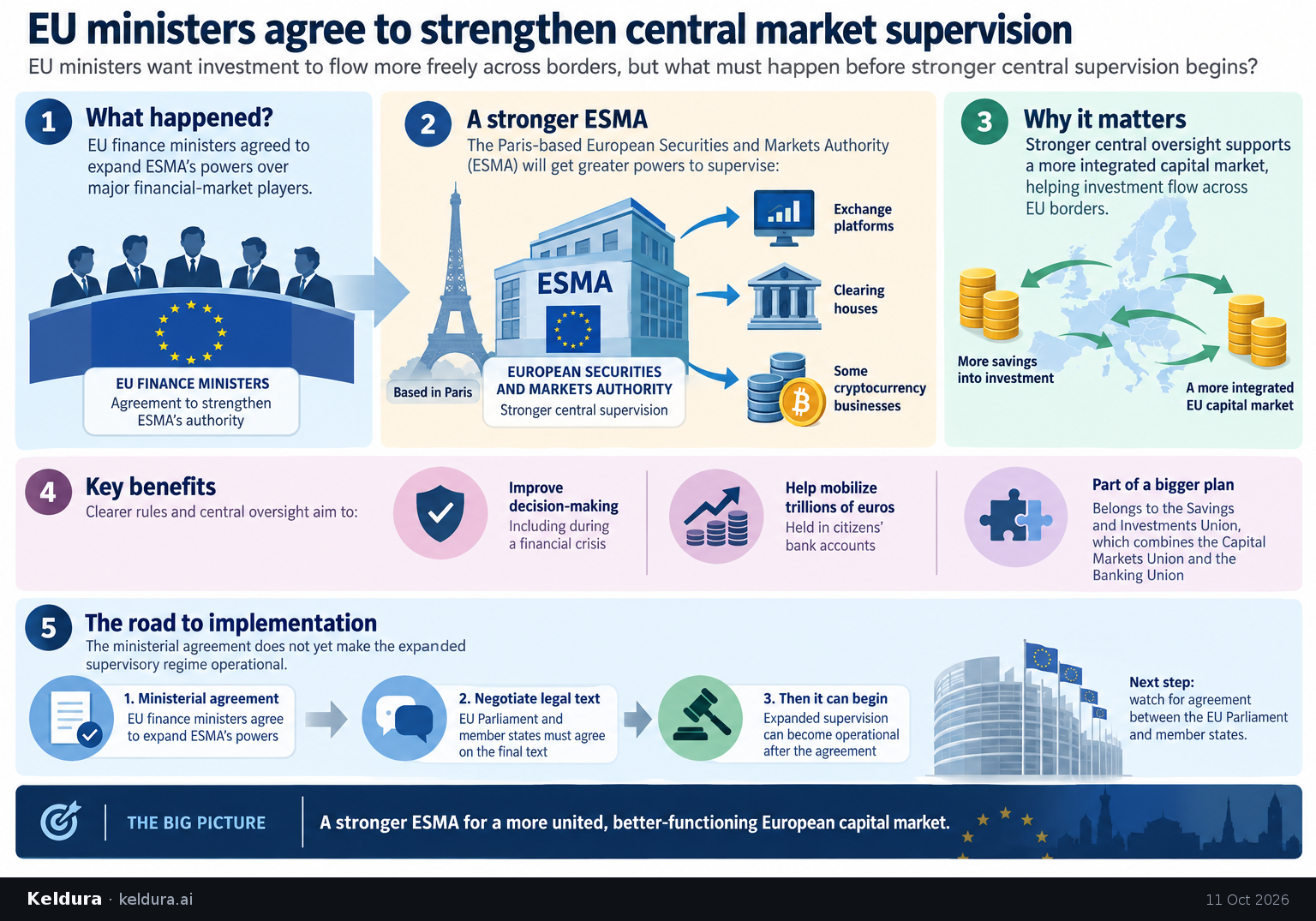
EU finance ministers agreed to give the Paris-based European Securities and Markets Authority (ESMA) greater powers to supervise major financial-market players, including exchange platforms, clearing houses, and some cryptocurrency businesses. [9] The expanded watchdog can become operational only after the EU Parliament and member states negotiate the final legal text. [9]
Why it matters: The reform links stronger central oversight to Europe's effort to build a unified capital market: policymakers want savings to move more readily into investments across national borders rather than remain in bank accounts. [9]
Key insights: This is an expansion of ESMA's authority, not the creation of an entirely separate regulator. [9] | Clearer responsibilities between ESMA and national regulators are intended to improve decision-making, including during a financial crisis. [9] | The reform belongs to the Savings and Investments Union, which combines the Capital Markets Union and the Banking Union. [9]
Cheatsheet facts: What happened: EU finance ministers agreed to expand ESMA's powers over major market operators. [9] | Why: The EU wants more seamless cross-border investment and to mobilize trillions of euros held in citizens' bank accounts. [9] | The catch: The ministerial agreement does not itself make the expanded supervisory regime operational. [9] | What's next: Watch for agreement between the EU Parliament and member states on the final legal text. [9]