Alberta voters reject a path toward Canadian separation
Alberta voters rejected a route toward separation, but what did their vote actually decide?
On October 20, early results showed Alberta voters rejecting a proposal to begin a process toward independence from Canada.
With more than 1 million votes counted, about 76% supported remaining in Canada, compared with 23% backing the start of a process that could lead to separation. The result delivered a victory for Prime Minister Mark Carney and Canadian-unity supporters amid U.S. President Donald Trump's trade war a…
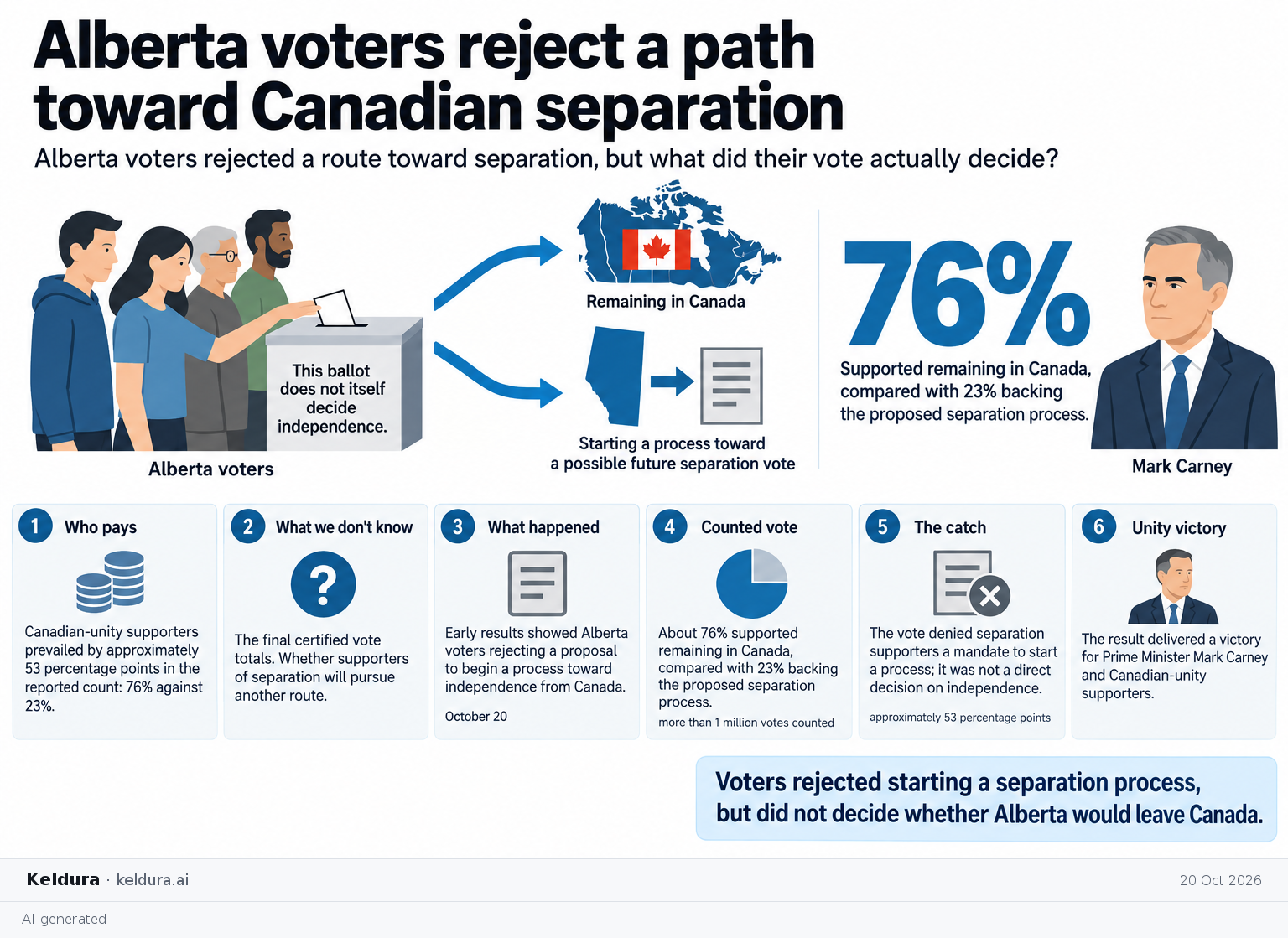
With more than 1 million votes counted, about 76% supported remaining in Canada, compared with 23% backing the start of a process that could lead to separation. The result delivered a victory for Prime Minister Mark Carney and Canadian-unity supporters amid U.S. President Donald Trump's trade war and annexation threats. [3]
Why it matters: The vote denied supporters of separation a mandate to start the proposed process; it was not itself a referendum deciding whether Alberta would leave Canada. That distinction defines both the result's immediate consequence and its limits. [3]
Key insights: The reported gap was approximately 53 percentage points, with more than 1 million ballots counted. [3] | Voters were deciding whether to begin a process toward a possible future separation vote, rather than authorizing independence directly. [3] | The result favored Canadian unity while Canada faced trade pressure and annexation threats from Trump. [3]
Cheatsheet facts: What happened: Early results showed about 76% supporting remaining in Canada and 23% supporting the proposed separation process. [3] | Why: The proposal sought to put Alberta on a path toward a future vote on separation. [3] | The catch: This was a vote on starting a process, not a direct decision on independence; the reported count was still an early result. [3]