China’s exports lift growth while domestic demand stays weak
Exports are lifting China’s economy, but can that strength carry growth while domestic demand remains weak?
On October 19, 2026, China reported that its economy grew 4.5% year on year in the July–September quarter.
China’s third-quarter growth accelerated to 4.5%, from 4.3% in the previous quarter, narrowly exceeding the 4.4% forecast in an AFP economist poll. [5][7] Strong exports supported the expansion, but weak domestic demand and a persistent property crisis left growth at the lower end of Beijing’s 4.5–…
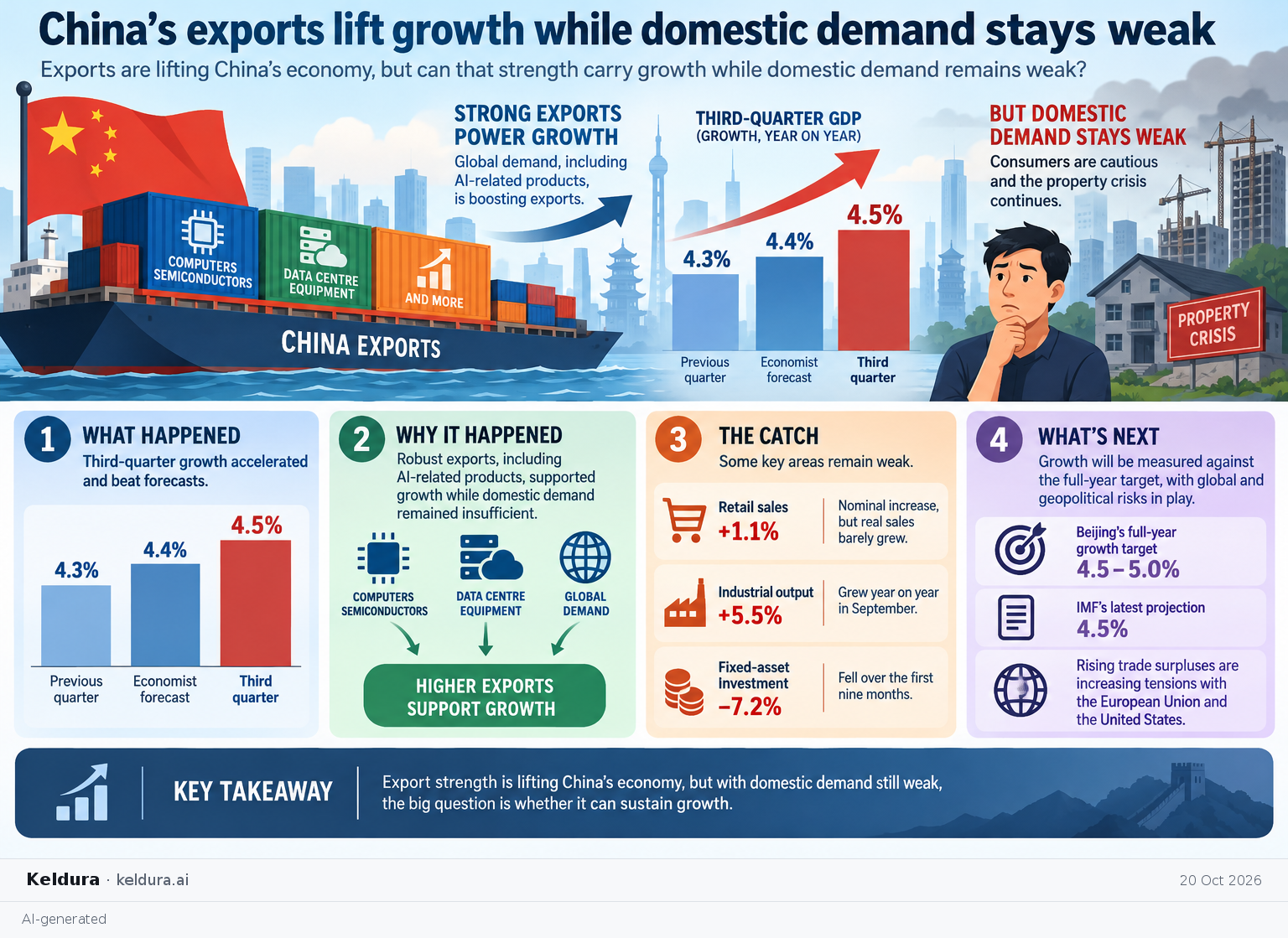
China’s third-quarter growth accelerated to 4.5%, from 4.3% in the previous quarter, narrowly exceeding the 4.4% forecast in an AFP economist poll. [5][7] Strong exports supported the expansion, but weak domestic demand and a persistent property crisis left growth at the lower end of Beijing’s 4.5–5.0% full-year target range. [7]
Why it matters: China’s export strength is supporting growth without resolving its domestic imbalance: overseas shipments are putting the country on course to exceed last year’s $1.2 trillion trade surplus, while those surpluses are increasing tensions with the European Union and the United States. [7]
Key insights: The headline improvement was modest: growth rose 0.2 percentage points from the previous quarter and beat the economist poll by 0.1 percentage point. [7] | September retail sales rose 1.1%, their fastest pace since March, but Pinpoint Asset Management economist Zhiwei Zhang said inflation-adjusted sales barely grew from a year earlier. [7] | The production-investment split remains pronounced: industrial output grew 5.5% year on year in September, while fixed-asset investment fell 7.2% over the first nine months. [7] | Global demand for computers, semiconductors and data centre equipment is supporting exports, while higher energy costs linked to the Iran war are adding pressure on China as the world’s largest crude importer. [7]
Cheatsheet facts: What happened: Third-quarter GDP grew 4.5% year on year, up from 4.3% in the previous quarter and slightly above the 4.4% economist forecast. [5][7] | Why: Robust exports, including AI-related products, supported growth while domestic demand remained insufficient, according to NBS deputy head Mao Shengyong. [7] | The catch: Retail sales improved in nominal terms, but real sales barely grew, according to Zhiwei Zhang; fixed-asset investment also contracted. [7] | What's next: The full-year growth result will be measured against Beijing’s 4.5–5.0% target; the IMF’s latest projection is 4.5%. [7]