Eisenkot gets first chance to form Israel’s next government
Israel’s president has chosen Netanyahu’s opponent, but can Eisenkot assemble a majority without alienating his partners?
On November 7, Israeli President Isaac Herzog gave opposition candidate Gadi Eisenkot the first opportunity to form a government, with up to six weeks to build a coalition.
President Isaac Herzog selected Gadi Eisenkot to try to form Israel’s next governing coalition after the October 27 election, a setback for Prime Minister Benjamin Netanyahu. Most main parties recommended Eisenkot in consultations, but he still needs to assemble a parliamentary majority within a wi…
Open original (2 sources):
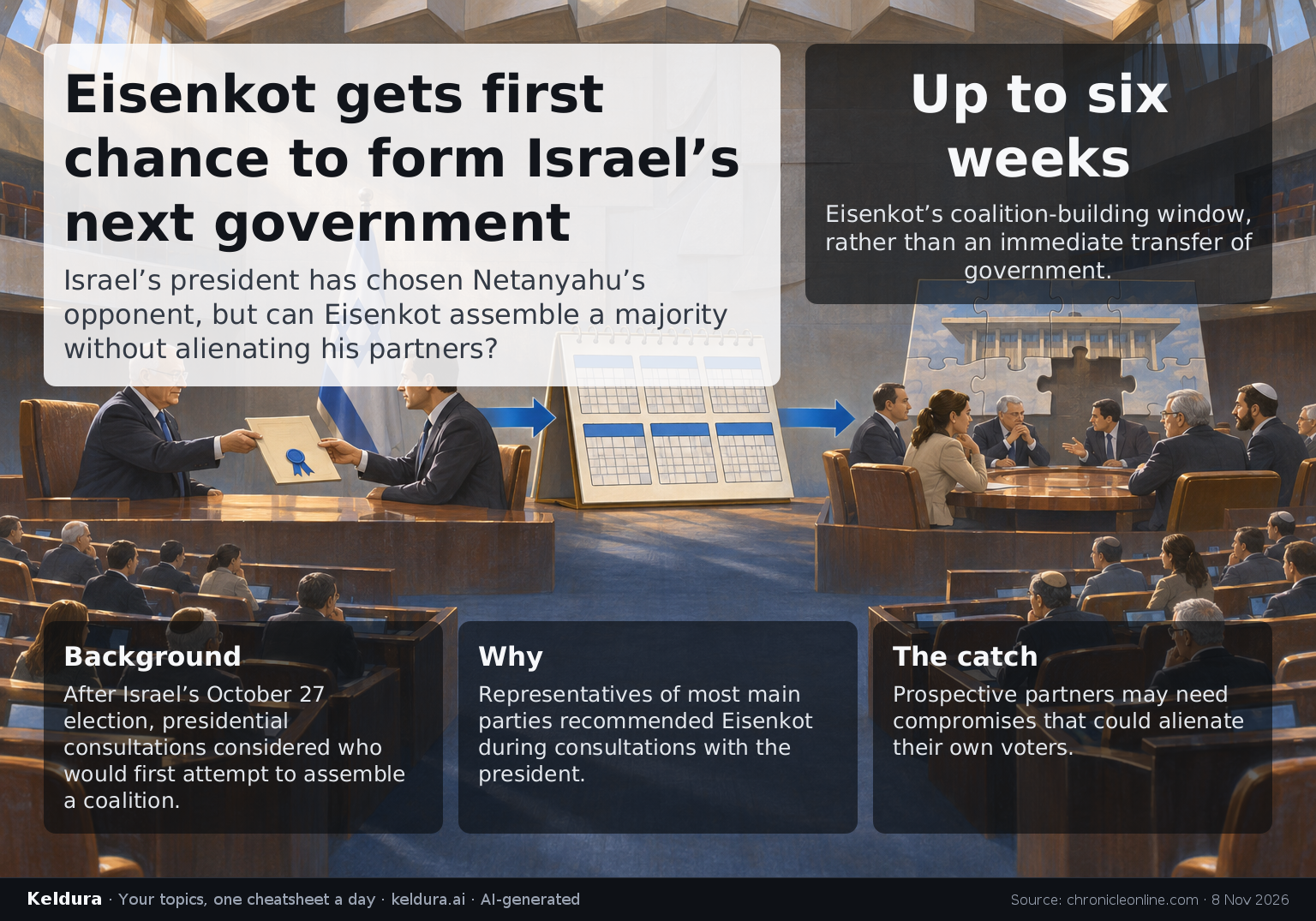
President Isaac Herzog selected Gadi Eisenkot to try to form Israel’s next governing coalition after the October 27 election, a setback for Prime Minister Benjamin Netanyahu. Most main parties recommended Eisenkot in consultations, but he still needs to assemble a parliamentary majority within a window of up to six weeks. [2][7]
Why it matters: Israel’s next government will lead a country dealing with the aftermath of the October 7, 2023, Hamas-led attacks and three years of war in Gaza and beyond. The six-week coalition process determines who can govern, and compromises needed to secure a majority could alienate the participating parties’ own voters. [2]
Key insights: Herzog gave Eisenkot the first opportunity to negotiate a coalition; the appointment itself does not establish a new government. [2] | Recommendations from most main parties gave Eisenkot an advantage at the nomination stage, but they do not by themselves constitute a parliamentary majority. [2] | The reported obstacle is coalition bargaining: prospective partners face compromises that could anger their voters. [2]
Cheatsheet facts: What happened: Herzog chose opposition candidate Gadi Eisenkot on November 7 to attempt to form Israel’s next government. [2] | Background: Following Israel’s October 27 election, a prospective government must assemble a parliamentary majority through coalition negotiations. [2] | Why: Representatives of most main parties recommended Eisenkot during consultations with the president. [2] | The catch: A workable coalition requires compromises that could alienate the parties’ own voters. [2] | What's next: Watch whether Eisenkot assembles a parliamentary majority during his allotted period of up to six weeks. [2]