US extends its Iran blockade effort to land routes
Washington is widening pressure on Iran, but can it restrict weapons supplies without restarting wider fighting?
On November 7, US Central Command announced Task Force Iron Gate to disrupt Iran’s supply routes across its land borders and the Caspian Sea.
US Central Command established Task Force Iron Gate to coordinate restrictions on weapons, dual-use technology, sanctioned materials and revenue moving across Iran’s land borders and the Caspian Sea. The operation expands a months-long naval blockade as Qatar pursues de-escalation and Iran’s Revolu…
Open original (6 sources):
- [8] US launches task force to disrupt Iran’s land-based supply routes | US-Israel war on Iran News | Al Jazeera — aljazeera.com
- [3] Iran says forces 'stronger' than at beginning of war | AFP.com — afp.com
- [7] Iran says it has lifted its self-imposed limit on missile ranges, and other Mideast news — apnews.com
- [14] US offers $20m reward for information about Iran's nuclear programme — BBC World
- [6] Middle East conflict: UAE rescues 22 as US tightens Iran blockade and Tehran lifts missile limits — gulfnews.com
- [12] Iran war live: US moves to block land supply routes; UAE rescues 22 sailors | US-Israel war on Iran News | Al Jazeera — aljazeera.com
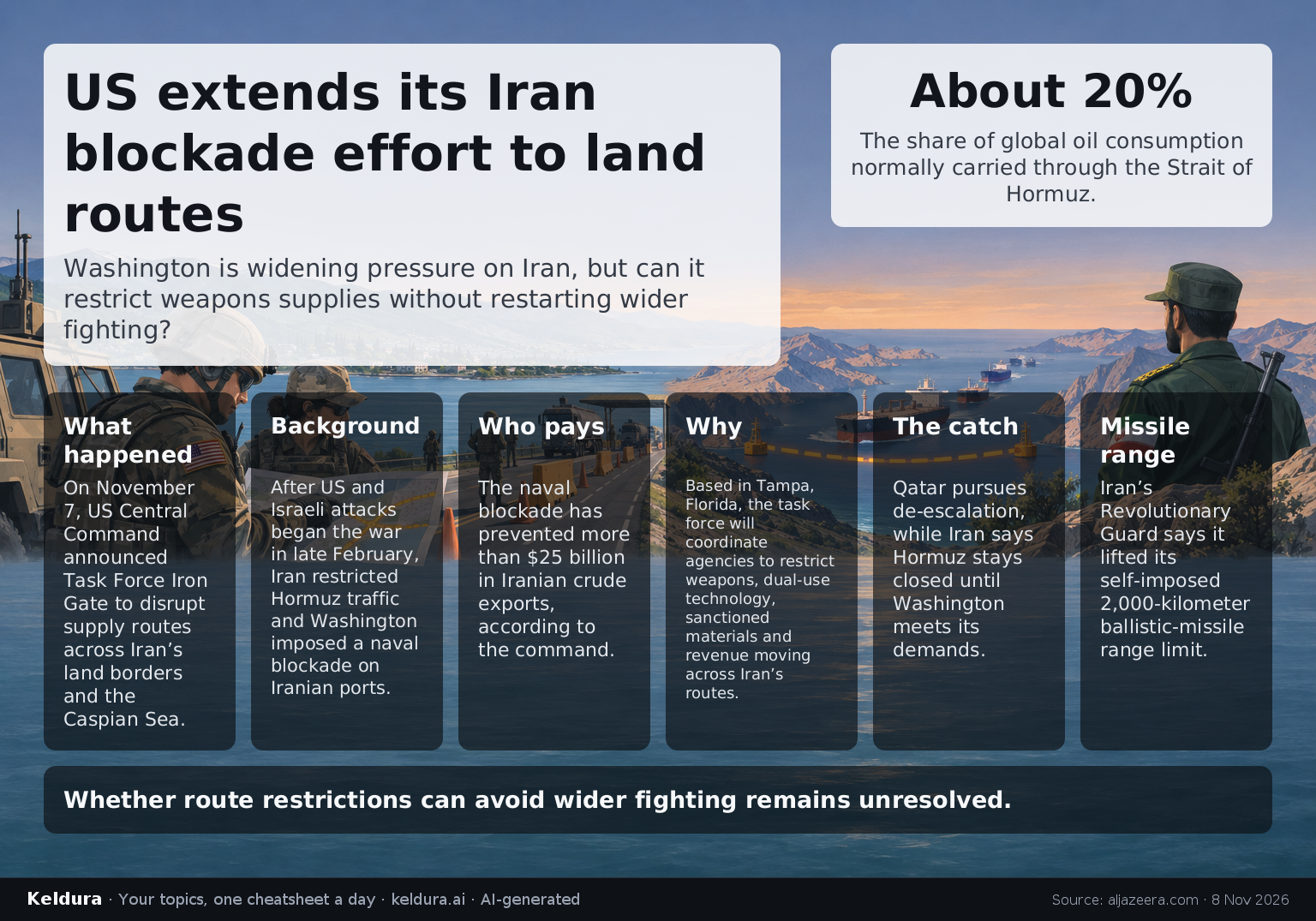
US Central Command established Task Force Iron Gate to coordinate restrictions on weapons, dual-use technology, sanctioned materials and revenue moving across Iran’s land borders and the Caspian Sea. The operation expands a months-long naval blockade as Qatar pursues de-escalation and Iran’s Revolutionary Guard says it has lifted its self-imposed 2,000-kilometer ballistic-missile range limit. [8][3][7]
Why it matters: The confrontation affects shipping through the Strait of Hormuz, which normally carries about one-fifth of global oil consumption. CENTCOM estimates its blockade has already prevented more than $25 billion in Iranian crude exports, while Iran says the waterway will remain closed until Washington meets its demands. [3][14]
Key insights: Task Force Iron Gate is based in Tampa, Florida, and will coordinate with other US agencies; its announced remit covers financial flows and dual-use technologies as well as weapons. [8] | The Revolutionary Guard’s removal of its 2,000-kilometer range ceiling signals an intention to reach farther, not evidence that a new longer-range missile has been deployed. [7] | Diplomacy continues alongside coercion: Donald Trump spoke with Qatar’s emir on Friday, and Abbas Araghchi reported calls with ministers from 12 countries over 48 hours. [3] | Maritime dangers remain immediate: CENTCOM said it disabled the M/V Huda over an alleged blockade breach, while the UAE separately reported rescuing 22 people from a burning cargo ship. [6][12]
Cheatsheet facts: What happened: CENTCOM announced Task Force Iron Gate on November 7 to disrupt Iran’s land-border and Caspian Sea supply routes. [8] | Background: The war began with US and Israeli attacks on Iran in late February; Iran restricted Hormuz traffic, and Washington imposed a naval blockade on Iranian ports. [3][6] | Why: CENTCOM says it wants to stop advanced weapons, dual-use technologies, sanctioned materials and illegal revenue from crossing Iran’s borders. [8] | Who pays: CENTCOM puts blocked Iranian crude exports above $25 billion; the contested strait normally carries about 20% of global oil consumption. [14][3] | The catch: Qatar is working to prevent renewed fighting, but Iran says Hormuz will stay closed until its demands are met and has removed its declared missile-range ceiling. [3][7]