Trump sidelines Iran talks as Gulf military confrontation continues
Trump is leaning on sanctions and a blockade, but will that bring Iranian concessions or further attacks in the Gulf?
On November 12, Donald Trump pulled JD Vance back from potential Iran peace talks; on November 13, the U.S. military reported downing two Iranian drones headed toward Bahrain.
Trump redirected Vice President JD Vance away from potential peace talks with Iran and said the U.S. did not need a deal, while relying on sanctions and a naval blockade. The next day, the U.S. military said it intercepted two Iranian attack drones headed toward Bahrain; Iran separately claimed a s…
Open original (4 sources):
- [6] Trump bets on economic strangulation to force Iranian concessions | Stars and Stripes — stripes.com
- [8] Early Edition: November 13, 2026 — justsecurity.org
- [9] US military downs 2 Iranian attack drones as Iran claims a strike on a US radar in Bahrain — apnews.com
- [10] Reuters World News Summary | International — devdiscourse.com
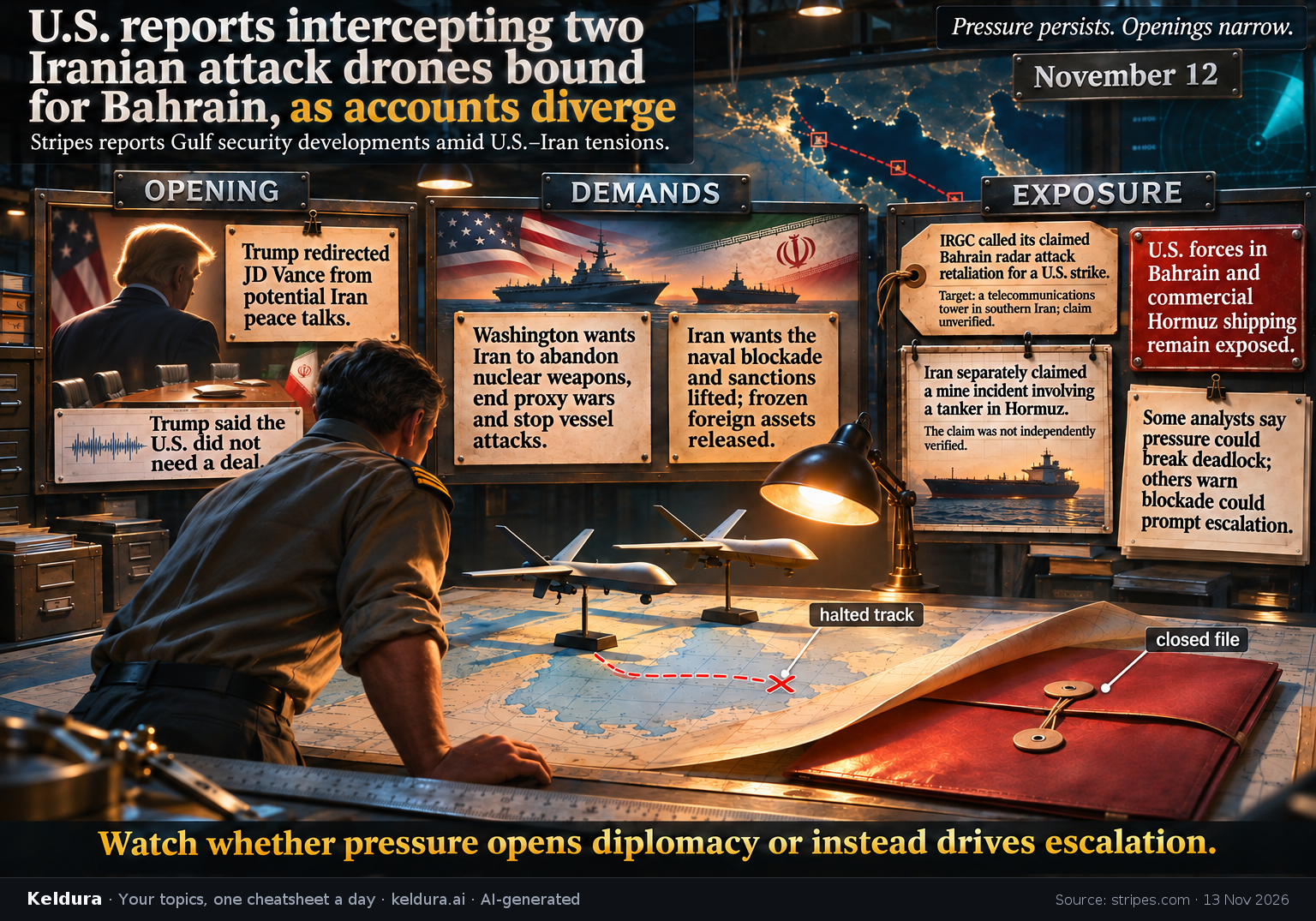
Trump redirected Vice President JD Vance away from potential peace talks with Iran and said the U.S. did not need a deal, while relying on sanctions and a naval blockade. The next day, the U.S. military said it intercepted two Iranian attack drones headed toward Bahrain; Iran separately claimed a strike on a U.S. radar and a tanker mine incident, neither independently verified. [6][8][9][10]
Why it matters: U.S. military assets in Bahrain and commercial shipping through the Strait of Hormuz remain exposed to the confrontation. The competing demands also block a straightforward diplomatic exit: Washington seeks nuclear and regional concessions, while Tehran wants the blockade and sanctions lifted and frozen assets released. [6][9]
Key insights: Washington wants Iran to abandon nuclear weapons, end regional proxy wars and stop attacks on vessels in the Strait of Hormuz. [6] | Iran wants the U.S. naval blockade lifted, economic sanctions removed and billions in frozen foreign assets unlocked. [6] | Iran's Revolutionary Guard described its claimed Bahrain radar attack as retaliation for a U.S. strike on a telecommunications tower in southern Iran. [8][10] | Some analysts say economic pressure could break the deadlock, while others caution that the blockade could prompt Iranian escalation. [6]
Cheatsheet facts: What happened: Trump stepped back from a potential diplomatic opening, and the U.S. military then reported intercepting two Iranian attack drones headed toward Bahrain. [6][8][9] | Why: Washington is using sanctions and a naval blockade to seek Iranian concessions on nuclear weapons, regional proxies and attacks on shipping. [6] | Who pays: U.S. forces in Bahrain face drone threats, while Iran's claimed mine incident concerns a tanker attempting to cross the Strait of Hormuz. [9] | The catch: Iran demands relief from the pressure Washington is using as leverage; its claims of radar damage and a tanker explosion remain independently unverified. [6][9]
X copy pack
Edition complete
You've reached the end of this edition.