Hormuz shipping restrictions reach the UN Security Council
The Security Council is confronting threats to Gulf shipping, but what can reopen a route still operating far below prewar levels?
On November 13, the UN Security Council met at Bahrain's request over Gulf maritime threats, with Hormuz transits about 65% below pre-conflict levels.
The UN Security Council met at Bahrain's request as attacks on shipping increased and Iran continued restricting the Strait of Hormuz, which carried a fifth of the world's oil before the war. [9] Iranian state television separately relayed an IRGC claim that two tankers struck mines, without identi…
Open original (3 sources):
- [9] Security Council LIVE: Fragile Gulf calm tested as threats to Hormuz shipping mount | UN News — news.un.org
- [10] World News, November 14th: ASEAN prioritizes energy security, Iran claims two oil tankers struck mines. — vietnam.vn
- [1] With shifting Iran rhetoric following US elections, Trump leaves Mideast in limbo about path ahead — apnews.com
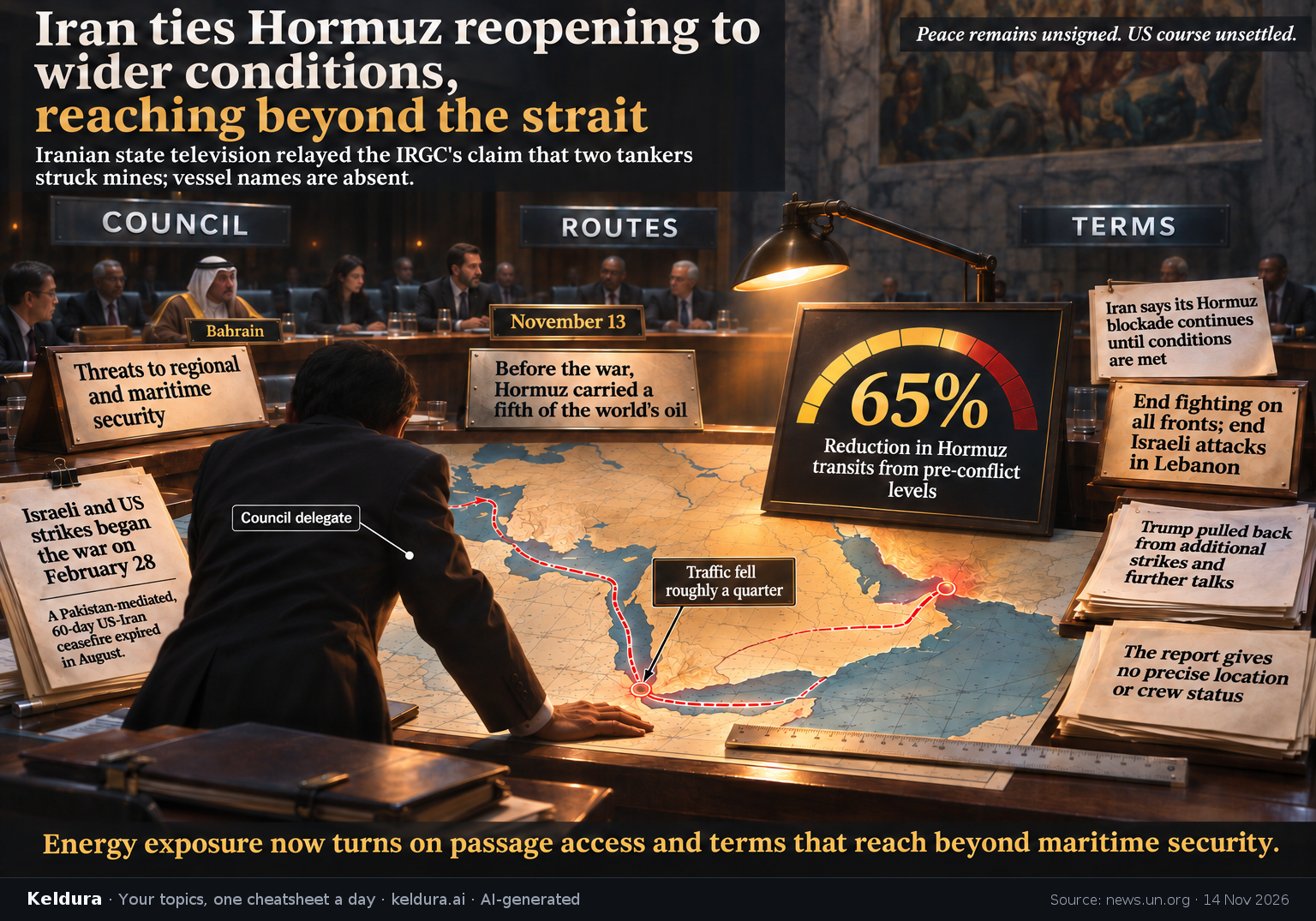
The UN Security Council met at Bahrain's request as attacks on shipping increased and Iran continued restricting the Strait of Hormuz, which carried a fifth of the world's oil before the war. [9] Iranian state television separately relayed an IRGC claim that two tankers struck mines, without identifying the vessels or reporting the crews' condition. [10] Meanwhile, AP reported that Trump had pulled back from both additional strikes and further talks, leaving the US approach unsettled. [1]
Why it matters: Ships using Hormuz face a disrupted route that previously carried one-fifth of global oil, with transits about 65% below pre-conflict levels. That links the security dispute directly to energy transport, while another regional passage, Bab al-Mandab, has seen traffic fall roughly a quarter. [9]
Key insights: The immediate diplomatic gap dates to August, when a Pakistan-mediated, 60-day US-Iran ceasefire expired without a peace deal. [9] | October recorded the most shipping incidents since the war began, according to the UN account citing UK Maritime Trade Operations. [9] | Iran says it will maintain its Hormuz blockade until its conditions are met, including an end to fighting on all fronts and Israeli attacks in Lebanon. [10] | The tanker-mine account remains an Iranian claim: the supplied report gives no vessel names, precise incident location or crew status. [10]
Cheatsheet facts: What happened: Bahrain requested a November 13 Security Council meeting on threats to regional and maritime security. [9] | Background: The war began with Israeli and US strikes on February 28; a Pakistan-mediated US-Iran ceasefire later expired in August without a peace deal. [9] | Who pays: Shipping faces transits around 65% below prewar levels through Hormuz, a route that previously carried a fifth of the world's oil. [9] | The catch: Iran ties reopening the route to conditions extending beyond Hormuz, including an end to Israeli attacks in Lebanon. [10] | What we don't know: Which two tankers Iran says struck mines, where they were hit, and whether their crews were harmed. [10]
X copy pack
Edition complete
You've reached the end of this edition.