U.N. warns climate overshoot could trap governments in a disaster-spending cycle
A new U.N. Environment Programme report says humanity is highly likely to exceed the 1.5 C warming threshold and warns that a prolonged overshoot could force governments to redirect fiscal, administrative and political capacity toward disaster relief and reconstruction. [2] That response could crow…
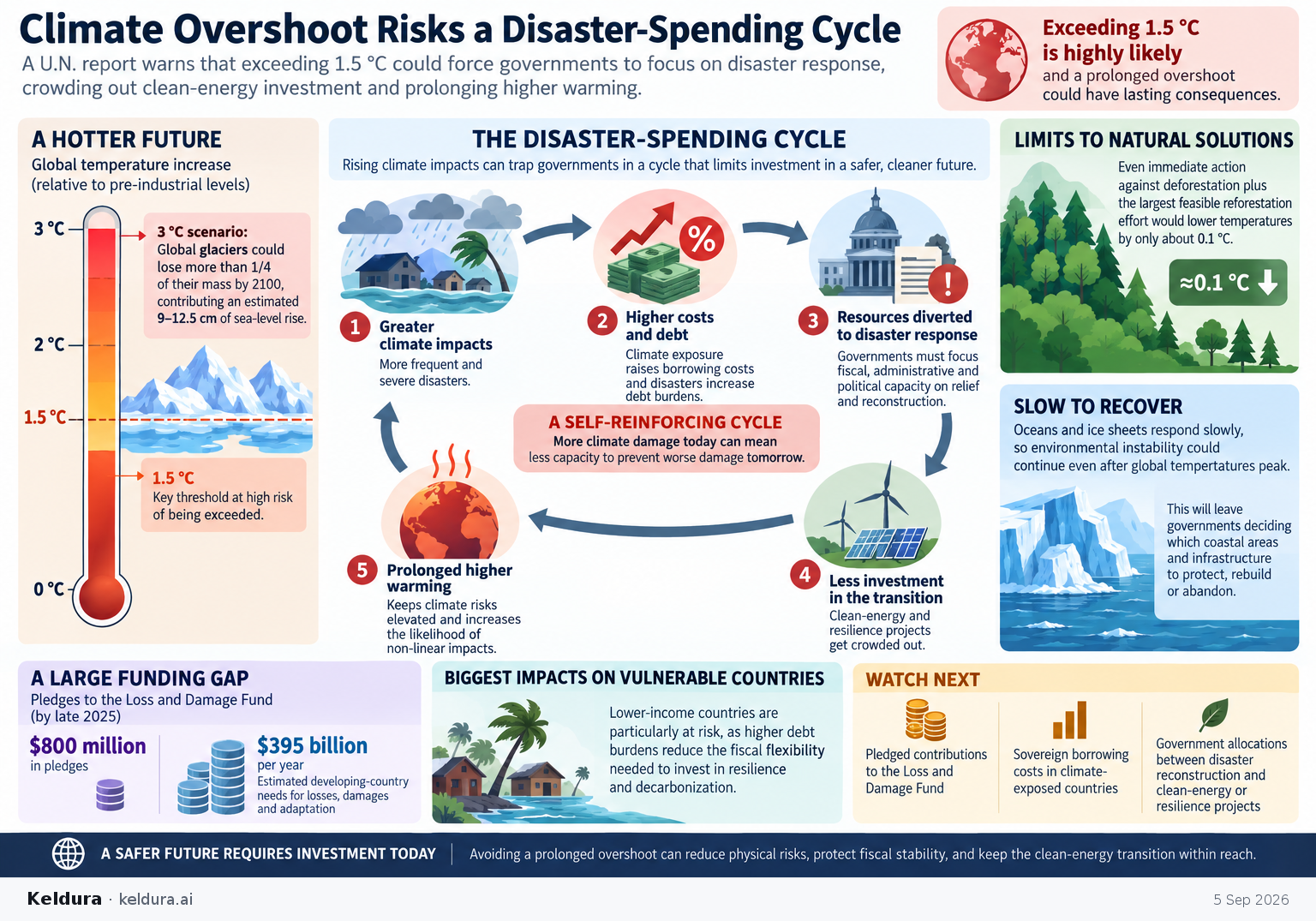
A new U.N. Environment Programme report says humanity is highly likely to exceed the 1.5 C warming threshold and warns that a prolonged overshoot could force governments to redirect fiscal, administrative and political capacity toward disaster relief and reconstruction. [2] That response could crowd out clean-energy and resilience investments, prolonging elevated warming and increasing the likelihood of non-linear impacts such as ice-sheet destabilization and accelerating permafrost thaw. [2]
Why it matters: The report identifies a financial feedback loop in which climate exposure raises borrowing costs, disasters increase debt burdens and governments—particularly in lower-income countries—lose the fiscal flexibility required to invest in resilience and decarbonization. [2]
Key insights: In a 3 C warming scenario, global glaciers could lose more than one-quarter of their mass by 2100 and contribute an estimated 9 to 12.5 centimeters of sea-level rise. [2] | The report cautions against relying on future carbon removal: even immediate action against deforestation combined with the largest feasible century-long reforestation effort would lower temperatures by only about 0.1 C. [2] | By late 2025, pledges to the Loss and Damage Fund totaled about $800 million, compared with estimated developing-country needs averaging $395 billion annually for losses, damages and adaptation. [2] | Oceans and ice sheets respond slowly, meaning environmental instability could continue after global temperatures peak and leave governments deciding which coastal areas and infrastructure to protect, rebuild or abandon. [2]
Cheatsheet facts: What changed: UNEP has framed prolonged temperature overshoot as both a physical climate threat and a fiscal risk that could impede the energy transition. [2] | Why now: The report says exceeding 1.5 C is highly likely while existing international support remains far below developing countries’ estimated loss, damage and adaptation needs. [2] | Watch next: Watch pledged contributions to the Loss and Damage Fund, sovereign borrowing costs in climate-exposed countries, and government allocations between disaster reconstruction and clean-energy or resilience projects. [2]