Jeju’s Soft Corals Are Slumping Again
Divers and scientists say the slumping of soft corals has returned around South Korea’s Jeju island after the phenomenon was first scientifically documented there in 2024.[3][6] Unlike hard corals, soft corals depend on internal fluid pressure to remain upright, and environmental disruption can cau…
Divers and scientists say the slumping of soft corals has returned around South Korea’s Jeju island after the phenomenon was first scientifically documented there in 2024.[3][6] Unlike hard corals, soft corals depend on internal fluid pressure to remain upright, and environmental disruption can cause them to sag, collapse and die.[3][6] Researchers identify high water temperatures, heavy rain and salinity changes associated with Yangtze River outflow as potential triggers.[3][6]
Why it matters: Jeju’s soft corals serve as nursery habitat and form a foundational part of the marine ecosystem within the UNESCO-listed Jeju Island Biosphere Reserve.[3][6] Their decline could therefore affect wider marine biodiversity and livelihoods already strained by thinner catches and shorter harvesting days.[3]
Key insights: Marine heatwaves around Korea have grown almost four times longer over the past decade, reaching 83.3 days, according to weather authorities.[3][6] | Jeju lies at the northernmost limit of coral distribution in the East China Sea, where sensitive soft-coral communities live near the edge of tolerable environmental conditions.[3][6] | The Oceans Ministry plans a detailed investigation into the scale of the damage, while researchers are calling for consistent, quantitative monitoring.[3]
Cheatsheet facts: What changed: Jeju’s monitored soft-coral communities are exhibiting another slumping event similar to the collapse documented in 2024.[3][6] | Why now: South Korea has experienced a record heatwave and heavy southern rainfall, while prolonged marine heat and changing salinity are being examined as possible triggers.[3][6] | Watch next: Watch September water temperatures, the Oceans Ministry’s damage assessment and quantitative monitoring of coral losses.[3][6]
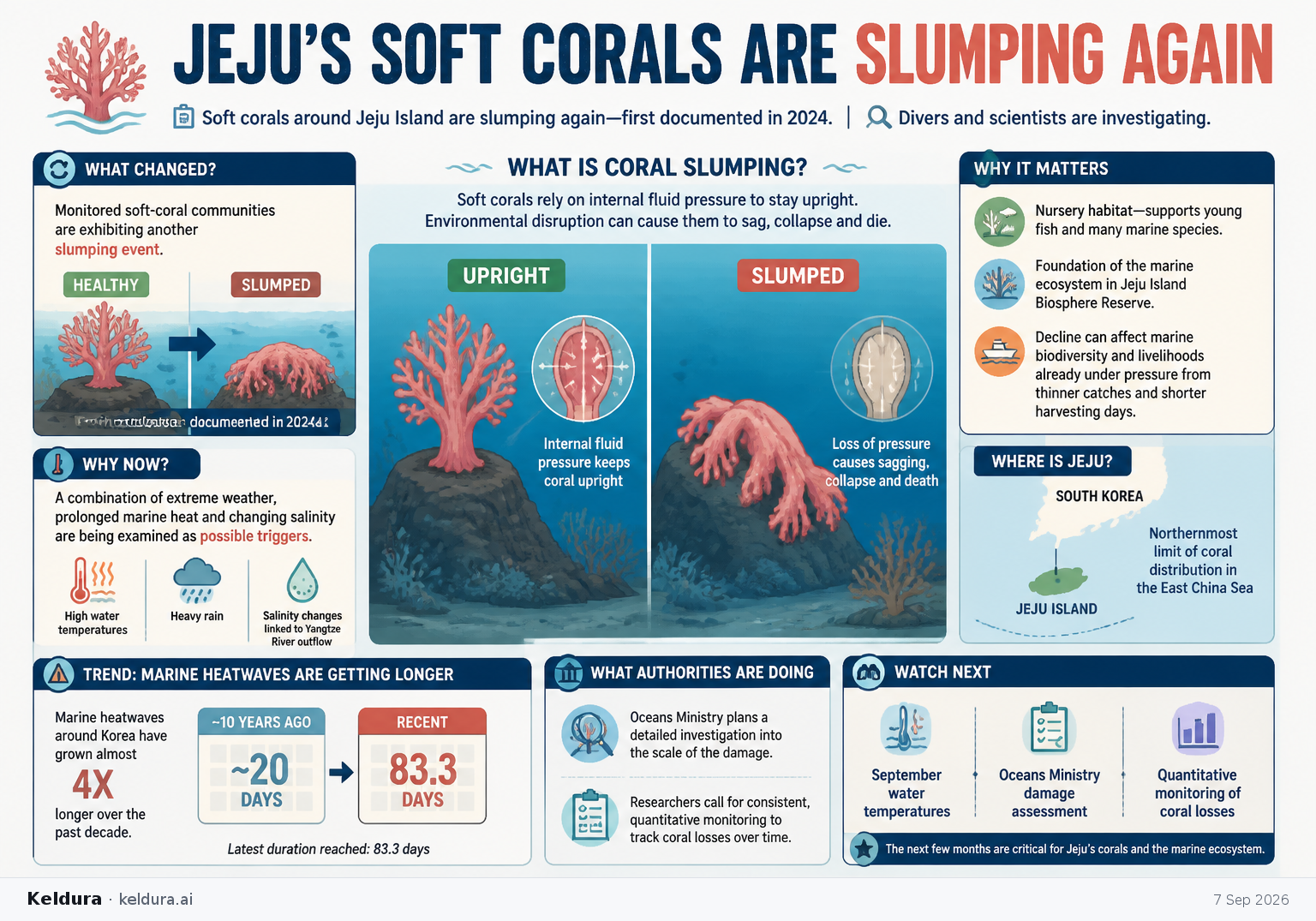
Divers and scientists say the slumping of soft corals has returned around South Korea’s Jeju island after the phenomenon was first scientifically documented there in 2024.[3][6] Unlike hard corals, soft corals depend on internal fluid pressure to remain upright, and environmental disruption can cause them to sag, collapse and die.[3][6] Researchers identify high water temperatures, heavy rain and salinity changes associated with Yangtze River outflow as potential triggers.[3][6]
Why it matters: Jeju’s soft corals serve as nursery habitat and form a foundational part of the marine ecosystem within the UNESCO-listed Jeju Island Biosphere Reserve.[3][6] Their decline could therefore affect wider marine biodiversity and livelihoods already strained by thinner catches and shorter harvesting days.[3]
Key insights: Marine heatwaves around Korea have grown almost four times longer over the past decade, reaching 83.3 days, according to weather authorities.[3][6] | Jeju lies at the northernmost limit of coral distribution in the East China Sea, where sensitive soft-coral communities live near the edge of tolerable environmental conditions.[3][6] | The Oceans Ministry plans a detailed investigation into the scale of the damage, while researchers are calling for consistent, quantitative monitoring.[3]
Cheatsheet facts: What changed: Jeju’s monitored soft-coral communities are exhibiting another slumping event similar to the collapse documented in 2024.[3][6] | Why now: South Korea has experienced a record heatwave and heavy southern rainfall, while prolonged marine heat and changing salinity are being examined as possible triggers.[3][6] | Watch next: Watch September water temperatures, the Oceans Ministry’s damage assessment and quantitative monitoring of coral losses.[3][6]