What an off-balance water cycle means for global freshwater security
Rivers experienced one of their driest years in more than three decades in 2025, while freshwater stored on and beneath land was 42% below.
Rivers experienced one of their driest years in more than three decades in 2025, while freshwater stored on and beneath land was 42% below normal globally.[2] Below-normal river discharge affected 36% of the world, and every major glacier region lost ice for a fourth consecutive year.[4]
Rivers experienced one of their driest years in more than three decades in 2025, while freshwater stored on and beneath land was 42% below normal globally.[2] Below-normal river discharge affected 36% of the world, and every major glacier region lost ice for a fourth consecutive year.[4]
Why it matters: As fossil-fuel pollution makes the water cycle more erratic, societies face shrinking rivers and glaciers alongside sharper swings between drought and flooding, making historical water patterns less dependable for planning.[3][4]
Key insights: The terrestrial water-storage measure includes groundwater, lakes, rivers, snow, ice, soil moisture and water held in plants and trees, making it a broad indicator of the planet’s freshwater reserves.[2] | The WMO described the disruption as a persistent decade-long signal rather than the result of one anomalous year.[4] | Climate change is not the sole driver of every observed shift; natural variability and pressure on water resources also contribute.[4]
Cheatsheet facts: What changed: Global terrestrial freshwater storage fell 42% below normal in 2025, while below-normal river discharge covered 36% of the world.[2][4] | Why now: The WMO says the water cycle is becoming more erratic and unpredictable as fossil-fuel pollution combines with natural variability and other pressures on water resources.[3][4] | Watch next: Watch the expansion of water monitoring, cross-border data-sharing and early-warning systems, which the WMO identifies as central adaptation indicators.[4]
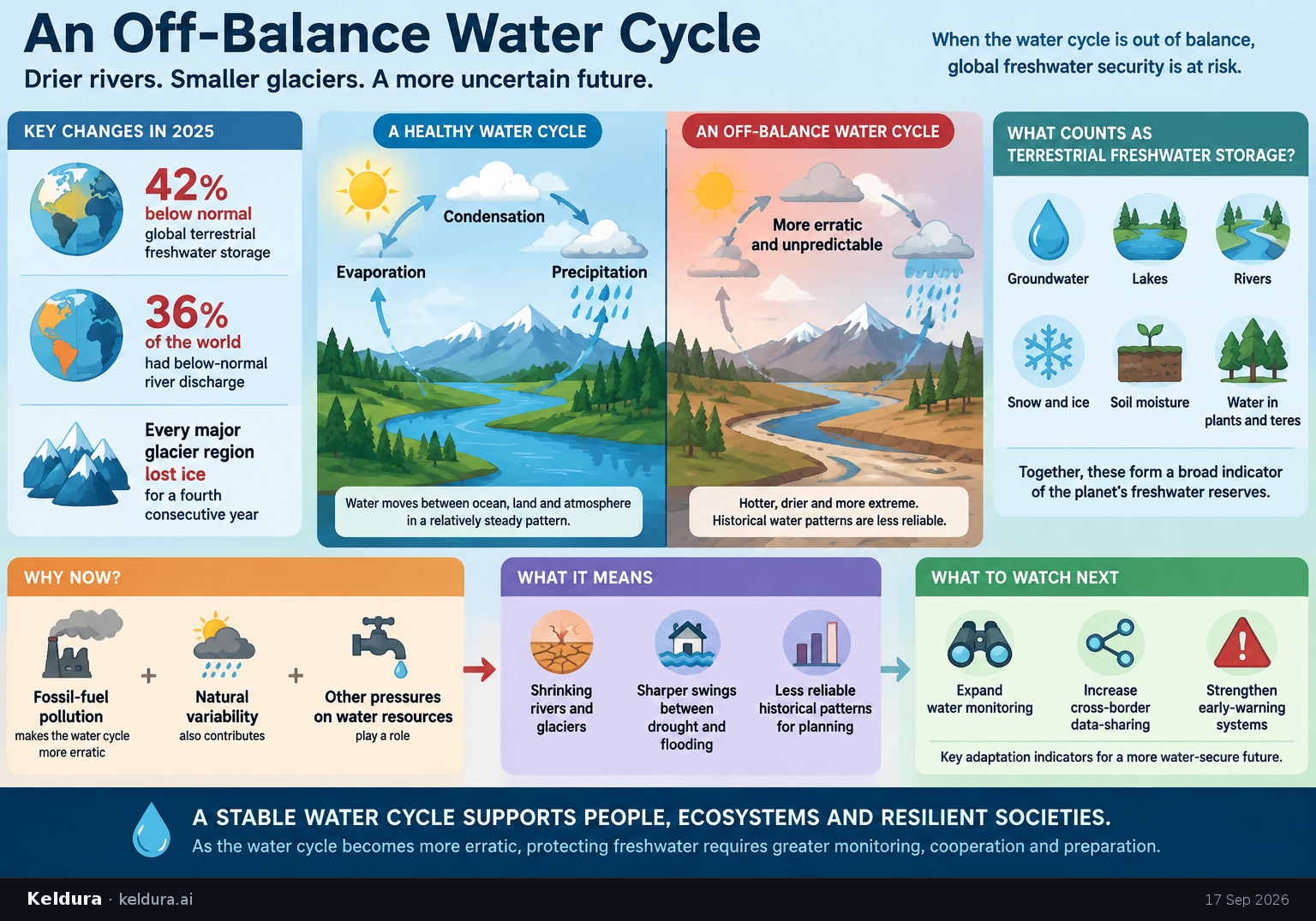
Rivers experienced one of their driest years in more than three decades in 2025, while freshwater stored on and beneath land was 42% below normal globally.[2] Below-normal river discharge affected 36% of the world, and every major glacier region lost ice for a fourth consecutive year.[4]
Why it matters: As fossil-fuel pollution makes the water cycle more erratic, societies face shrinking rivers and glaciers alongside sharper swings between drought and flooding, making historical water patterns less dependable for planning.[3][4]
Key insights: The terrestrial water-storage measure includes groundwater, lakes, rivers, snow, ice, soil moisture and water held in plants and trees, making it a broad indicator of the planet’s freshwater reserves.[2] | The WMO described the disruption as a persistent decade-long signal rather than the result of one anomalous year.[4] | Climate change is not the sole driver of every observed shift; natural variability and pressure on water resources also contribute.[4]
Cheatsheet facts: What changed: Global terrestrial freshwater storage fell 42% below normal in 2025, while below-normal river discharge covered 36% of the world.[2][4] | Why now: The WMO says the water cycle is becoming more erratic and unpredictable as fossil-fuel pollution combines with natural variability and other pressures on water resources.[3][4] | Watch next: Watch the expansion of water monitoring, cross-border data-sharing and early-warning systems, which the WMO identifies as central adaptation indicators.[4]
X copy pack
[2] 2025 was among driest years on record for world’s rivers, study finds | Environment | The Guardian — theguardian.com[4] As freshwater reserves shrink, countries must prepare for a new water reality | UN News — news.un.org[3] The water cycle you learned about at school is off balance | CNN — cnn.comRead in BriefingsPost to X