How warming primed a Himalayan slope for catastrophic collapse
The Langtang Lirung collapse and resulting flood killed around 1,400 people and left more than 5,000 missing.
The Langtang Lirung collapse and resulting flood killed around 1,400 people and left more than 5,000 missing.[1][5] Researchers concluded that decades of glacier retreat, thawing permafrost and increased meltwater destabilized the slope, while an earlier earthquake and unusual snowfall may also hav…
The Langtang Lirung collapse and resulting flood killed around 1,400 people and left more than 5,000 missing.[1][5] Researchers concluded that decades of glacier retreat, thawing permafrost and increased meltwater destabilized the slope, while an earlier earthquake and unusual snowfall may also have contributed.[5][7]
Why it matters: The disaster exposed a gap in mountain-risk planning: Nepal’s warning systems are designed mainly for forecastable, rainfall-driven floods, while this fast cascade began with an abrupt slope collapse and quickly destroyed monitoring gauges.[5][7]
Key insights: The glacier edge near the failure site retreated only 75 metres between 1964 and 2000, then another 373 metres between 2010 and 2026, removing ice that had supported the rock wall.[5] | The regional freezing line has shifted upward by around 100 metres per decade, while human-induced climate change made July and August temperatures at the site about 1.5C warmer than they otherwise would have been.[7] | About 116 million cubic metres of material broke away, generating a debris flood that reached speeds of up to 188kmph and travelled 200km in under seven hours.[7]
Cheatsheet facts: What changed: Scientists linked the disaster to a cascade in which glacier retreat, permafrost thaw and meltwater progressively weakened the mountainside, rather than identifying one simple trigger.[5][7] | Why now: July and August were the warmest on record at the site, with extreme heat immediately before the collapse adding to long-term destabilization.[5][7] | Watch next: Watch whether Himalayan authorities add glacier and slope monitoring to flood-warning systems that currently focus on rainfall, despite the challenge of covering thousands of glaciers.[5][7]
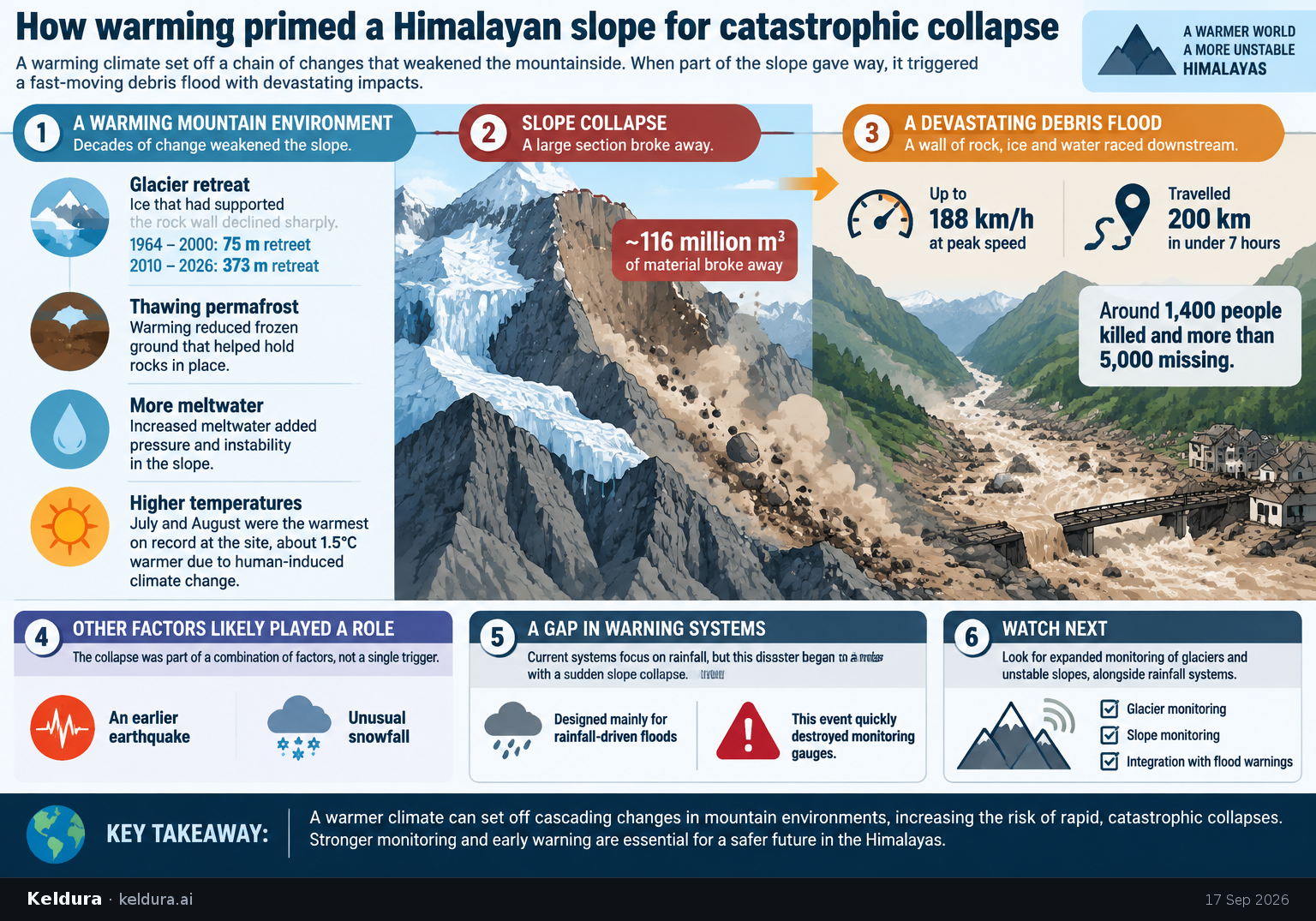
The Langtang Lirung collapse and resulting flood killed around 1,400 people and left more than 5,000 missing.[1][5] Researchers concluded that decades of glacier retreat, thawing permafrost and increased meltwater destabilized the slope, while an earlier earthquake and unusual snowfall may also have contributed.[5][7]
Why it matters: The disaster exposed a gap in mountain-risk planning: Nepal’s warning systems are designed mainly for forecastable, rainfall-driven floods, while this fast cascade began with an abrupt slope collapse and quickly destroyed monitoring gauges.[5][7]
Key insights: The glacier edge near the failure site retreated only 75 metres between 1964 and 2000, then another 373 metres between 2010 and 2026, removing ice that had supported the rock wall.[5] | The regional freezing line has shifted upward by around 100 metres per decade, while human-induced climate change made July and August temperatures at the site about 1.5C warmer than they otherwise would have been.[7] | About 116 million cubic metres of material broke away, generating a debris flood that reached speeds of up to 188kmph and travelled 200km in under seven hours.[7]
Cheatsheet facts: What changed: Scientists linked the disaster to a cascade in which glacier retreat, permafrost thaw and meltwater progressively weakened the mountainside, rather than identifying one simple trigger.[5][7] | Why now: July and August were the warmest on record at the site, with extreme heat immediately before the collapse adding to long-term destabilization.[5][7] | Watch next: Watch whether Himalayan authorities add glacier and slope monitoring to flood-warning systems that currently focus on rainfall, despite the challenge of covering thousands of glaciers.[5][7]
X copy pack
[1] Climate change likely to have helped trigger Nepal glacier collapse, scientists say | Reuters — reuters.com[5] How climate change worsened Nepal's deadly mountain collapse — dw.com[7] Nepal floods an ‘unprecedented’ climate disaster beyond scope of warning systems, scientists say | The Independent — independent.co.ukRead in BriefingsPost to X