Can a country survive after rising seas erase its land?
The unanimous declaration says states can retain their political existence and established maritime zones despite physical changes caused.
The unanimous declaration says states can retain their political existence and established maritime zones despite physical changes caused by rising seas.[6] It also calls for stronger international cooperation and adaptation finance as roughly 770 million people live in areas vulnerable to sea-leve…
The unanimous declaration says states can retain their political existence and established maritime zones despite physical changes caused by rising seas.[6] It also calls for stronger international cooperation and adaptation finance as roughly 770 million people live in areas vulnerable to sea-level rise.[2]
Why it matters: Preserving statehood and maritime boundaries could protect island nations’ UN membership and control over waters used for fishing, energy development and other economic activity, even if their land becomes uninhabitable or disappears.[2][6] The declaration establishes principles, however, without itself supplying additional adaptation money.[6]
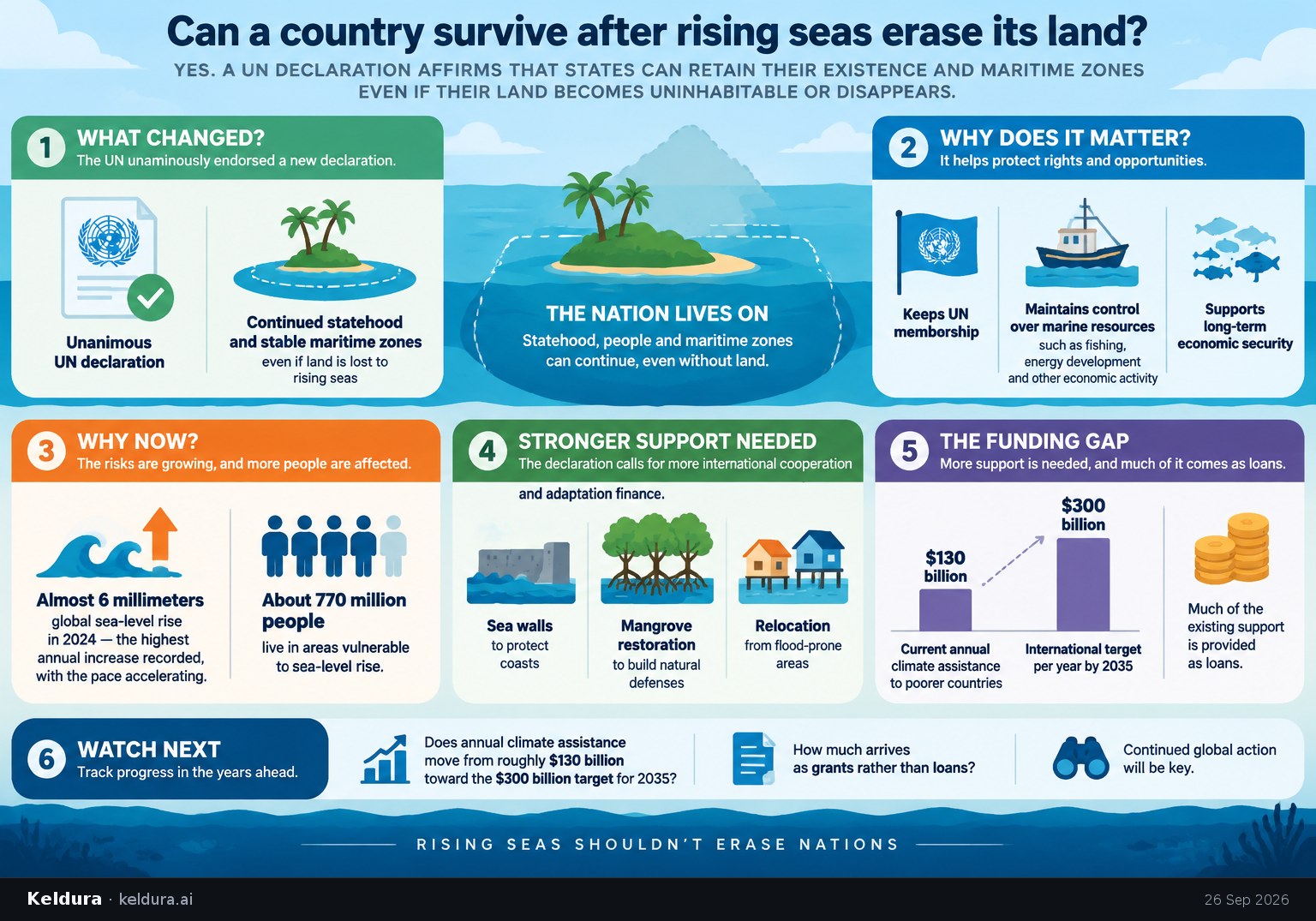
Key insights: The agreement creates a “presumption in favor of continued statehood,” echoing an International Court of Justice ruling that losing a constituent element does not necessarily extinguish an established state.[6] | Global sea level rose almost 6 millimeters in 2024, the highest annual increase recorded, and the pace is accelerating.[2] | The declaration recognizes an urgent obligation to expand developing countries’ access to adaptation funding that could support sea walls, mangrove restoration or relocation from flood-prone areas.[6] | Current climate assistance to poorer countries is about $130 billion annually, while the international target is $300 billion a year by 2035; much of the existing support is provided as loans.[6]
Cheatsheet facts: What changed: The UN unanimously endorsed continued statehood and stable maritime zones for countries losing land to sea-level rise.[6] | Why now: About 770 million people live in vulnerable areas, while the recorded annual sea-level increase reached almost 6 millimeters in 2024.[2] | Watch next: Track whether annual climate assistance moves from roughly $130 billion toward the agreed $300 billion target for 2035, and how much arrives as grants rather than loans.[6]
The unanimous declaration says states can retain their political existence and established maritime zones despite physical changes caused by rising seas.[6] It also calls for stronger international cooperation and adaptation finance as roughly 770 million people live in areas vulnerable to sea-level rise.[2]
Why it matters: Preserving statehood and maritime boundaries could protect island nations’ UN membership and control over waters used for fishing, energy development and other economic activity, even if their land becomes uninhabitable or disappears.[2][6] The declaration establishes principles, however, without itself supplying additional adaptation money.[6]
Key insights: The agreement creates a “presumption in favor of continued statehood,” echoing an International Court of Justice ruling that losing a constituent element does not necessarily extinguish an established state.[6] | Global sea level rose almost 6 millimeters in 2024, the highest annual increase recorded, and the pace is accelerating.[2] | The declaration recognizes an urgent obligation to expand developing countries’ access to adaptation funding that could support sea walls, mangrove restoration or relocation from flood-prone areas.[6] | Current climate assistance to poorer countries is about $130 billion annually, while the international target is $300 billion a year by 2035; much of the existing support is provided as loans.[6]
Cheatsheet facts: What changed: The UN unanimously endorsed continued statehood and stable maritime zones for countries losing land to sea-level rise.[6] | Why now: About 770 million people live in vulnerable areas, while the recorded annual sea-level increase reached almost 6 millimeters in 2024.[2] | Watch next: Track whether annual climate assistance moves from roughly $130 billion toward the agreed $300 billion target for 2035, and how much arrives as grants rather than loans.[6]