Why Ukraine’s digital backbone has become a battlefield
Russian strikes this week targeted data centres and internet providers in Kyiv as Ukraine prepares for winter.
About 100,000 households in Kyiv and the surrounding region temporarily lost internet access after strikes on Wednesday and Thursday, while a Friday drone strike hit the offices of telecommunications company Datagroup and killed four people.[1] Russia confirmed attacks on several data-processing an…
About 100,000 households in Kyiv and the surrounding region temporarily lost internet access after strikes on Wednesday and Thursday, while a Friday drone strike hit the offices of telecommunications company Datagroup and killed four people.[1] Russia confirmed attacks on several data-processing and telecommunications sites, claiming the Datagroup facility was used by Ukrainian military intelligence; Ukraine says the widening campaign is intended to disrupt ordinary life.[6]
Why it matters: Banks, payment systems and public services depend on the targeted networks, making digital infrastructure another route through which Russia can impose economic and civilian disruption alongside its intensified attacks on energy and railway systems.[1][6]
Key insights: The strikes move beyond conventional power infrastructure toward the servers and connectivity underpinning Ukraine’s digital economy.[1] | Some companies are transferring data from damaged servers abroad, illustrating how geographic redundancy can become a wartime resilience measure.[6] | Datagroup said its services continued operating from backup sites after the strike, showing that physical damage does not necessarily produce immediate network failure.[6] | A Ukrainian defence-technology adviser warned of possible local disruptions and higher internet prices as providers absorb repair costs.[6]
Cheatsheet facts: What changed: Russian forces struck multiple Ukrainian data centres and telecommunications providers, temporarily cutting internet service to about 100,000 households.[1][6] | Why now: The attacks come as Moscow intensifies pressure on Ukraine’s energy, railway and communications infrastructure before winter.[1][6] | Watch next: Track local outage data, service-price changes and whether operators continue shifting data abroad or relying on backup sites.[6]
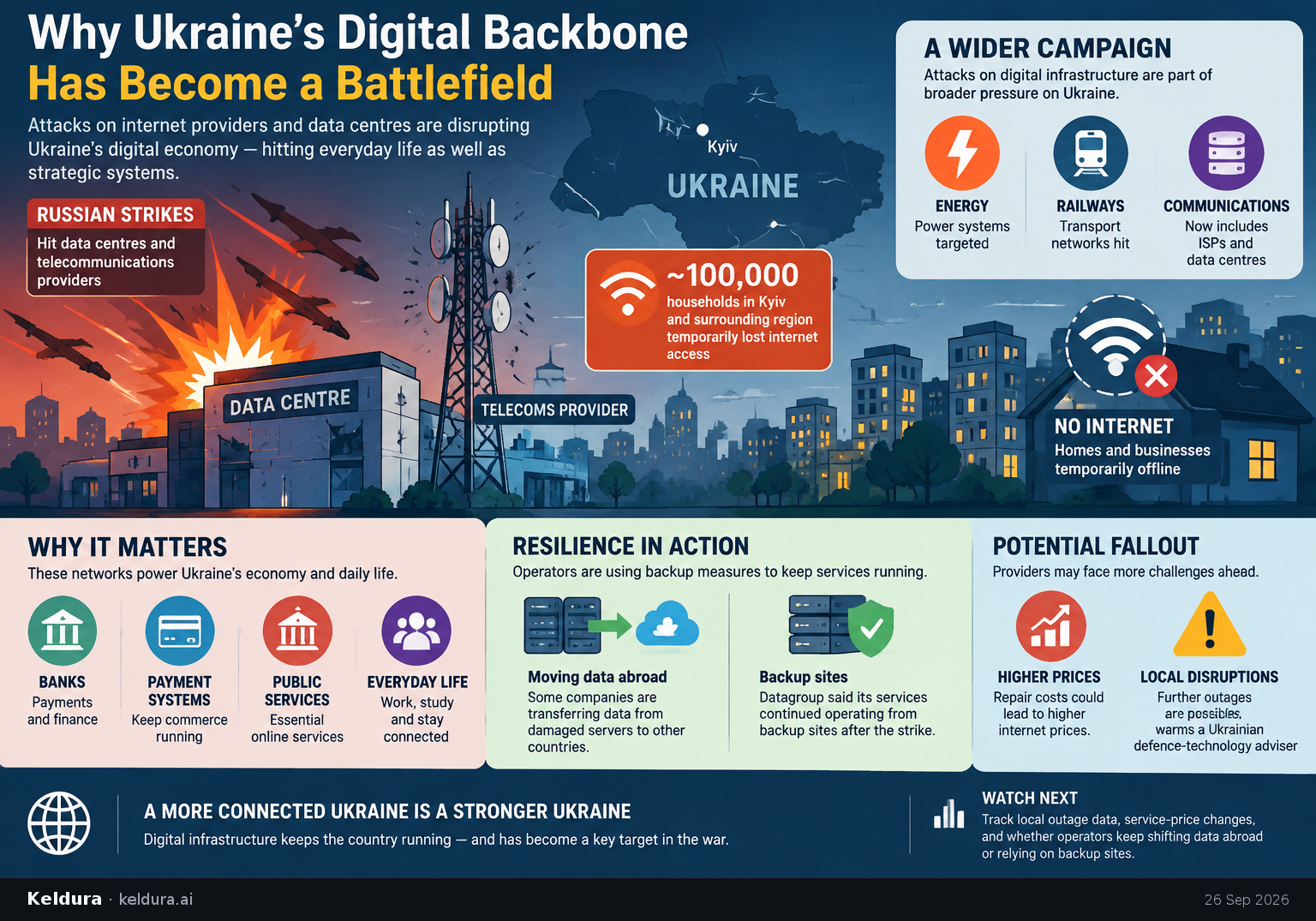
About 100,000 households in Kyiv and the surrounding region temporarily lost internet access after strikes on Wednesday and Thursday, while a Friday drone strike hit the offices of telecommunications company Datagroup and killed four people.[1] Russia confirmed attacks on several data-processing and telecommunications sites, claiming the Datagroup facility was used by Ukrainian military intelligence; Ukraine says the widening campaign is intended to disrupt ordinary life.[6]
Why it matters: Banks, payment systems and public services depend on the targeted networks, making digital infrastructure another route through which Russia can impose economic and civilian disruption alongside its intensified attacks on energy and railway systems.[1][6]
Key insights: The strikes move beyond conventional power infrastructure toward the servers and connectivity underpinning Ukraine’s digital economy.[1] | Some companies are transferring data from damaged servers abroad, illustrating how geographic redundancy can become a wartime resilience measure.[6] | Datagroup said its services continued operating from backup sites after the strike, showing that physical damage does not necessarily produce immediate network failure.[6] | A Ukrainian defence-technology adviser warned of possible local disruptions and higher internet prices as providers absorb repair costs.[6]
Cheatsheet facts: What changed: Russian forces struck multiple Ukrainian data centres and telecommunications providers, temporarily cutting internet service to about 100,000 households.[1][6] | Why now: The attacks come as Moscow intensifies pressure on Ukraine’s energy, railway and communications infrastructure before winter.[1][6] | Watch next: Track local outage data, service-price changes and whether operators continue shifting data abroad or relying on backup sites.[6]